An 8500 watt generator can run most home essentials and a small air conditioner.
I’ve worked with portable and standby generators for years, and I’ll walk you through exactly what an 8500 Watt Generator What Appliances Equipment Can It Power. This guide uses clear rules, real numbers, and simple math so you can plan and pick gear with confidence. Read on to learn which appliances run together, how to size loads, and real tips from hands-on experience.
How generator ratings work: running watts vs starting watts
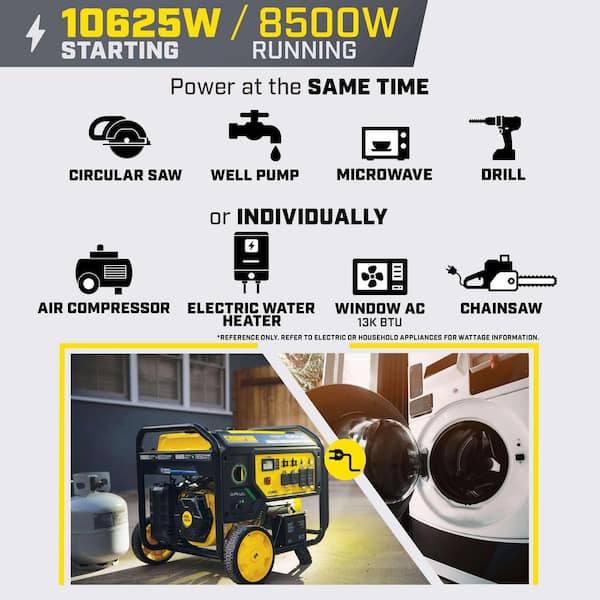
Manufacturers list two key numbers. Running watts (continuous) are what the generator can sustain. Starting watts (surge) cover the brief extra power many motors need to start.
When you ask about 8500 Watt Generator What Appliances Equipment Can It Power, check whether 8500 is the running rating or the peak rating. Some models say 8500 peak and 6800 running. That difference changes what you can run together.
Keep a small margin. Do not load a generator to its absolute limit. Aim to use 70–80% of the running watts for steady, safe performance.
What appliances an 8500 watt generator can power
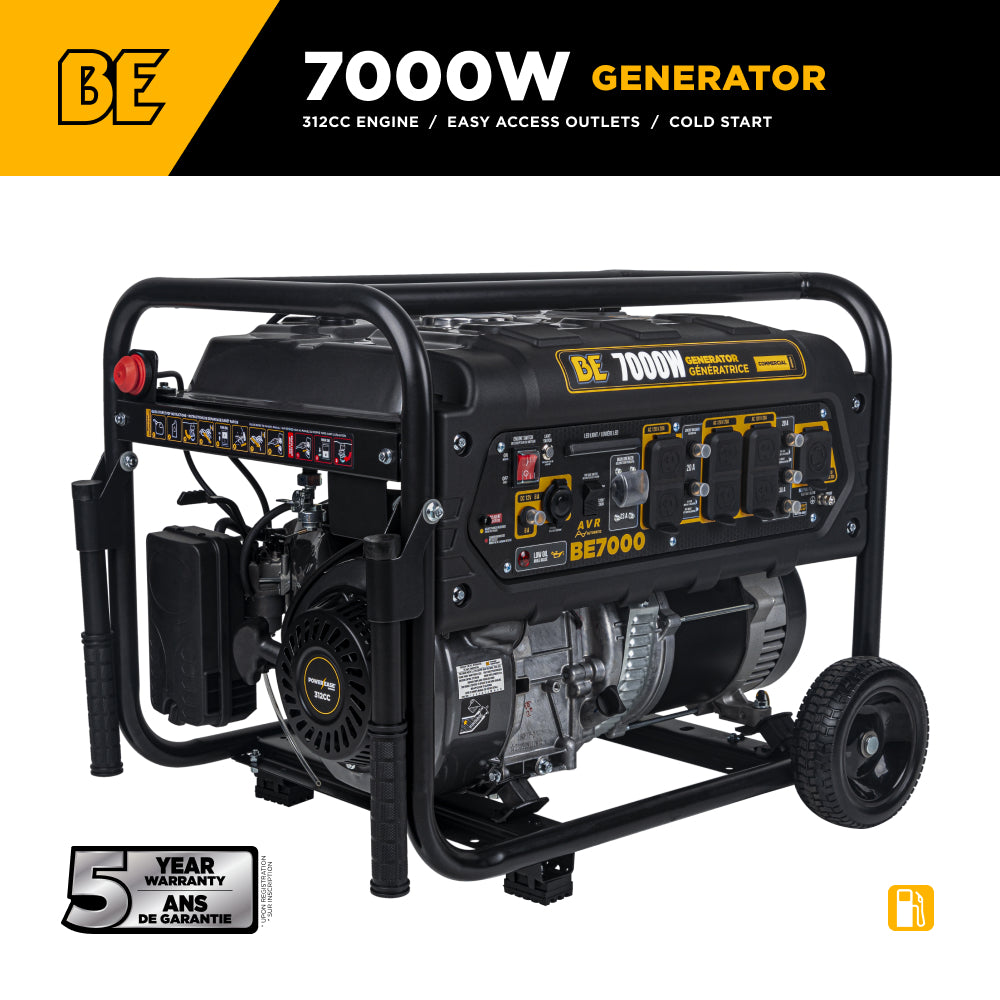
Below are common home and jobsite appliances with typical watt ranges. I include running and starting needs to help you plan.
- Refrigerator
- Running: 600 to 800 watts
- Starting: 1200 to 2000 watts
- Chest freezer
- Running: 300 to 700 watts
- Starting: 800 to 1500 watts
- Window air conditioner (10,000 to 12,000 BTU)
- Running: 900 to 1500 watts
- Starting: 2000 to 3000 watts
- Central air conditioner (small single-stage)
- Running: 3000 to 5000 watts
- Starting: 6000 to 12,000 watts (may exceed 8500)
- Well pump (1/2 to 1 HP)
- Running: 800 to 1500 watts
- Starting: 2000 to 4000 watts
- Sump pump
- Running: 700 to 1500 watts
- Starting: 1500 to 3000 watts
- Electric water heater (instant on)
- Running: 4000 to 4500 watts (likely too heavy to run with other large loads)
- Microwave
- Running: 900 to 1500 watts (plus surge)
- Cooktop or oven (electric)
- Running: 2000 to 5000 watts (varies; often too high for combined loads)
- Well-lit house (LED lights, Wi-Fi, fridge, TV)
- Combined running: 800 to 2000 watts
When answering 8500 Watt Generator What Appliances Equipment Can It Power, a unit with 8500 running watts can typically run:
- Full-size refrigerator and freezer
- Several lights, TV, and Wi-Fi
- A 10k–12k BTU window AC plus basic household loads
- A 1 to 1.5 HP well pump or sump pump (depending on start watts)
- Power tools like table saws and compressors, one at a time depending on surge needs
If the model is 8500 peak and 6800 running, you must account for a lower continuous load. Always check the generator’s running watt rating before planning loads.
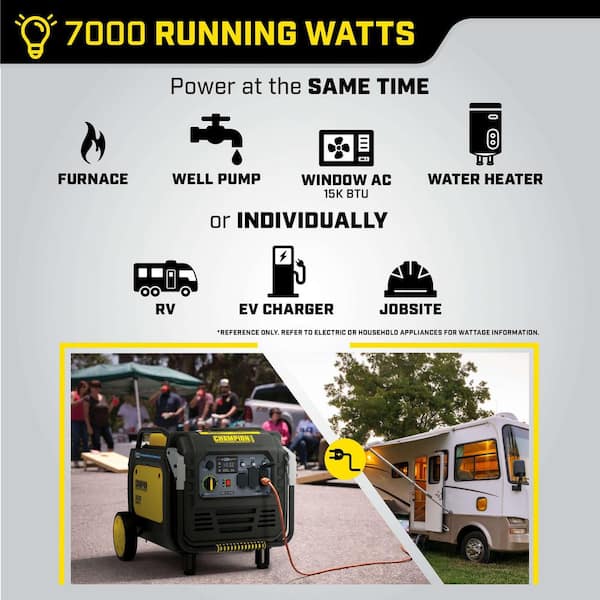
Real-world load examples and calculations
Example 1: Basic home backup with window AC
- 1 window AC (running 1200W, start 2500W)
- Refrigerator (running 800W, start 1500W)
- Lights, router, TV (running 200W)
Total running = 2200W. Peak start = 4000W. An 8500 running unit handles this with ease. Even an 8500 peak / 6800 running model will manage it if loads are within running capacity.
Example 2: Whole-house essentials (conservative)
- Furnace blower 800W
- Refrigerator 800W
- Freezer 500W
- Well pump 1200W
- Lights and outlets 400W
Total running = 3700W. Peak start could be 7000W. An 8500 generator is usually fine here. But central AC likely pushes you past limits.
Example 3: Jobsite tools (one at a time)
- Table saw running 1800W, start 3600W
- Air compressor running 1500W, start 3000W
- Lights and radio 200W
Run tools one at a time. The 8500 generator covers most combos if you avoid simultaneous large starts.
Quick load-check steps
- List running watts for each device.
- Add running watts to get continuous load.
- Identify the highest starting watt need.
- Ensure generator running watts > total running watts.
- Ensure generator starting watts or peak margin covers the single largest start.
This practical approach answers 8500 Watt Generator What Appliances Equipment Can It Power by letting you check your exact gear.
Safety, setup, and best practices
Use a transfer switch for home connection. It prevents backfeed into utility lines and protects utility workers.
Always ground and place the generator on firm, level ground outside. Keep it away from doors and vents to avoid carbon monoxide hazards.
Use heavy-duty, outdoor-rated extension cords. Match cord gauge to load and distance. Avoid cheap thin cords.
Manage loads. Start heavy motor loads one at a time. If voltage dips, shut off non-essential items first. This protects both the generator and your appliances.
Follow the manual for oil type, break-in, and service intervals. Proper maintenance keeps output steady and reliable.

Buying tips, maintenance, and what to watch for
Decide whether you need portable or standby. Portable 8500 units are great for short outages and jobsites. Standby units are for full home backup and auto-start with utility loss.
Check these specs:
- Running watts vs peak watts
- Fuel type and tank size
- Run time at 50% load
- AVR or inverter tech for stable power (important for electronics)
- Noise levels and weight
- Warranty and service network
Maintenance tips from experience:
- Change oil after the first 20 hours, then every 50–100 hours.
- Run the generator monthly for 15–20 minutes under load.
- Store fuel safely and use stabilizer for long-term storage.
- Keep air filters and spark plugs clean.
These steps ensure your 8500 Watt Generator What Appliances Equipment Can It Power remains reliable when you need it.
Frequently Asked Questions of 8500 Watt Generator What Appliances Equipment Can It Power
What is the difference between starting and running watts?
Starting watts are the brief surge needed to start motors. Running watts are the steady power needed to keep them running. You must size your generator to handle both.
Can an 8500 watt generator run a whole house?
It can run many essentials and some HVAC systems, but running a full central AC plus the whole house may exceed capacity. Check your home’s total running and starting watts to be sure.
Will an 8500 watt generator run a well pump?
Yes, many 8500 generators can run a 1/2 to 1.5 HP well pump, if the start surge is within the generator’s peak rating. Use staggered starts and avoid simultaneous heavy loads.
Is my microwave safe to run on an 8500 watt generator?
Most microwaves draw 900–1500 watts and are safe to run if the total load stays under the running watt limit. Avoid running high-draw appliances together.
Should I use a transfer switch with an 8500 watt generator?
Yes. A transfer switch is the safest way to connect a generator to home wiring. It prevents backfeed and makes switching power simple and legal.
Conclusion
An 8500 watt generator can power a wide mix of home essentials, some air conditioners, pumps, and jobsite tools when you size loads carefully. Use running and starting watt checks, a transfer switch, and proper maintenance to get reliable power. My advice: list your devices, add running watts, check the single highest start surge, and aim for a safety margin of 20–30%.
Try a small load test before an actual outage. Share your planned load list in the comments or subscribe for a printable load worksheet and more tips.