
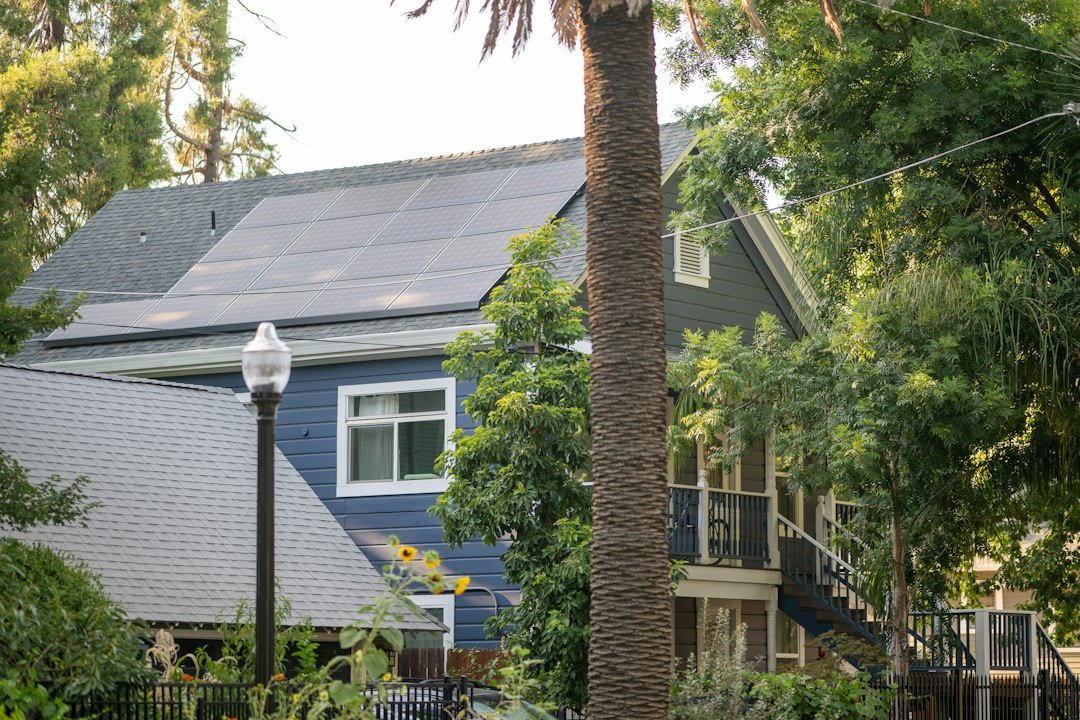
A practical starting answer: many U.S. homes need roughly 15 to 25 modern solar panels to offset a year of household electricity use, but that range is not a quote and it is not valid for every house. The correct count comes from your own 12 months of kilowatt-hour use, the sunlight at your address, the panel wattage, roof conditions, and the amount of utility electricity you actually want to offset. A household using 10,380 kWh per year might need about a 7.1 kW array under a reasonable illustrative production assumption; with 400-watt modules, that is about 18 panels. The same home in a cloudier location or on a shaded roof may need more, while an efficient home in a sunny location may need fewer.
This guide shows the calculation without pretending one national average fits every roof. It also separates three questions that are often mixed together: how many panels offset annual energy use, how many fit on the roof, and whether solar alone can keep a home running during an outage.
Start with annual energy, not the size of the house
Square footage is a weak shortcut. Two houses of the same size can use very different amounts of electricity because of climate, insulation, occupancy, electric heating, air conditioning, water heating, cooking, pool pumps, electric vehicles, and appliance efficiency. The useful input is the total kilowatt-hours shown on 12 consecutive utility bills.
The U.S. Energy Information Administration reported that residential customers averaged 865 kWh per month in 2024, or about 10,380 kWh per year. That is useful for an example, not a substitute for your bills. Regional and household variation is large. If your utility portal lets you download hourly or monthly data, keep it: an installer can use the load shape as well as the yearly total.
- Collect the most recent 12 full billing periods.
- Add the billed kWh, not the dollar amounts.
- Adjust for unusual vacancies, construction, or extreme weather.
- Add expected future loads such as an EV, heat pump, electric water heater, workshop, or home addition.
- Choose an offset target. It may be 70%, 90%, or 100%; it does not have to be all annual use.
If the home is new and has no history, estimate each major load and use a professional load model. Copying the panel count from a neighboring house is especially risky when the homes use different heating fuels or have different roof shade.
The basic solar-panel calculation
A quick planning formula is:
Required array size (kW DC) = annual electricity target (kWh) ÷ expected annual production per installed kW (kWh/kW-year)
Then convert array size to a module count:
Panel count = required array watts ÷ panel rated watts
Always round the result up to a whole panel, then check whether the inverter, roof layout, electrical service, utility rules, and budget support that design. The production-per-kW value should come from a location-specific model. NREL’s PVWatts tool estimates monthly and annual electricity production using the address, array size, module assumptions, tilt, azimuth, and system losses. That is much more defensible than assuming every panel receives a fixed number of “sun hours” every day.
Worked example using a 400-watt panel
Suppose a home used 10,380 kWh during the last year and the owner wants to offset all of it. Assume PVWatts or a comparable site-specific model estimates 1,450 kWh of annual output for each installed kW DC. This is an illustration, not a universal production factor.
- Array size: 10,380 ÷ 1,450 = 7.16 kW DC.
- Array watts: 7.16 × 1,000 = 7,160 watts.
- Panel count with 400-watt modules: 7,160 ÷ 400 = 17.9.
- Rounded planning count: 18 panels, producing a nominal 7.2 kW DC array.
If the same load were modeled at only 1,200 kWh per installed kW per year, the calculation would be 10,380 ÷ 1,200 = 8.65 kW, or about 22 panels at 400 watts. At 1,650 kWh/kW-year it would be 6.29 kW, or about 16 panels. That spread is why a single answer such as “17 panels for every home” is misleading.
Quick examples for different annual loads
The following table uses 400-watt modules and an illustrative production factor of 1,450 kWh per installed kW per year. It is only a screening table. Replace the production factor with a result for your address before making a purchase decision.
| Annual target | Estimated array | 400 W panels | Nominal array after rounding |
|---|---|---|---|
| 6,000 kWh | 4.14 kW | 11 | 4.4 kW |
| 8,000 kWh | 5.52 kW | 14 | 5.6 kW |
| 10,380 kWh | 7.16 kW | 18 | 7.2 kW |
| 12,000 kWh | 8.28 kW | 21 | 8.4 kW |
| 15,000 kWh | 10.34 kW | 26 | 10.4 kW |
Panel wattage also changes the count. A 7.2 kW design could use 20 panels rated at 360 watts, 18 rated at 400 watts, or 16 rated at 450 watts. Fewer panels does not automatically mean more annual production; compare the complete array rating, modeled yield, equipment compatibility, warranties, roof fit, and installed cost.
Why the estimate changes by address
Solar resource and weather
Available sunlight varies by geography and season. Clouds reduce output, although panels can still produce electricity under diffuse light. Snow cover, smoke, haze, heat, and local weather patterns also affect yield. Our guide to solar panels on cloudy days explains why cloudy-day production is lower but not necessarily zero.
Roof direction, tilt, and shade
A roof plane that receives strong unshaded sun can produce more per panel than one shaded by trees, dormers, chimneys, or nearby buildings. Orientation and tilt affect when and how much energy is produced. The Department of Energy notes that rooftop potential depends on roof size, orientation, shading, and geographic location. Shade must be assessed across seasons because a tree that looks harmless in summer may cast a long winter shadow.
System losses
Panel nameplate ratings are measured under standardized conditions. A real system experiences losses from inverter conversion, wiring, mismatch, soiling, temperature, availability, and other factors. Do not multiply panel wattage by 24 hours or assume nameplate output all day. Use a model with documented loss assumptions and ask the installer which losses were included.
Utility policy and desired offset
A 100% annual energy offset is not always the most economical or even permitted design. Net-metering or export-credit rules may make exported daytime energy worth less than electricity purchased later. Some utilities cap system size relative to historical load. Fixed charges may remain even when annual solar generation equals annual consumption. Review the current tariff, interconnection rules, and local permitting requirements before choosing the final count.
How much roof space will the panels need?
Do not estimate roof fit from panel count alone. Obtain the exact module dimensions, multiply length by width, and add the required gaps, setbacks, pathways, and clearances. Roof obstructions and multiple roof planes can reduce usable area. As a rough planning illustration, if a module occupies about 21 square feet, 18 modules occupy about 378 square feet before spacing and code-required access areas. Actual modules differ, so this is not a design value.
An installer should verify the roof structure, remaining roof life, flashing method, wind and snow loads, fire-code pathways, and electrical routing. Replacing an aging roof shortly after installing solar can create avoidable labor costs. Ground mounting may be an option when the roof is shaded, structurally unsuitable, or too small, but it brings land, trenching, racking, setback, and permitting considerations.
Annual offset is not the same as off-grid power
A grid-connected array can offset energy over a year while still relying on the utility at night and during low-production periods. Most ordinary grid-tied inverters shut down during a utility outage for worker safety unless the system has specifically designed backup equipment. Panels alone therefore do not guarantee that household circuits will remain energized.
Outage backup requires a compatible inverter or other isolation equipment, a transfer method, and usually battery storage. Battery sizing is a separate exercise based on critical-load watts, starting surges, desired hours or days of autonomy, usable battery capacity, conversion losses, and expected solar recharge. The number of panels needed to refill a battery during poor weather may be different from the count needed for annual bill offset. See how solar energy can be stored before treating an annual net-zero estimate as an outage plan.
A reliable step-by-step sizing workflow
- Define the goal. Decide whether the priority is bill reduction, a specific annual offset, resilience, carbon reduction, or partial off-grid use.
- Total 12 months of kWh. Correct obvious anomalies and add future electric loads.
- Choose the target percentage. Multiply annual use by the desired offset. For 10,000 kWh and an 80% target, size around 8,000 kWh of annual solar output.
- Model the address. Use NREL PVWatts or an installer model with documented weather data, orientation, tilt, and losses. Run each roof plane separately when directions differ.
- Calculate DC size and module count. Divide target kWh by modeled kWh/kW-year, then divide watts by module wattage and round up.
- Check electrical compatibility. Confirm inverter input voltage and current, string length, rapid-shutdown requirements, service capacity, and applicable code. If evaluating string wiring, review solar panels in series versus parallel; final design belongs with qualified professionals.
- Check physical fit. Use a scaled roof plan and exact module dimensions, including required setbacks and access paths.
- Compare proposals on the same assumptions. Ask each installer for array kW DC, inverter kW AC, modeled first-year kWh, loss assumptions, degradation assumptions, equipment models, warranties, and the utility tariff used.
- Verify permits and interconnection. Do not assume permission to operate follows immediately after installation.
Common sizing mistakes
- Using the electric bill total in dollars: rates, taxes, and fixed charges change. Use kWh.
- Using one high-use month: heating and cooling are seasonal. Use a full year when possible.
- Calling panel watts daily energy: watts measure power; kWh measure energy over time.
- Ignoring future electrification: an EV or heat pump can materially change annual use.
- Assuming 100% offset means no bill: fixed charges, tariff structure, and timing still matter.
- Ignoring shade and roof geometry: a count that works on paper may not fit or produce the modeled energy.
- Confusing solar with backup: outage operation requires compatible equipment and a separately sized storage plan.
How to verify an installer’s proposal
Divide the quoted first-year kWh by the quoted DC array kW. The result is the proposal’s assumed kWh per installed kW per year. Compare that value with an independent PVWatts run using the same roof direction and tilt. A difference is not automatically wrong, but the installer should explain it through shade analysis, equipment, weather data, or loss assumptions.
Also verify that the proposal does not mix AC and DC ratings. Modules are commonly summed as DC nameplate capacity, while inverters have AC output ratings. A DC array larger than the inverter’s AC rating can be intentional, but the designer should model clipping and explain the DC-to-AC ratio. Ask for production guarantees and warranties in writing, and distinguish a forecast from a guarantee.
Frequently asked questions
Can 10 solar panels power a house?
Ten 400-watt panels make a 4 kW DC array. Whether that offsets a house depends on annual consumption and local production. At an illustrative 1,450 kWh/kW-year, it might produce about 5,800 kWh in the first year before considering site-specific differences. That may cover an efficient household or only part of a high-use home.
How many 400-watt panels are needed for an average home?
Using EIA’s 2024 average of 865 kWh per month and the illustrative 1,450 kWh/kW-year factor gives about 18 panels. This is a worked example, not a national design recommendation. Run the actual bills and address through a location-specific model.
Should I oversize the array?
Modest oversizing may account for future loads or support an economic DC-to-AC ratio, but excessive oversizing can run into roof, inverter, utility, or export-compensation constraints. Model alternatives and use current utility rules rather than adding panels “just in case.”
Do I need batteries to power the house with solar?
Not for ordinary grid-connected bill offset. Batteries are needed when the goal includes storing energy for later use or operating selected loads during an outage with compatible isolation and control equipment. Battery capacity and power must be sized separately.
Can I install enough panels to eliminate my electric bill?
Solar may offset much or all annual energy purchases, but fixed charges, minimum bills, taxes, demand charges, and unequal import/export rates may remain. Read the utility tariff and use conservative financial assumptions.
Bottom line
To estimate how many solar panels will power your house, total a year of kWh, choose an offset goal, model annual production for the address, divide the required DC watts by the panel rating, and then verify roof, electrical, code, and utility constraints. For many homes the answer may land near 15 to 25 panels, but the defensible number is the one supported by your bills and a site-specific production model—not a generic online average.
Primary references
- U.S. Department of Energy: Homeowner’s Guide to Solar
- National Renewable Energy Laboratory: PVWatts Calculator
- U.S. Energy Information Administration: 2024 residential electricity consumption
- U.S. Department of Energy: Solar Rooftop Potential
Featured-image credit: Michael Kahn on Unsplash. The photo is an editorial illustration, not a representation of a measured installation or hands-on test.