
The original Jackery Explorer 1500 is now primarily an existing-owner or secondhand-buying question, not a model to confuse with the newer 1500 V2 or Ultra. Jackery’s September 28, 2026 comparison identifies the original Explorer 1500 and 1500 Pro as discontinued. If you already own the original unit, the useful questions are whether its present capacity suits your trip, whether its charging accessories are correct, and whether replacing it solves a real limitation.
This guide covers the US JSG-1500B original Explorer 1500. We checked manufacturer support and comparison information on October 15, 2026. We have not tested a sample, cannot certify a secondhand battery’s condition, and do not treat conflicting advertising figures as verified real-world performance.
Do not buy the wrong “1500”
Record the complete model name and the label on the unit before ordering a charger or comparing an offer. The original Explorer 1500, 1500 Pro, 1500 V2 and 1500 Ultra differ in hardware and charging arrangements. A search-result title containing 1500 does not establish which model is being sold.
Jackery’s current model table lists the original JSG-1500B with 1,534.68Wh of NCM lithium-ion storage and 1,800W combined AC output across three sockets. Its 3,600W instantaneous specification is not a continuous 3,600W operating allowance. Use the nameplate and exact manual when matching a load.
For shoppers, a practical comparison sheet should include model, condition, accessories, written coverage, total delivered price and the requirement you are trying to meet. If one seller includes approved charging equipment and another sells only the station, those are not equivalent offers even when the photos look similar.
A realistic road-trip energy plan
Build your trip plan around energy use and charging opportunities rather than the largest appliance you can briefly switch on. Start with the loads you genuinely need between reliable recharge stops. For example, an illustrative camp day might include a 60W average cooler load for eight hours, a 50W laptop load for three hours and 10W lighting for four hours.
That hypothetical day consumes 480Wh + 150Wh + 40Wh = 670Wh before the power station’s losses and other consumption. These inputs are examples for planning, not measurements or a claim that every cooler averages 60W. A cooler’s duty cycle and ambient conditions can make the real figure very different.
Assume, only for a preliminary calculation, that 80% of the original 1,534.68Wh label is available to the loads after a general allowance for losses and reserve. This produces 1,227.744Wh. The illustrative 670Wh day would leave 557.744Wh of that modeled allowance. An aged battery, a different load pattern or an unexpected device can change the result.
Give the remaining allowance a purpose. You might reserve it for an additional night of lighting and communications rather than use it for optional cooking. A reserve is only meaningful when everyone using the equipment knows which loads should stop first.
Compare load size with calculated operating time
| Alternative constant-load scenario | 1,227.744Wh divided by load |
|---|---|
| 100W | 12.28 hours |
| 250W | 4.91 hours |
| 600W | 2.05 hours |
| 1,200W | 1.02 hours |
Our 80% factor is not a measured Explorer 1500 efficiency, and these rows are not simultaneous loads. They demonstrate how quickly high-power use can spend a finite energy budget. A 1,200W appliance used for fifteen minutes consumes 300Wh by arithmetic before losses—nearly half the example camp day’s 670Wh load energy.
Startup compatibility remains a separate test. A motor may need a different starting allowance from its average consumption, and a device’s input rating can differ from the useful output advertised on its front. Our refrigerator starting-watts guide explains why an energy calculation alone cannot certify compressor startup.
Account for slow charging before leaving
The original JSG-1500B support page lists approximately 6.5 hours for AC charging and 13 hours for car charging. Jackery’s broader comparison article gives different figures: six hours and 15.5 hours respectively. Treat these as conflicting manufacturer estimates rather than selecting the shortest number as an unconditional promise.
Ask support which estimate applies to your unit, approved adapter, available input and charging conditions. If a trip includes only a short powered stop, find out how much energy your actual setup replenishes during that stop. A complete refill time and a two-hour opportunity are different planning quantities.
For example, a hypothetical average 250W accepted input over two hours represents 500Wh before charging losses. If 100W of loads remain active for those two hours, they consume 200Wh, leaving at most 300Wh before other losses. This is a simplified energy balance, not a claim that the original Explorer 1500 will hold that input rate throughout charging.
Record observed input and the battery percentage before and after a representative charging session. This makes it easier to identify an unexpectedly weak supply or a charger mismatch before arriving at a campsite without another option.
Missing charger? Verify the complete charging assembly
The original support table specifies an external-adapter charging arrangement and DC8020 inputs. A newer model’s AC cable or a similar-looking barrel connector does not establish that a substitute assembly is correct. Supply the exact model label and accessory labels when asking Jackery to approve a replacement.
Jackery’s separate accessory FAQ gives general compatibility guidance but also warns that a cable designed for a smaller model should not be used with a larger one. Do not turn that general statement into approval for every adapter, power brick or input arrangement. Request the correct part identification for your delivered unit.
For a secondhand listing, ask the seller to show charging from the supplied approved equipment, with the display’s input reading visible. A photograph of a charger beside the battery is weaker evidence than a clear demonstration that the intended arrangement is recognized. Neither observation substitutes for a full condition assessment.
Solar accessories must match this generation
The model-specific support documentation describes approved solar combinations and adapters for the original Explorer 1500. It is not interchangeable with the input architecture of the newer V2 or Plus products. Have Jackery verify the proposed panel models, quantity and connectors before buying a multi-panel package.
A useful question is not merely “Can I use a 200W panel?” Ask whether your complete arrangement is supported, including the precise panel label, adapter and intended input connection. Save the response with the equipment documentation so you do not have to reconstruct the setup during a trip.
Do not assume panel nameplate watts arrive continuously. Shading, position and weather influence production. Plan a low-sun day as well as a favorable one, and keep the battery station protected according to its own manual. A panel’s environmental rating does not establish that the station and every cable joint can be left in rain.
Evaluate an older battery without inventing its health
Cycle-life figures are not a diagnosis of a particular unit. The current support table lists 500 cycles for the original model, while the comparison article contains inconsistent cycle-life statements in its narrative and table. We cannot use those statements to certify remaining capacity, a precise replacement date or a guaranteed number of years.
Ask the seller about age, storage, service history and known faults, but keep those answers separate from independently observed behavior. A seller’s statement that it was rarely used does not reveal every storage condition. A full-charge indication does not independently measure the original watt-hour capacity.
For a practical acceptance session, use a known noncritical load within the documented limits, record the starting charge, run a representative period and note the remaining charge and any warning. Repeat only as appropriate under the manual and return terms. Do not open the enclosure or attempt cell replacement as part of a marketplace inspection.
If your current unit safely meets a measured occasional-use requirement, the existence of newer chemistry is not by itself a reason to discard it. Conversely, buying an older model to save a small amount can be false economy if you immediately need a costly charger or a longer recharge window than your travel plan allows.
Recognize limits that extra accessories do not remove
The original Explorer 1500 support page does not support expansion battery packs, parallel operation or app control. If your need has grown beyond its energy budget, do not buy an arbitrary extra battery expecting a supported modular upgrade. Our Explorer 2000 Plus guide explains a different expansion architecture and its separate limits.
Three AC sockets also do not mean three independent 1,800W allowances. Add the devices that will run together, then investigate starting events and port restrictions. If a load trips protection, remove it and follow the exact model’s recovery instructions. Repeatedly restarting an incompatible combination is not an upgrade.
Do not choose this station as a medical or safety-critical supply based on a generic backup-power label. If interruption has serious consequences, obtain an appropriately designed professional solution. This article does not verify no-break transfer behavior for the original unit.
Keep camper and household connections within scope
This guide is about compatible loads and planning, not DIY modifications to a camper’s fixed wiring or a home’s panel. Obtain qualified advice for a fixed-circuit connection. Never use a male-to-male lead or energize home wiring through a wall socket; CPSC warns that these backfeeding arrangements can cause electrocution and fire.
A portable fuel generator used for recharging remains a combustion generator even when its only load is a battery charger. Follow CDC guidance: run it outdoors, more than 20 feet from the home and away from openings, never inside a garage with doors open. Our backfeeding safety guide explains the connection hazards separately from battery capacity.
Ownership and buying decision checklist
- Confirm that the label identifies the original JSG-1500B.
- Match your real loads and recharge opportunities to a written energy plan.
- Verify the complete charging and solar accessories, not just plug fit.
- Inspect condition and investigate errors before relying on the station.
- Use a representative noncritical acceptance session rather than assuming original capacity.
- Compare the total complete-system cost with newer alternatives.
Keep the original Explorer 1500 when its actual condition and charging pattern fit an occasional trip or noncritical backup role. Seek another solution when you need supported expansion, shorter verified recharge windows or a different output arrangement. The right answer comes from the requirement and delivered condition, not from nostalgia or a discount percentage.
Does a redirected sales page establish original-model specifications?
No. The old refurbished Explorer 1500 address redirected to an Explorer 2000 Plus refurbished listing during our check. Read the destination carefully and use the original model’s support page for identification.
Are 1500 V2 accessories automatically compatible?
No. Obtain compatibility confirmation for the original JSG-1500B and the exact accessory before purchase.
Official references
- Original JSG-1500B specifications
- Manufacturer comparison, discontinuation and conflicting figures
- Accessory-compatibility cautions
- Battery energy and runtime principles
- CPSC backfeeding warning
- CDC fuel-generator safety
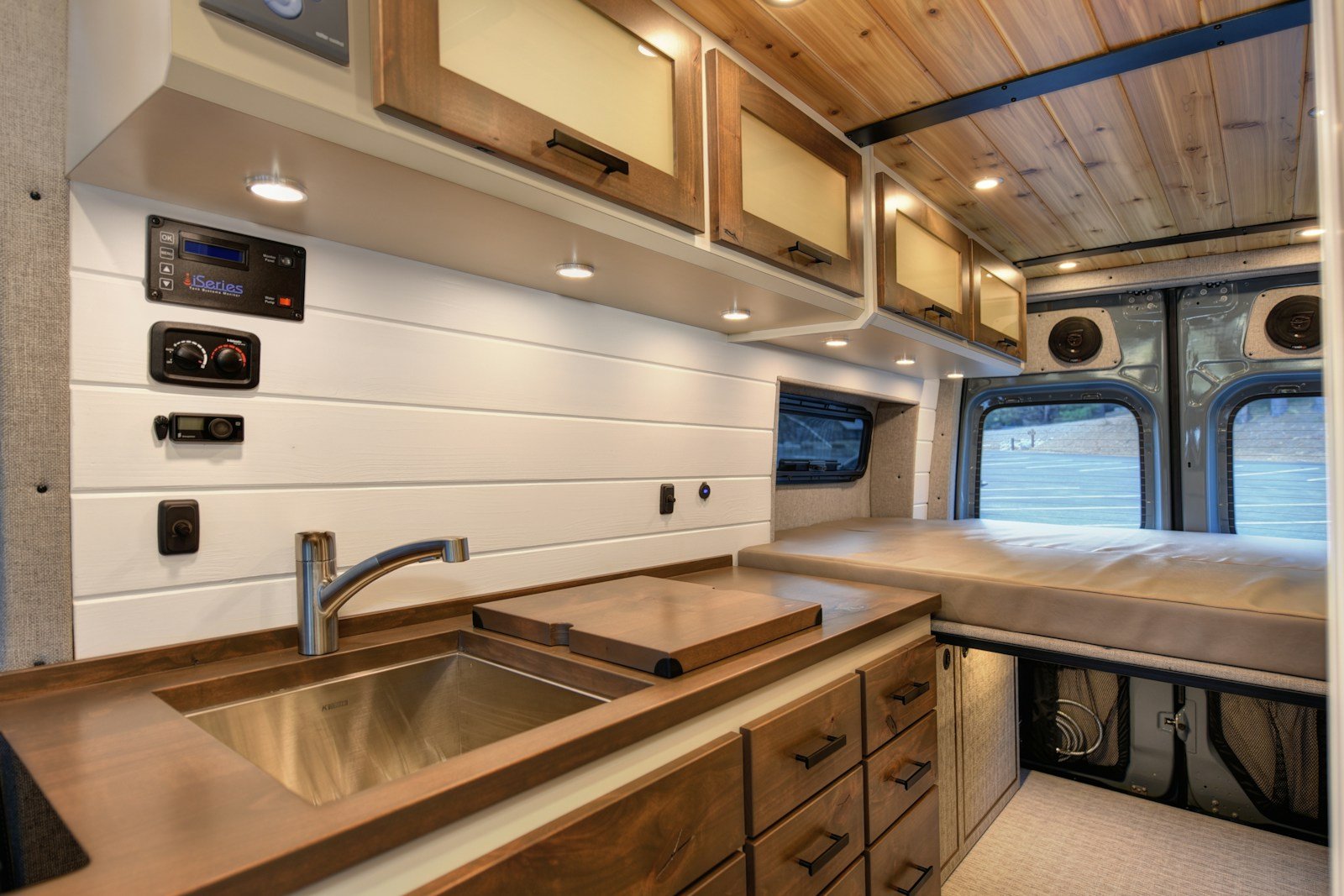
Editorial photograph: Leo_Visions / Unsplash. A camper interior illustrates trip-load planning; no Jackery installation or hands-on test is depicted.
2 thoughts on “Jackery Explorer 1500: Original Model Charging, Runtime and Used-Buying Guide”