
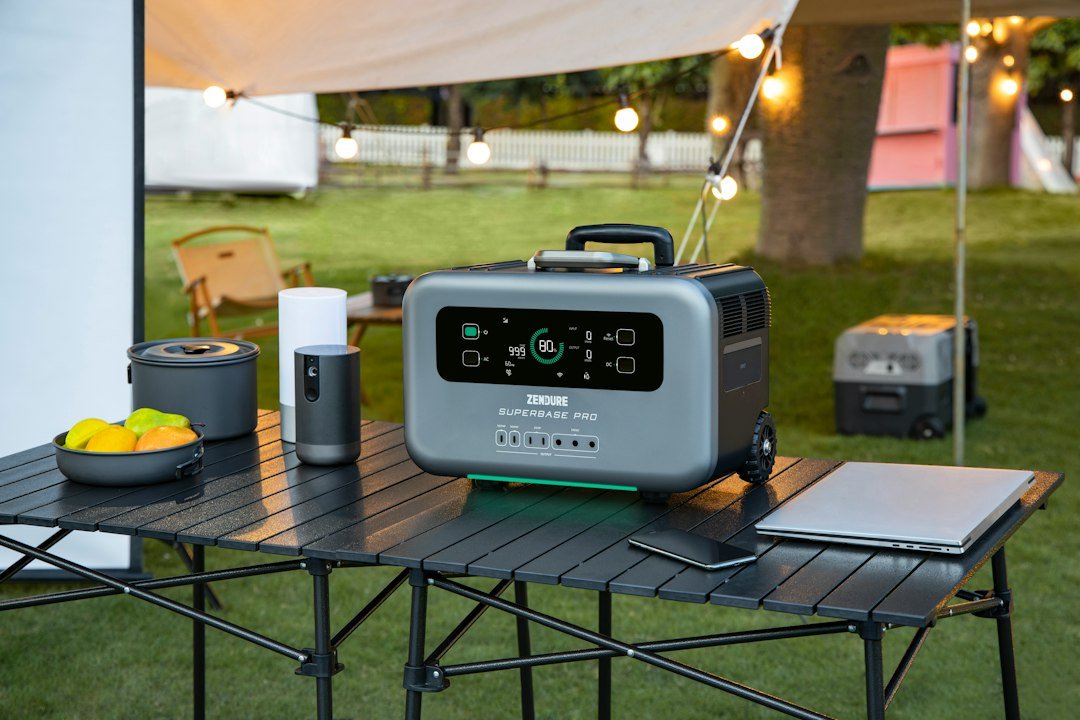
Are solar generators good? Yes—for the right job. A portable solar generator can be an excellent way to keep phones, a laptop, lights, a router, and certain small appliances running during camping trips or short power outages. It stores electricity in a rechargeable battery and can accept energy from compatible solar panels. Unlike a gasoline generator, the battery unit does not burn fuel while supplying electricity. But it has finite stored energy, and its solar charging rate depends on the weather, panel setup, and the equipment’s limits.
For a refrigerator, a home office, or a few essential emergency devices, a correctly sized system can be genuinely useful. For continuous air conditioning, electric heating, or several days of heavy household demand, a small portable unit is often the wrong tool. The most important buying decision is to match battery capacity, inverter output, and solar input to your actual needs—not to choose a product because its name includes the word generator.
What Is a Solar Generator, Exactly?
In the portable-power market, a solar generator usually means a rechargeable portable power station used with solar panels. The power station contains a battery, charging electronics, outlets, and an inverter that turns stored direct-current electricity into alternating-current electricity for compatible household appliances. The panels are a source of charging energy, not a substitute for the battery. Some bundles include folding panels; other products are sold as the battery station alone.
The term can be misleading. A gasoline generator converts fuel into electricity while the engine runs. A portable solar generator mainly stores electricity that was produced elsewhere—by solar panels, a wall outlet, or sometimes a compatible vehicle charging connection. It does not create unlimited energy. Once its battery is depleted, it needs another charge before it can deliver the same amount of electricity again.
The U.S. Department of Energy’s solar-and-storage guide explains why batteries are useful: solar generation changes with sunlight, while stored energy can be discharged later when it is needed. That basic principle applies to small portable systems as well as larger home installations, although their equipment and capabilities differ.
The Biggest Advantages of Solar Generators
Quiet power without a running combustion engine
A battery power station can supply electricity without the exhaust or engine noise of a fuel-burning generator. Some models still have cooling fans, and those fans may become noticeable under high loads or while charging. Even so, for indoor electronics, a campsite with noise restrictions, or a nighttime router backup, the absence of a continuously running engine is a major practical benefit.
Useful for indoor emergency electronics
A correctly maintained portable battery station can be used indoors according to its manufacturer’s instructions because it does not produce combustion exhaust during operation. That is an important difference from gasoline and propane generators, which must never be run indoors or near openings where exhaust can enter. Indoor battery use is not a reason to ignore battery safety: keep the unit dry, allow required ventilation, avoid damaged packs, and follow the maker’s temperature and charging limits.
Rechargeable from sunlight when conditions allow
Compatible panels can replenish stored energy without fuel deliveries. That is particularly attractive at remote campsites and during outages when the grid is unavailable. The Department of Energy notes that solar paired with storage can improve resilience because energy can be stored and used after sunset. But cloudy days, shade, winter daylight, panel angle, and the unit’s maximum solar-input rating all affect how much charging you actually get.
Portable and flexible for small loads
A small unit can move between a home office, a vehicle, a tent, and an outdoor work area. USB and AC outputs may support different devices, subject to each port’s rating. Portability decreases as battery size increases: large-capacity stations can be heavy and difficult to move up stairs or into a car. Check dimensions and actual weight, not just marketing photographs.
The Main Disadvantages of Solar Generators
Stored energy runs out
A solar generator has a finite energy capacity, usually stated in watt-hours (Wh) or kilowatt-hours (kWh). A 1,000-Wh battery does not mean it can provide 1,000 watts forever. It means the nominal stored energy is equivalent to 1,000 watts for one hour before considering conversion losses and usable-capacity restrictions. If you use energy faster than sunlight replenishes it, the battery eventually runs down.
Solar recharging can be slow or unpredictable
A folding panel advertised at 200 watts will not necessarily deliver 200 watts throughout the day. That rating is measured under specified test conditions. Real output changes with sun angle, temperature, clouds, cable losses, and panel positioning. The power station may also cap incoming solar power. Plan around conservative real-world charging assumptions, particularly for emergencies when you cannot choose the weather.
High-power appliances can overwhelm the inverter
A station’s AC output rating is a separate limit from battery capacity. Even a large battery cannot run an appliance whose required continuous or starting power exceeds the inverter’s capability. Refrigerators and pumps can briefly draw more power when motors start. Heating appliances such as kettles, space heaters, and electric cooktops can drain smaller batteries quickly. Check the appliance label and the power station’s continuous and surge specifications.
The total system can be expensive
A battery station and sufficiently large solar panels may cost more upfront than a basic fuel generator with similar short-term output power. Prices vary widely by battery capacity, inverter capability, included panels, warranty, and brand, so a generic price tag is not reliable. The proper comparison includes replacement batteries, fuel and maintenance for combustion equipment, charging options, and how often the backup system will actually be used.
What Can a Solar Generator Run?
A portable solar generator can be good for many everyday devices, but the answer depends on both instantaneous watts and total watt-hours. A device must stay within the outlet’s power limit, and the battery must hold enough energy for the desired runtime. Use the appliance’s measured consumption whenever possible, because labels often list maximum rather than average draw.
| Example device or use | What to check first | Practical consideration |
|---|---|---|
| Phone, tablet, LED lights | USB/AC output and Wh capacity | Usually modest energy demand |
| Laptop and Wi-Fi router | Combined watts and hours needed | Good candidate for short backup |
| Refrigerator | Running energy and motor start surge | Duty cycle makes runtime variable |
| CPAP device | Exact model, humidifier settings, power adapter | Test compatibility before relying on it |
| Microwave or electric kettle | High continuous inverter output | Rapidly consumes stored energy |
| Central AC or electric heating | High running and starting power | Often impractical for smaller stations |
For refrigerator planning, our power station versus generator refrigerator guide covers why compressor startup and cycling matter. If you depend on powered medical equipment, use a backup plan approved for the specific device and discuss outage preparation with the device manufacturer or clinical provider; a general-purpose power station should not be assumed to be a certified medical UPS.
How Long Does a Solar Generator Last on One Charge?
A rough runtime estimate is usable battery watt-hours divided by the average appliance wattage. To allow for inverter losses and other practical factors, a planning calculation may assume less than the advertised nominal capacity reaches the AC outlets. The exact usable fraction depends on the unit and operating conditions; it is not one universal efficiency percentage.
For illustration only, suppose a power station is rated at 1,024 Wh and 85% of that energy is available to an AC load under the chosen conditions. That gives about 870 Wh of usable energy. A steady 60-watt load would run for approximately 14.5 hours (870 ÷ 60), while a steady 300-watt load would run for about 2.9 hours. These figures are arithmetic examples, not tested runtimes for a particular model.
Real appliances may cycle on and off, and some power stations consume energy while their inverter is on even with a very small load. Cold temperatures, battery age, and manufacturer reserve settings can also affect available energy. If runtime is critical, measure the actual load with an appropriate meter and test the complete setup before an emergency. Read our portable power station runtime guide for more detail.
How Long Does Solar Charging Take?
Solar charging time depends on the battery energy to replace, the actual solar watts reaching the station, and charging losses. A simple starting calculation is energy needed in watt-hours divided by average input watts. For example, replacing 800 Wh at an average of 160 watts would take about five hours before accounting for losses and charge-rate tapering. Real charging could take longer, and the sunlight may not remain that strong for five consecutive hours.
A larger folding array may shorten charging time if the station supports its voltage, current, connector, and maximum input power. Do not assume that connecting more panels always helps. An array that exceeds the station’s allowed input voltage can damage equipment or create a hazard. Consult the manufacturer-approved wiring diagram and specifications; our solar panel series versus parallel guide explains why voltage and current limits matter.
Are Solar Generators Good for Power Outages?
They can be excellent for targeted backup: communications, lighting, device charging, and some refrigeration when the unit is correctly sized. They are especially useful where a fuel generator is impractical because of noise or exhaust restrictions. But they are not automatically whole-house systems, and most portable stations cannot simply be connected to a home’s electrical wiring.
For a planned outage kit, list essential loads and how many hours each must run. A router and a few LED lights might require relatively little energy. A refrigerator, freezer, or electric heating appliance can change the calculation substantially. Decide whether you need backup for a few hours, overnight, or several days without reliable sunlight. Then select the battery and solar array to match that scenario.
Never backfeed a home by plugging a power station or generator into a wall outlet. Any connection to household circuits must use approved equipment and be installed according to applicable electrical requirements by a qualified professional. See our generator backfeeding safety guide. A portable power station’s ordinary AC outlets are generally intended for directly connected compatible devices unless the manufacturer explicitly supports another certified installation.
Are Solar Generators Good for Camping and RV Travel?
For camping, they are often a strong fit. They can charge cameras and phones, power small lights, support laptops, and operate selected low-wattage equipment without a running engine. A folding solar panel may help extend a trip if you have a sunny place to deploy it. The key limitations are pack weight, weather resistance, campsite shade, and the time required to recharge.
Do not place battery equipment in standing water, block cooling vents, or expose non-weather-rated units to rain. Solar panels may be designed for outdoor use while the power station itself is not. For RV use, check whether the station is compatible with the RV’s electrical system, grounding and transfer arrangement. Directly plugging an RV or household distribution system into a power station without verifying the electrical requirements is not a safe default.
Solar Generator vs Gas Generator: Which Is Better?
Neither option is best for every household. A battery station is often better for quiet, limited-duration electronics backup and for places where combustion exhaust is unacceptable. A gasoline or propane generator may be better suited to sustained high-wattage demands when fuel can be supplied safely and the equipment is operated outdoors according to instructions. Fuel generators require fuel management, maintenance, and strict carbon monoxide precautions.
| Factor | Portable solar generator | Fuel-burning generator |
|---|---|---|
| Energy source | Stored electricity; solar or grid recharge | Gasoline, propane, or another fuel |
| Noise during use | Often quiet; cooling fans possible | Engine noise |
| Indoor operation | Follow battery and ventilation instructions | Never indoors due to exhaust |
| Runtime | Limited by battery and recharging | Limited by fuel and safe refueling |
| High continuous loads | Requires a suitably rated, often larger system | Available in many high-output models |
| Maintenance | Battery care and periodic testing | Engine, fuel, and periodic servicing |
A hybrid preparedness plan can also make sense: a portable battery for overnight electronics and a properly installed outdoor generator for longer high-demand outages. But mixing power sources requires equipment designed for that purpose. The Department of Energy’s resilience discussion explains the trade-offs between solar, storage, and combustion generators.
How to Choose a Good Solar Generator
- Start with loads, not product names. Write down every device, its watts, and how long you want to run it.
- Choose enough usable energy. Add the watt-hour demand and allow a margin for losses and changing conditions.
- Check inverter limits. Confirm continuous AC watts, motor surge capability, and the ratings of individual ports.
- Verify solar input compatibility. Match panel voltage, current, connector, and input wattage to the manufacturer’s limits.
- Check battery chemistry and warranty. Compare the documented cycle-life test conditions, capacity warranty, and service arrangements rather than relying on a headline cycle count alone.
- Review safety documentation. Look for applicable independent product safety certification and follow the maker’s operating and charging instructions.
- Consider portability. Check the actual weight, handle design, operating temperature, and whether the enclosure is weather-rated.
- Understand what is in the box. Some solar generator listings do not include panels or the adapters required for a particular solar array.
For U.S. shoppers, independently evaluated safety standards and reputable support channels are important, especially for large lithium-battery products. Avoid assuming a logo printed in a product photo proves certification. Check the actual model’s listing and documentation, and never modify a battery pack or charging cable to bypass its protections. The Department of Energy’s solar fire-safety guide stresses quality equipment and proper installation for energy storage systems.
Are Solar Generators Worth the Money?
A solar generator is worth considering when you have frequent short outages, need quiet off-grid electronics power, or want a portable alternative to a fuel-burning generator. The value comes from reliably powering the things you actually use. A unit that keeps communications and essential devices running can be worthwhile even if it never offsets enough utility electricity to repay its purchase price.
It may be a poor purchase if you expect it to operate a whole house for days, run large electric heaters, or provide unlimited energy regardless of weather. A very small battery can disappoint if the buyer focuses on inverter watts but ignores watt-hours. Conversely, a large expensive system may be unnecessary if the goal is only charging phones. Decide on the use case first, then compare the complete price including solar panels, cables, accessories, and any additional batteries.
Do Solar Generators Work? Real-World Performance Explained
Yes, solar generators really work. A typical portable solar generator is a rechargeable battery power station that accepts electricity from compatible solar panels. The panels convert sunlight into direct-current (DC) electricity, charging electronics regulate the incoming power, the battery stores energy, and an inverter provides alternating-current (AC) electricity for compatible household devices. Unlike a gasoline generator, a portable solar generator does not continuously create electricity by burning fuel. It must be charged, and its available energy is finite.
This distinction is central to understanding whether a solar generator will work for your needs. It can be an effective solution for phones, routers, lights, computers, camping equipment, and selected emergency appliances. But a unit with a small battery cannot power large appliances indefinitely. A solar panel’s advertised wattage also does not guarantee that much charging power every hour. Sunlight, temperature, shading, panel orientation, the power station’s input limits, and conversion losses all influence performance.
The U.S. Department of Energy explains the photovoltaic effect behind solar electricity generation, while its inverter guide explains why electronics are needed to convert DC power into AC. For a product-focused overview of the category, see EnergySage’s October 2026 solar generator guide.
How can you tell whether a solar generator is working?
A working solar generator should be able to power an appropriately sized device from its stored battery energy. If solar panels are connected, the unit’s display or companion app may also show incoming charging watts when sufficient sunlight is available. Some stations show a battery percentage, input watts, output watts, and an estimated time remaining. These readings are useful, but they are estimates and can change as conditions or loads change.
Try a low-power device that the manufacturer explicitly supports, such as a phone charger or LED lamp. Check that the station is sufficiently charged and that the relevant output port has been enabled. Then observe whether the device runs and whether the station reports output power. For solar charging, place a compatible panel in unobstructed sunlight and verify that the station reports an input reading. A zero-watt reading may indicate insufficient light, an incompatible cable, a disabled charging input, or another issue; it does not prove the technology is ineffective.
What makes a solar generator work during a power outage?
A charged portable power station can supply electricity independently of the utility grid through its own outlets. That makes it useful when the grid is down, provided the device’s output rating and battery capacity are sufficient for the connected loads. Solar panels may recharge the station during the outage when sunlight is available, but charging speed is variable and weather-dependent. The Department of Energy explains that batteries allow solar energy to be used when sunlight is not available.
Do not assume a portable solar generator can safely energize your home’s wiring through an ordinary wall outlet. Backfeeding can endanger utility workers and damage equipment. Running selected household circuits requires a compatible system and professionally installed, code-compliant transfer equipment. Otherwise, plug supported appliances directly into the power station’s designated outlets, following the manufacturer’s instructions.
Do solar generators work without solar panels?
Many portable power stations sold as solar generators can be charged from a household AC outlet, and some support car charging or other approved inputs. Once the battery is charged, the station can power compatible devices even if no solar panel is attached. However, it cannot replenish its energy from sunlight without a suitable solar charging source. Check whether the product listing includes panels or sells them separately; the term “solar generator” alone does not guarantee a panel is in the box.
Charging methods vary by model. Some stations accept a wide solar voltage range, while others require a narrow input range. Using an incompatible panel, connector, or voltage can prevent charging or damage equipment. Match the manufacturer’s allowed solar input voltage, current, connector, and maximum power before connecting panels. Read our portable power station not charging guide if the display shows no incoming power.
How long will a solar generator actually run?
Runtime depends mainly on usable battery energy and the power drawn by your devices. Battery energy is measured in watt-hours (Wh), while the power consumed at a moment is measured in watts (W). For a rough first estimate, divide usable battery energy by the appliance’s average watts. Then allow for inverter and other losses. The result is an approximation, not a guaranteed runtime.
Consider a hypothetical power station rated at 1,000 Wh. If 85% of that energy is available to a particular AC load after all relevant losses, the usable amount is about 850 Wh. A constant 50 W load could then run for approximately 17 hours (850 ÷ 50). A constant 100 W load could run for about 8.5 hours. A 500 W load would last roughly 1.7 hours. These are illustrative calculations, not tested runtimes for a specific product. Actual losses and battery limits differ by model and operating conditions.
| Hypothetical constant load | Approximate runtime from 850 usable Wh | What this illustrates |
|---|---|---|
| 20 W | 42.5 hours | Low-power electronics may run a long time |
| 50 W | 17 hours | Modest loads are often manageable |
| 100 W | 8.5 hours | Runtime decreases as power rises |
| 250 W | 3.4 hours | Medium loads consume energy faster |
| 500 W | 1.7 hours | High loads quickly exhaust the battery |
Appliances such as refrigerators cycle on and off, so their average energy consumption can differ greatly from their running-watt label. Some appliances also draw a high startup surge. Always check both the station’s continuous AC output rating and any applicable surge limit. For more runtime planning, see how long a portable power station lasts.
Do solar generators work on cloudy days?
They can, but charging usually slows when clouds reduce the sunlight reaching the panels. A charged battery can continue powering devices regardless of whether the sun is currently shining, until its stored energy is depleted. During a prolonged cloudy period, solar input may be too low to keep pace with the devices being used. This is why emergency plans should not assume a fixed daily charging yield.
For example, a station drawing 80 W continuously uses 640 Wh over eight hours. If the solar panels deliver only 200 Wh during that period, the battery must supply the remaining 440 Wh, ignoring additional conversion details for simplicity. This is a hypothetical energy-balance example, not a forecast for any specific weather condition. The practical question is whether daily solar charging replaces the energy you consume.
Do solar generators work at night?
Yes, a charged station can deliver electricity at night from its battery. The solar panels themselves generally do not produce useful electricity in darkness, so the battery is discharging rather than receiving sunlight-generated energy. If you plan to power essential devices overnight, size the battery for the hours of use and leave a reserve for unexpected needs.
Nighttime use is one reason battery capacity matters more than a product’s “solar generator” label. A station advertised with a powerful inverter may still have a modest battery and short runtime under heavy loads. Look at watt-hours and continuous output watts separately rather than treating them as interchangeable.
Can a solar generator run a refrigerator or air conditioner?
Some solar generators can run certain refrigerators, but compatibility depends on the refrigerator’s running consumption, compressor startup surge, and the station’s inverter output. A refrigerator may cycle rather than draw constant power, making its energy use difficult to estimate from a single instant reading. Check the appliance’s label and, when appropriate, measure its energy consumption using a safe, suitable power meter.
Air conditioners, electric heaters, kettles, and other high-power devices can demand far more power and energy than a small portable station can provide. Some large systems support specific high-demand appliances, but do not assume that every solar generator can run an air conditioner or an entire house. The correct answer requires the exact station model and appliance specifications.
How quickly can solar panels recharge a generator?
Solar charging time is determined by the battery energy to be replenished and the actual charging watts delivered to the unit, not merely the panels’ advertised maximum rating. Suppose a station needs 800 Wh added to its battery and receives an average of 160 W of effective charging power during suitable daylight. The idealized time is 800 ÷ 160 = 5 hours. This example assumes a constant average input and omits charging taper and other variations, so real charging may take longer.
A panel sold as 200 W does not deliver 200 W all day. Solar irradiance changes as the sun moves, and clouds, heat, shading, and panel orientation can reduce output. In addition, a power station may cap its solar input below the total nameplate rating of connected panels. For accurate planning, examine the manufacturer’s input specifications and measure real charging performance in your location.
Why might a solar generator seem not to work?
Common problems include an empty battery, an output port that has not been turned on, a load exceeding the inverter’s continuous or surge limit, weak sunlight, shading, an incompatible solar input, loose or damaged cables, or a protective shutdown. Some stations stop charging or discharging outside their permitted temperature range. A unit may also enter standby or an energy-saving mode that affects low-power devices.
- Check the battery level. Confirm the station has enough stored energy to power the intended device.
- Confirm the correct output is enabled. AC outlets and DC or USB outputs may have separate controls.
- Check appliance power requirements. Compare running and startup watts with the station’s published limits.
- Review solar input compatibility. Confirm voltage, current, connectors, and input range before connecting panels.
- Inspect sunlight conditions. Shade or poor orientation may leave solar input too low for charging.
- Look for error messages. Follow the manufacturer’s manual for temperature, overload, or battery protection warnings.
- Stop if anything appears damaged. Do not open battery packs or attempt improvised repairs to high-energy electrical equipment.
Use the device’s manufacturer-approved troubleshooting procedure. If the unit repeatedly trips, overheats, smells unusual, or shows a damaged battery enclosure, discontinue use and seek qualified service. A portable power station should not be treated as a do-it-yourself electrical panel.
Solar generator performance checklist before buying
| Specification | What it tells you | Why it matters |
|---|---|---|
| Battery capacity (Wh) | Stored energy | Helps estimate runtime |
| Continuous AC output (W) | Maximum supported sustained load | Determines which appliances can run |
| Surge rating (W) | Short startup allowance | Important for motor-driven appliances |
| Solar input voltage range | Permitted panel voltage | Prevents incompatible connections |
| Maximum solar input (W) | Charging power limit | Helps estimate best-case recharge rate |
| Battery chemistry and warranty | Product-specific storage characteristics | Useful for lifespan and service decisions |
| Panel inclusion | Whether panels are in the bundle | Avoids surprise extra purchases |
Read the actual specifications for the exact model, not just the product family name. A seller may market a station as a “2,000-watt generator” because of its inverter rating even though the battery capacity is much smaller than 2,000 Wh. Similarly, a bundle may include a small solar panel that would require a long time to refill the battery. Compare the energy capacity, output capability, and solar charging input as three distinct limits.
Frequently asked questions: do solar generators really work?
Do solar generators produce unlimited free electricity? No. Solar panels convert sunlight into electricity, while the station stores a limited amount. Energy production varies with available sunlight, and the equipment itself has a purchase cost.
Will a solar generator work inside a house? A properly designed battery power station can generally be used indoors according to its manufacturer’s instructions, unlike fuel-burning generators that produce dangerous exhaust. Keep vents clear, follow temperature limits, and do not use damaged battery equipment.
Can I use a solar generator while it is charging? Some models support simultaneous charging and discharging, often called pass-through operation, but the rules and limits vary. Check the specific manufacturer’s instructions instead of assuming the feature is universal.
Does a solar generator need direct sunlight? Strong, unobstructed sunlight usually gives better charging performance. Some charging may occur under weaker daylight, but the input can become too low for practical recharging.
Will it work during a multi-day blackout? It can continue to run supported loads as long as sufficient battery energy or charging input is available. Extended cloudy weather and heavy appliance use may exhaust the battery before the grid returns.
Are solar generators a replacement for gas generators? They can replace a fuel generator for certain lower-power, shorter-duration uses, but they are not interchangeable for every application. A battery station has finite energy, while a fuel generator’s runtime depends on fuel availability and maintenance. Compare the exact power demand and required duration.
Bottom line: solar generators work, but their real performance is determined by the battery’s watt-hours, the inverter’s watts, compatible solar charging input, and how much energy your devices consume. Choose the system for the specific loads and outage duration you need, and treat manufacturer charging estimates as conditional rather than guaranteed.
Sources for this practical section: U.S. Department of Energy — How Does Solar Energy Work?; DOE — Inverters and Grid Services Basics; DOE — Solar Energy and Storage Basics; EnergySage — Best Solar Generators in 2026 (updated October 30, 2026). Runtime and charging calculations are illustrative and do not represent verified performance for a specific product.
Frequently Asked Questions
Do solar generators really work?
Yes. A portable battery station can supply electricity through compatible outlets, and properly matched solar panels can recharge it in sufficient sunlight. Actual output and recharge speed depend on the equipment and conditions. A solar generator does not produce unlimited electricity without charging.
Can a solar generator power a refrigerator?
Some can, provided the inverter handles the refrigerator’s starting surge and the battery stores enough energy for the intended duration. Refrigerator energy use varies with size, ambient temperature, door opening, and compressor cycling. Test the exact refrigerator and station combination before relying on it.
Can you use a solar generator indoors?
A battery-based portable power station does not emit engine exhaust while supplying power, but it still requires appropriate ventilation, temperature control, and safe charging practices. Follow the manufacturer instructions and do not operate damaged equipment. Never run a fuel-burning generator indoors.
Do solar generators work at night?
The battery can power devices at night if it has stored energy. Solar panels do not produce useful charging power in darkness. Whether the station lasts until morning depends on remaining battery energy and the connected load.
Do solar generators work on cloudy days?
They may receive some charging energy from diffuse sunlight, but charging is typically reduced compared with bright, unobstructed sunshine. The battery can continue supplying devices while the panels are underperforming, until stored energy is exhausted.
How many years does a solar generator last?
There is no universal lifespan. Battery chemistry, cycle count, storage temperature, charging habits, and electronics reliability all affect service life. Compare manufacturer warranties and their specific capacity-retention terms rather than assuming every station lasts a fixed number of years.
Is a solar generator better than a gas generator?
For quiet, small-load backup and indoor electronics, a battery system is often more convenient. For sustained high loads, a correctly sized outdoor fuel generator may be more practical if safe fuel supplies are available. The better choice depends on runtime, power demand, budget, and safety constraints.
Final Verdict: Are Solar Generators Good?
Solar generators are good when your power needs are realistic. They are particularly useful for portable electronics, camping, home-office continuity, and short emergency backup. Their strengths are quiet operation, rechargeable stored energy, and the ability to collect additional energy from sunlight. Their weaknesses are limited battery capacity, variable solar charging, and the high power demand of some household appliances.
Before buying, calculate watt-hours for the devices you want to run, verify the inverter can start and operate them, and check the solar input limits. If you need whole-home or multi-day backup, compare a professionally designed home battery system or a safely installed generator instead. Matching the system to the job is more important than the word solar on the box.
Sources and Image Credit
- U.S. Department of Energy: Solar Energy and Storage Basics
- U.S. Department of Energy: Solar and Resilience Basics
- U.S. Department of Energy: The Road to Resilience with Rooftop Solar
- U.S. Department of Energy: Fire Safety with Solar Systems
Editorial note: Runtime and charging calculations are hypothetical illustrations, not product test results. Featured photograph: Zendure Power Station / Unsplash. The image depicts a portable solar-generator setup and is not an endorsement or product recommendation.