
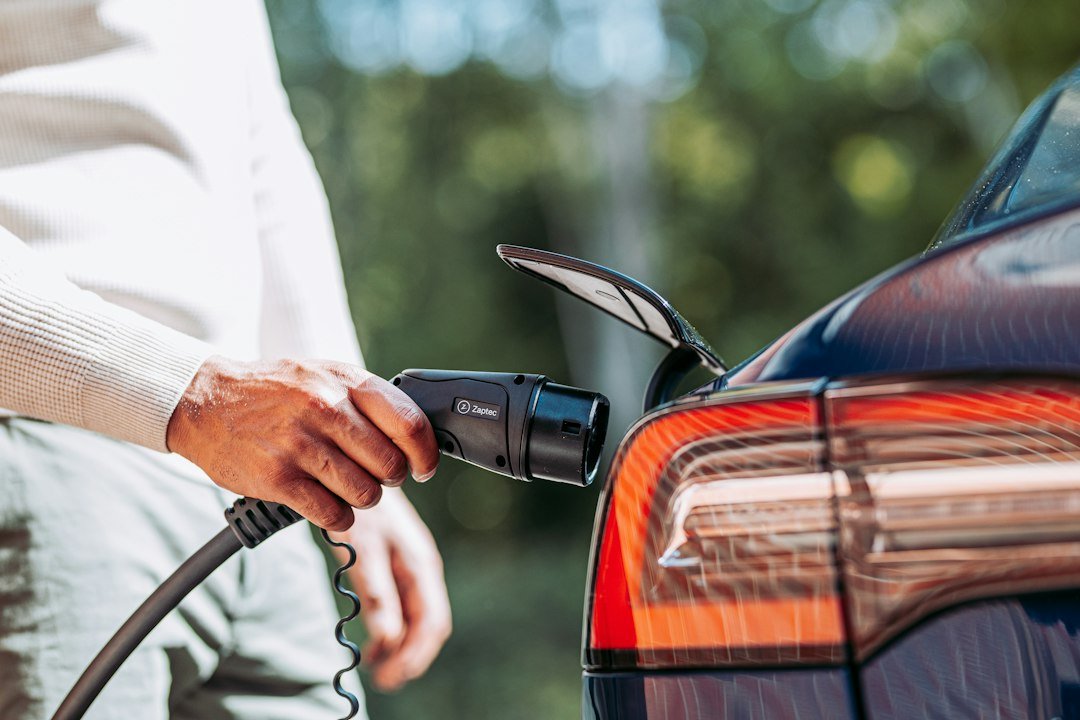
Yes, solar panels can charge a Tesla. A properly designed home solar photovoltaic system produces electricity that can be used by your house, including an electric vehicle charger. The panels do not usually connect directly to the car. Instead, an inverter and the home’s electrical system deliver suitable alternating-current (AC) electricity to compatible charging equipment. When solar generation is insufficient, a grid-connected home can use utility electricity to make up the difference.
You do not have to buy Tesla-branded solar panels to charge a Tesla. You also do not need a home battery simply to use daytime solar production. However, Tesla offers additional energy-management features that may help owners direct excess solar electricity toward their cars. These options have specific hardware and software requirements and should not be confused with ordinary solar-powered home charging.
This 2026 guide explains how the process works, how many panels you may need, what a solar-powered charging session might look like, whether a Powerwall is necessary, and which questions to ask an installer before spending money.
How do solar panels charge a Tesla?
A rooftop solar array converts sunlight into direct-current electricity. A compatible solar inverter converts that electricity into AC power that can serve household circuits. An electric vehicle charger, such as a professionally installed home charging unit or a supported mobile charging arrangement, delivers electricity to the Tesla through the vehicle’s charging connection. The car’s onboard charging system manages battery charging.
At any instant, the home may be using electricity for refrigeration, lighting, cooling, computers and the vehicle. Solar production contributes to the home’s total demand. If demand is higher than solar output, a grid-connected home normally imports the balance from the utility. If output exceeds demand, excess electricity may be exported, stored in a compatible battery or managed in another permitted way depending on the system.
Tesla’s official explanation of home solar says its solar system can supply household electrical loads, including EV chargers. Tesla also gives an illustrative range of approximately three to four miles of driving per kilowatt-hour for its vehicles under normal conditions, although actual efficiency varies by vehicle, temperature, speed, tires and driving style.
Can you charge a Tesla directly from one solar panel?
A standard rooftop panel is not a safe plug-in replacement for a vehicle charger. A bare solar panel provides variable DC electricity and cannot be connected straight to a Tesla’s normal charging port. Vehicle charging requires equipment that meets the car’s electrical and communication requirements. A single panel also produces only a fraction of the power that a typical home EV charging session may use.
For example, a panel rated at 450 watts produces up to 0.45 kilowatts under its specified test conditions. Its real-world output changes with sunlight and temperature. A home charging circuit may draw several kilowatts, so a single panel is generally insufficient to sustain normal home charging by itself. Even with a larger array, the proper inverter, protective devices, approved wiring and charging equipment are essential.
Avoid DIY adapters that claim to connect panel leads directly to a vehicle inlet or household receptacle. Solar and EV charging equipment should be installed and commissioned by qualified professionals according to the applicable codes and manufacturer instructions.
How many solar panels does it take to charge a Tesla?
There is no single panel count that works for every Tesla owner. It depends on how far you drive, the car’s actual energy consumption, your panel wattage, the local solar resource, shading, orientation and losses in the charging process.
A practical first step is to estimate the energy the vehicle uses each day. Suppose a driver travels 40 miles daily and the car averages 3.5 miles per kilowatt-hour. The vehicle would use approximately 11.4 kWh from its battery for that travel. Allowing for charging losses, the electricity required at the charger could be somewhat higher. The exact amount depends on the vehicle and charging conditions.
Next, estimate the array’s annual electricity production at the specific address. The number of rated watts on the roof is not the same as the number of kilowatt-hours produced in a day. A professional solar model should incorporate weather, tilt, shade, inverter performance and other losses. Compare the resulting production with both household electricity demand and vehicle charging demand.
Illustrative panel-count calculation
Consider a simplified example in which a 450-watt panel produces an average of 1.5 kWh of usable AC electricity per day over the relevant period. That is a hypothetical production assumption, not a universal rating. If the driver’s charging need is 12 kWh per day, dividing 12 by 1.5 suggests the energy equivalent of eight such panels. That does not mean eight panels will charge the car continuously whenever it is plugged in; solar production is concentrated in daylight hours and household loads compete for the same electricity.
If each panel instead averages 1.0 kWh per day in a less favorable installation, the energy-equivalent count rises to twelve. If a more productive location yields 1.8 kWh per panel per day, the same simplified calculation suggests roughly seven panels. These examples show why a blanket claim such as “four panels will charge any Tesla” is unreliable.
For a more complete residential sizing discussion, see How Many Solar Panels Do You Need to Power a House?.
Can a Tesla charge from solar power during the day?
Yes. Daytime charging can use electricity generated by the roof array while it is operating. A conventional grid-connected installation does not necessarily distinguish individual electrons from solar and utility sources. Instead, the home’s instantaneous balance determines how much power comes from solar and how much is imported from the grid.
Suppose the array is generating 5 kW, other household loads are consuming 1 kW, and the vehicle charger is drawing 3 kW. Ignoring minor losses, the home’s 4 kW total demand can be covered by the 5 kW of solar output, leaving about 1 kW of surplus. If a cloud reduces solar output to 2 kW, the home may import approximately 2 kW from the grid while the car continues charging at the same rate.
That is why a charging session described as “solar-powered” may still involve some utility electricity unless the system is configured to follow available solar production. Ask your installer or energy-management provider how solar self-consumption is measured and controlled.
Does Tesla’s Charge on Solar feature work?
Tesla provides a feature called Charge on Solar that can prioritize excess solar energy for charging compatible vehicles. The company’s support documentation says the vehicle can adjust charging to match surplus solar production and household demand. It also explains that charging may wait until at least about 1.2 kW of stable surplus power is available, depending on the system.
The traditional vehicle-specific Charge on Solar experience requires a supported Tesla vehicle, Powerwall with solar at the property, compatible software versions and the Tesla app. Tesla’s published requirements include specified vehicle, Powerwall and app firmware minimums. Owners should check the current support page rather than relying on an old screenshot of the app.
Tesla also describes a newer Smart Charging experience for a paired Wall Connector and Powerwall. Its documentation says the Smart Charging Charge on Solar mode can work with Tesla vehicles and other supported EVs, and that the system considers a charging target and departure time. That is a different configuration from the older vehicle-specific feature, so do not assume every solar installation or charger supports the same controls.
In either case, available sunlight, house demand, hardware configuration and charging thresholds determine what actually happens. A marketing phrase such as “charge on sunshine” does not guarantee that all electricity used during a session came from the panels.
Do you need a Tesla Powerwall to charge a Tesla with solar panels?
No, not for ordinary solar-assisted home charging. A grid-connected rooftop solar system can supply a home EV charger without any battery. The grid covers the shortfall when solar generation is lower than the household and vehicle demand.
However, Tesla’s specific Powerwall-integrated charging features may require a Powerwall and compatible equipment. A Powerwall can also store some daytime solar electricity for later use, subject to capacity and system settings. The decision to buy storage should be based on the value of nighttime energy use, outage resilience, electricity tariffs and the full installed cost, rather than the mistaken belief that solar panels cannot charge a car without one.
For more on this distinction, see Do Solar Panels Need Batteries?.
Can solar panels charge a Tesla at night?
Solar panels themselves do not produce useful electricity after dark. If your Tesla is plugged in overnight, a home without storage will normally charge it using utility electricity. If you have a properly designed battery system that stored solar energy earlier, some of that stored electricity may be available for overnight vehicle charging.
There are important limits. Home batteries have finite usable energy and power output. Charging a large EV battery can quickly use stored energy that might otherwise power household essentials. Battery charging and discharging also involve losses. Compare the cost of storing daytime solar electricity with your utility’s overnight rates and any credits you would receive for exporting surplus solar during the day.
Some households find it economical to export solar electricity in the daytime and charge the vehicle during low-cost off-peak hours. Others benefit from storing and using their own solar generation. The answer depends on the local rate structure; it is not determined by the Tesla badge on the car.
How long does it take to charge a Tesla with solar panels?
Charging time depends on the amount of energy the car needs and the power actually delivered by the charger. As a simplified example, adding 20 kWh to the vehicle battery at an average delivered rate of 4 kW would take about five hours before considering any additional charging losses or power changes. At an average of 2 kW, the same 20 kWh would take about ten hours.
Those are charging-power examples, not solar forecasts. A rooftop array might produce more than 4 kW near midday but far less in the morning, evening or cloudy conditions. A charger following surplus solar may slow down or pause, extending the elapsed time. Vehicle charge limits, battery temperature and the car’s charging controls can also affect the session.
To plan reliably, estimate both the car’s daily energy requirement and the likely hours when it is parked at home in sunlight. A commuter who leaves before sunrise and returns after sunset may have plenty of rooftop solar generation but little opportunity for direct daytime charging without a battery or a different charging schedule.
Can a small solar system cover daily Tesla driving?
Potentially, especially for a driver with modest daily mileage and a favorable roof. Imagine someone who drives 25 miles per day and averages 3.5 miles per kWh. The car uses about 7.1 kWh for that trip, before charging losses. A modest solar array might produce that amount on some days, but it may produce less during winter, storms or periods of shade.
A household also needs electricity for other appliances, so it is misleading to allocate every kilowatt-hour generated by the roof to the vehicle. A sensible system proposal should show annual generation, existing home demand, expected EV demand, and how much charging will occur during solar-producing hours. Future changes such as a second electric vehicle or a heat pump may also affect the preferred array size.
Can solar panels charge a Tesla during a power outage?
Not automatically. Standard grid-tied solar equipment generally shuts down during a utility outage to avoid energizing lines that should be de-energized. Having sunlight on the roof does not by itself mean the home’s charger will remain operational.
Tesla documents vehicle charging during an outage for compatible Powerwall systems. Its controls can slow or stop vehicle charging to preserve power for household loads, and excess solar may be directed toward the vehicle when conditions permit. Whether this feature works at a specific property depends on the approved equipment, backup wiring, battery state and system configuration.
A large EV charging load can shorten backup duration considerably. If outage resilience is important, ask the installer to identify which circuits are backed up, whether the EV charger is among them, and what happens when battery charge reaches the configured reserve. Do not bypass transfer or isolation equipment to force a charger to operate during a blackout.
How much does it cost to charge a Tesla with solar?
The electricity produced by panels has no per-kWh fuel cost, but the solar installation has an upfront cost and may involve financing, maintenance and equipment replacement. It is therefore inaccurate to describe solar vehicle charging as completely free. The financial benefit depends on the full installed solar price, energy yield, the utility rate you avoid, export compensation and any storage costs.
For a simple illustration, suppose a Tesla needs 12 kWh from the wall for a day’s travel and grid electricity costs $0.20 per kWh. Buying that energy would cost about $2.40. If solar generation offsets all 12 kWh of purchased electricity, the avoided retail charge could be approximately $2.40, subject to tariff details and the opportunity cost of exporting the solar energy instead. This does not establish the solar system’s lifetime return on investment.
Where export credits are lower than retail electricity prices, charging during sunny hours may increase the value of self-consumed solar energy. Where off-peak grid prices are very low, overnight charging may be financially attractive. Compare real utility bills and proposed solar production, not generic online savings claims.
Do you need Tesla-branded solar panels or a Tesla Wall Connector?
No. A Tesla vehicle can be charged from a home electrical supply that receives power from a compatible solar installation, regardless of whether the panels are Tesla-branded. Appropriate EV charging equipment, installation and vehicle compatibility remain essential. A Tesla Wall Connector may offer useful features, but it is not the only way to charge a Tesla at home.
Specific Tesla energy-management features may require Tesla equipment, including Powerwall and a paired Wall Connector, or the vehicle-specific Charge on Solar setup. Check which feature you actually want before choosing equipment. Buying a Tesla car does not automatically make an unrelated solar inverter, battery and charger communicate with the Tesla app.
How should homeowners plan solar charging for a Tesla?
Start with your actual driving and charging habits. Review the vehicle’s energy use over several weeks rather than relying on a single idealized efficiency figure. Estimate the average miles driven daily, the days the vehicle is parked at home in daylight, and how often you need a fast overnight recharge.
Next, ask a qualified solar installer to model annual roof production with realistic shade, orientation, weather and equipment losses. Have a licensed electrician evaluate the home’s service capacity, charging circuit and any electrical upgrades. Ask the utility about interconnection requirements and the compensation for electricity exported to the grid.
If you are considering Powerwall or another home battery, request two proposals: solar with conventional grid-connected EV charging, and solar with storage and any desired automated charging controls. Compare installed cost, expected bill savings, backup functionality, warranties and whether the system can expand later. A lower-cost solar-only arrangement may be entirely adequate for daytime charging.
Finally, check that the installer explains how the system behaves during cloudy weather, at night and during outages. Those three situations often reveal more about the usefulness of a proposal than its headline panel wattage.
Frequently asked questions
Can four solar panels charge a Tesla?
Four panels can contribute electricity toward Tesla charging, but whether they cover a day’s driving depends on panel wattage, sunlight, household use and driving demand. Four 450-watt panels total 1.8 kW of rated DC capacity; they will not produce that power continuously throughout the day. Use a site-specific annual production estimate before assuming they can fully cover vehicle charging.
Can I charge a Tesla with portable solar panels?
A portable solar setup may contribute energy through an appropriately designed and compatible power system, but ordinary portable panels do not connect directly to a Tesla’s charging port. Portable power stations also have output and energy limits that can make vehicle charging slow or impractical. Never improvise electrical connections.
Will charging my Tesla use all the solar power from my roof?
Not necessarily. Solar electricity supplies household demand as a whole. The car may use some or much of the available production, depending on charging power and other loads. With supported controls, vehicle charging may be adjusted to follow surplus generation.
Is a Powerwall required for Tesla Charge on Solar?
Tesla’s vehicle-specific Charge on Solar feature requires a compatible Powerwall with solar, along with supported vehicle and app software. Ordinary home charging with solar electricity does not require Powerwall. Tesla’s newer Smart Charging options have their own hardware and configuration requirements.
Can solar panels charge a Tesla Model 3 or Model Y?
Yes. A properly designed solar-powered home electrical system can support charging of these and other compatible electric vehicles. The solar array does not need to match a particular Tesla model, although vehicle energy consumption and charging capability affect the required system size.
Can I charge a Tesla with solar power on cloudy days?
Yes, if the solar installation is producing electricity and the charging arrangement can use it. Output will often be lower than on a clear day, and a grid-connected home may import additional electricity to keep charging. Excess-solar-only charging modes may slow or pause when production falls below their operating thresholds.
Does solar charging damage a Tesla battery?
Electricity from a properly installed, compatible home charging system is managed through the vehicle’s normal charging electronics. Solar generation is not a special battery-damaging type of electricity. Follow Tesla’s vehicle charging instructions and avoid unauthorized electrical modifications.
Final verdict: can solar panels charge a Tesla?
Yes. Home solar panels can provide electricity used to charge a Tesla, and a battery is not required for ordinary grid-connected daytime charging. The amount of driving powered by solar depends on the array’s production, the car’s efficiency, charging losses and whether the vehicle is at home while the sun is shining. Tesla’s optional Powerwall-integrated features can help prioritize excess solar electricity, but they have specific compatibility requirements.
The best approach is to size the solar array for the household’s combined energy needs, confirm safe EV charging installation, and compare the cost of direct daytime charging with grid charging and optional storage. A realistic design and utility-rate analysis are more useful than a universal claim about how many panels every Tesla needs.
Featured image: Tesla electric vehicle with a home EV charger. Photo by Zaptec on Unsplash. This is an illustrative stock photo; it does not document solar generation at the pictured property.
Primary sources and further reading
- Tesla: How Solar Panels Work
- Tesla: Charge on Solar
- Tesla: Smart Charging for Powerwall and Wall Connector
- Tesla: Vehicle Charging During Power Outage
- Tesla: Combining Systems with Powerwall
- Tesla: Should You Get Solar If You Drive an EV?