

Are you looking to optimize your code and improve performance? Understanding when to use generator functions can be a game changer for your programming projects.
These powerful tools can help you manage memory more efficiently and simplify complex tasks. But knowing when to implement them can be tricky. You’ll discover the key scenarios where generator functions shine, and how they can transform the way you handle data.
Get ready to enhance your coding skills and streamline your processes—let’s dive in!
Generator Functions In Programming
Generator functions are a powerful feature in programming that allow you to work with iterators more efficiently. They enable you to create sequences of values on the fly without needing to store them in memory. This can be particularly useful when dealing with large data sets or streams of information.
What Are Generator Functions?
Generator functions are defined using the functionsyntax in languages like JavaScript and Python. Instead of returning a single value, they yield multiple values over time. This means you can pause and resume execution, making it easier to manage large data flows.
Think of a generator function like a recipe that lets you serve one dish at a time instead of cooking everything at once. This method saves you time and resources.
When To Use Generator Functions
Using generator functions is ideal when you need to handle large data sets or streams. If you’re processing files line by line or fetching data from an API, generators can help manage memory use effectively.
- Lazy Evaluation:Only generate values as needed.
- Memory Efficiency:Handle large collections without loading everything into memory.
- Asynchronous Programming:Work seamlessly with async operations.
Have you ever faced performance issues while iterating over a huge list? Generators can significantly reduce the time and memory required to process that list.
Practical Applications Of Generator Functions
Consider a scenario where you’re reading a massive log file. Instead of loading the entire file into memory, you can use a generator to read it line by line. This approach not only speeds up processing but also minimizes memory usage.
Another example is creating an infinite sequence, such as Fibonacci numbers. A generator can yield each number on request without needing to calculate all values up front. This flexibility can enhance your coding efficiency and performance.
Have you tried implementing a generator function in your projects? If not, consider testing it in a small task to see the benefits firsthand.
Generator functions streamline the way you handle data, making your code cleaner and more efficient. They’re a crucial tool in your programming toolkit, enabling you to tackle complex problems with ease.
How Generators Work
Understanding how generators work can transform the way you manage data in your applications. These special functions allow you to pause execution and yield control back to the caller, making them extremely efficient for handling large datasets or streams of information. Let’s dive into the mechanics of generators and see how they differ from traditional functions.
Yield Vs Return
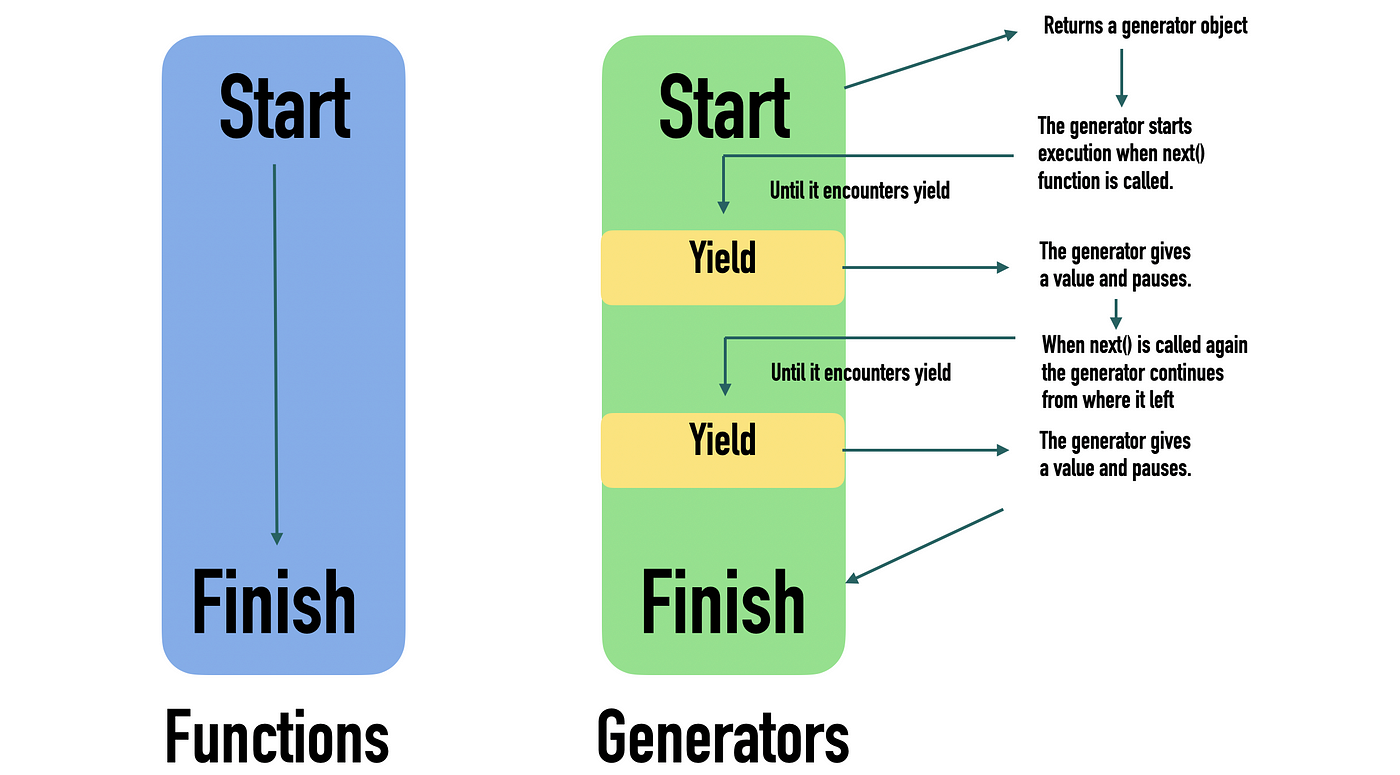
At first glance, ‘yield’ and ‘return’ may seem interchangeable, but they serve very different purposes. A return statement sends a value back to the caller and ends the function’s execution. In contrast, when you use ‘yield’, the function’s state is preserved, allowing it to resume where it left off.
Imagine you’re processing a large list of user data. With a traditional function, you’d load all the data into memory, which could be inefficient. By using a generator with ‘yield’, you can process each user one at a time, which saves memory and improves performance.
State Preservation
One of the most compelling features of generators is their ability to preserve state. This means that the function remembers its last execution point, making it perfect for tasks that require multiple passes over data. You can think of it as having a bookmark in a book; you can return to where you left off without starting over.
This state preservation can be incredibly useful in scenarios like reading files line by line or streaming data. You can implement a generator to read a large file without loading the entire content into memory. This way, you only handle one line at a time, which makes your application more efficient and responsive.
Have you ever faced performance issues when handling large datasets? Generators might just be the solution you need.
Benefits Of Using Generators
Generators offer many advantages. They are efficient and effective. Using generators can improve your code. Here are some key benefits.
Memory Optimization
Generators use less memory than lists. They produce values one at a time. This means your program uses less RAM. You can handle large data sets easily. No need to load everything at once.
Lazy Evaluation
Generators evaluate values only when needed. This saves time and resources. You get results faster. This is especially helpful in loops. Only generate what you require.
Enhanced Iteration
Generators simplify iteration over items. They allow for cleaner and clearer code. You can easily loop through data. This makes your code more readable. Use generators to improve your coding style.
Credit: betterprogramming.pub
Ideal Scenarios For Generators
Generators are useful in many situations. They help manage memory and improve performance. Knowing when to use them can make coding easier. Here are some ideal scenarios for using generator functions.
Handling Large Data Sets
Generators are great for large data sets. They allow you to process data one piece at a time. This reduces memory usage. You do not need to load the entire data set into memory. Instead, you can iterate through data efficiently.
For example, reading a huge file line by line is easier with a generator. You can handle each line as needed. This method keeps your application fast and responsive.
Streaming Data Processing
Streaming data requires timely processing. Generators excel in this area. They can yield results as data comes in. This way, you do not wait for all data to arrive.
Consider a live feed of sensor data. Using a generator, you can process each data point instantly. This helps maintain real-time performance in your application.
Infinite Sequence Generation
Generators can create infinite sequences. This is useful for tasks that require ongoing data. For example, you might need an endless supply of random numbers.
With a generator, you can yield numbers one at a time. You only generate more numbers when needed. This saves resources and keeps your code simple.
Common Pitfalls To Avoid
Generator functions are powerful tools in programming, but they come with their own set of challenges. Understanding the common pitfalls can save you time and frustration. Here are some key areas to watch out for when using generator functions.
Misuse Of Yield
Yield is the backbone of generator functions, but misusing it can lead to unexpected behaviors. Using yield in the wrong context can cause your function to return undefined values or break the flow of execution.
For instance, if you place yield inside a conditional statement that never runs, your generator won’t yield anything. This can lead to confusion when you expect output but get none. Always ensure that your yield statements are in the right places.
Debugging Challenges
Debugging generator functions can be tricky. Standard debugging techniques often fall short because the state of the function is paused between yields.
This can make it hard to track variable values or identify where things went wrong. Using tools like breakpoints can help, but they require a solid understanding of how generators work. Have you ever found yourself puzzled over the state of a paused generator? You’re not alone.
Compatibility Concerns
Not all environments support generator functions equally. Older browsers or outdated JavaScript versions may not recognize them, leading to compatibility issues.
Before implementing generator functions, check the environments where your code will run. Using polyfills can help, but they might add unnecessary complexity. Are you prepared to tackle these challenges to ensure your code runs smoothly everywhere?

Credit: www.youtube.com
Best Practices For Generators
Generators are powerful tools in programming. They help manage memory and simplify code. Following best practices ensures you use them effectively.
Keep Generators Simple
Simplicity is key. A generator should do one thing well. Avoid adding too many features. This keeps your code clean and easy to read.
Limit the complexity of your logic inside the generator. This makes it easier to debug. Simple generators are also easier to maintain.
Use With Iterables
Generators work best with iterables. They produce items one at a time. This saves memory, especially with large datasets.
Utilize generators when you need to iterate over a sequence. They are perfect for loops and collections. Use them to handle data streams efficiently.
Combine With Other Tools
Generators can work well with other programming tools. Pair them with functions like map or filter. This enhances their power and flexibility.
Using generators with async functions can improve performance. They help manage tasks that require waiting. This leads to smoother applications.
Generators Vs Other Techniques
Generators are a powerful tool in programming. They help manage memory better than other methods. Understanding their strengths can improve your code. This section compares generators with lists and coroutines.
Comparison With Lists
Lists store all data in memory. This can be a problem with large data sets. They can slow down your program. Generators, on the other hand, yield one item at a time. They do not load everything into memory. This makes them faster and more efficient.
With lists, you access all items at once. This can waste memory. Generators allow you to process items as needed. They reduce memory usage significantly. Use generators when you work with large sequences. They keep your program running smoothly.
Comparison With Coroutines
Coroutines are similar to generators. Both allow you to pause and resume functions. However, they serve different purposes. Coroutines are better for managing tasks. They handle multiple operations at once.
Generators focus on producing values. They yield items one by one. Coroutines can manage complex workflows. Use generators for simple data streams. Use coroutines for task management and concurrency.
Real-world Examples
Understanding when to use generator functions can significantly enhance your programming efficiency. Here are some real-world scenarios where they shine. Each example highlights how you can leverage generators for specific tasks.
Data Processing Pipelines
Data processing often involves handling large volumes of information. Generators allow you to process this data in chunks, reducing memory usage. Instead of loading everything into memory, you can yield one piece at a time.
Imagine you’re working with a dataset containing millions of records. You might need to filter, transform, and aggregate this data. A generator can read a file line-by-line, applying transformations on-the-fly. This approach keeps your application responsive and efficient.
- Yield data as it becomes available.
- Reduce memory consumption significantly.
- Process data incrementally, allowing for real-time analytics.
Web Scraping
Web scraping can be resource-intensive, especially when gathering data from multiple pages. Using generators helps manage this complexity. You can create a generator that fetches and parses web pages one at a time.
Consider a scenario where you need to scrape product information from an e-commerce site. Instead of storing all the data in memory, a generator can yield each product’s details as you go. This method can handle unexpected changes in web structure gracefully.
- Start with a generator that makes an HTTP request.
- Parse the response and yield the required data.
- Continue to the next page without storing all data at once.
Game Development
In game development, managing state and resources efficiently is crucial. Generators can help manage game loops and events without overwhelming the system. They enable a clean, organized way to handle multiple game states.
Picture a scenario where you have different game levels, each with unique challenges. You can use a generator to yield the current state of the game, allowing for smooth transitions between levels. This keeps your codebase manageable and responsive to player actions.
- Maintain game state with less overhead.
- Yield events and outcomes dynamically.
- Improve performance by only processing what’s necessary.
Have you considered how generator functions could simplify your projects? Whether you’re processing data, scraping websites, or developing games, they can enhance your workflow. It’s time to think about how you can apply these concepts to your projects!

Credit: dev.to
Frequently Asked Questions
When Should I Use A Generator Function?
Generator functions are ideal when you need to manage large datasets or streams of data. They allow you to iterate through data without loading everything into memory at once. Use them when performance is crucial and you want to save memory, especially in applications like web scraping or data processing.
What Are The Benefits Of Using Generator Functions?
The primary benefits of generator functions include improved memory efficiency and lazy evaluation. They yield values one at a time, reducing the need for large data structures. This is especially useful in scenarios where only a portion of the data is needed at any time, enhancing overall performance.
How Do Generator Functions Differ From Regular Functions?
Generator functions differ from regular functions in that they use the yield keyword instead of return. When called, they return a generator object that can be iterated over. This allows them to pause and resume execution, making them suitable for producing a series of values over time.
Can Generator Functions Handle Infinite Sequences?
Yes, generator functions can handle infinite sequences effectively. They can generate values on-the-fly without consuming memory for all possible outputs. This makes them perfect for scenarios like data streaming or real-time data processing, where you may not know the total number of iterations in advance.
Conclusion
Generator functions are useful tools in programming. They help manage large data sets easily. Use them when you need to save memory. They also improve performance in your code. When tasks involve iterations, generator functions shine. They allow you to pause and resume easily.
This makes your code cleaner and more efficient. Understanding when to use them is key. Embrace their power to write better, simpler code. Explore more about generator functions and enhance your programming skills.