
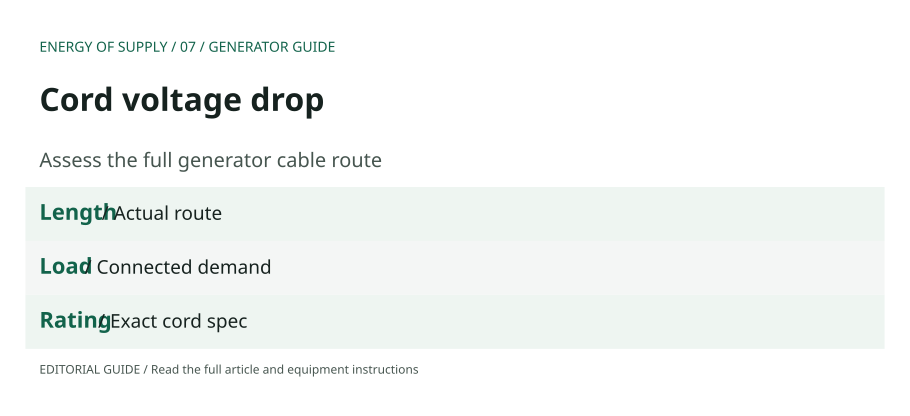
Plan a generator cable run using its length, load, voltage, and conductor information. Southwire’s voltage-drop calculator asks for cable-run length and other circuit details to help with conductor selection. A cord’s current rating and a voltage-drop assessment answer different questions. Source: Southwire voltage-drop calculator.
Start with a safe operating location
Do not shorten the cable route by placing a fuel-burning portable generator inside or too close to a building. Establish the outdoor operating plan first, then obtain a cord suitable for that route. Use the generator manual and public-health placement guidance while planning; cord convenience should not determine where the exhaust-producing equipment operates.
Gather the right inputs
- Generator outlet voltage and connector identification.
- Appliance or inlet connector identification.
- Total connected load and any relevant starting requirements.
- Actual cable route length, including bends around obstacles.
- Cord conductor size, material, and marked rating.
- Manufacturer restrictions on the intended application.
Ask a qualified electrician or the cord manufacturer to review uncertain details. Do not enter guessed values into a calculator and treat the result as an approval of your equipment.
Check rating and condition
CPSC advises using a heavy-duty outdoor-rated extension cord rated at least equal to the combined connected appliance load. Its generator guidance also warns against supplying house wiring through a wall outlet. See CPSC portable-generator guidance.
Document the planned route
Sketch the route from the generator to the appliance or professionally installed connection point. Note the distance, connector types, and expected loads on the same sheet. Keep this alongside the cord specification. If you change the route or add equipment, ask for the assessment to be reviewed instead of assuming the original plan still applies.
Avoid an unsupported universal answer
There is no single cord gauge recommendation for every generator and every run in this article. A label such as “heavy duty” is not a substitute for the cord’s actual electrical rating. Likewise, a calculator result does not inspect plug condition, establish connector compatibility, or replace equipment instructions.
Before ordering
Send the supplier your outlet identification, route length, and load information. Ask them to identify the exact suitable product and explain any limits. Record their answer and the product number, then check the delivered cord against that specification. For a household inlet connection, have the electrician include the cord requirements in the installation proposal.
2 thoughts on “Generator Extension Cord Voltage Drop: Planning the Cable Run”