
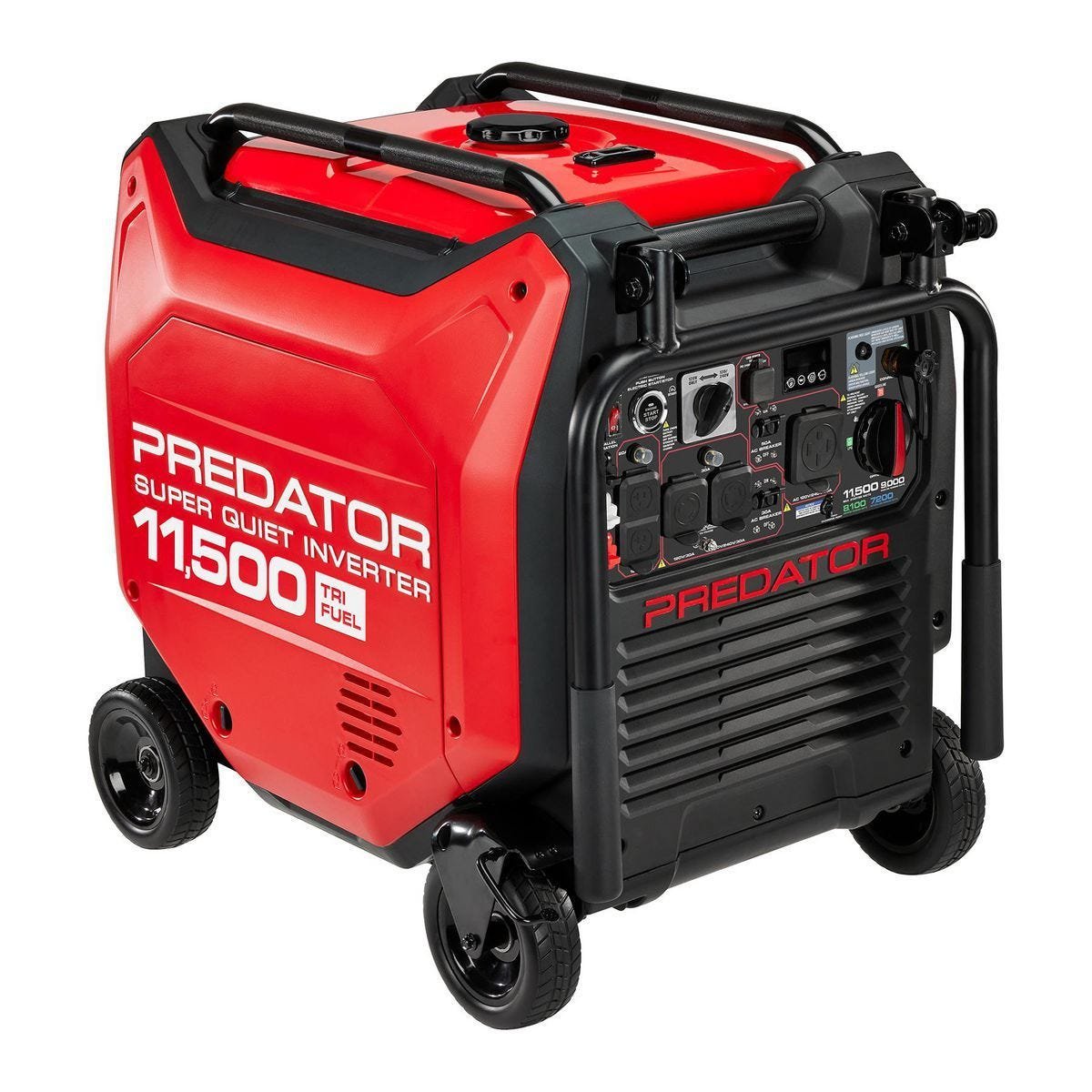
For the Predator 11500 tri-fuel inverter generator, SKU 72614, Harbor Freight lists different continuous ratings for gasoline, propane, and natural gas. Match your load plan to the fuel you will actually use instead of treating the largest number in the name as continuous output.
Featured image: Harbor Freight.
Use the fuel-specific continuous rating
The official Harbor Freight listing for Predator 11500 item 72614 specifies 9,000 running watts on gasoline, 8,100 on propane, and 7,200 on natural gas. These are the continuous-output figures to keep with the selected fuel configuration. The headline 11,500 describes starting output and should not be substituted for any of those running ratings. Save the item number and the current manual with the worksheet so an older or different model’s information is not mixed into the comparison.
Fuel flexibility therefore does not mean an unchanged load allowance. A household can plan for one mode or prepare separate operating plans for several supported modes. If the goal is to switch fuels when supply conditions change, the permitted appliance combination needs to remain suitable on the replacement mode. Do not wait until an outage to discover that the planned continuous load fits the gasoline rating but exceeds the natural-gas rating.
Quantify the difference without overstating it
The propane continuous rating is 900 watts below gasoline, a difference of 10 percent relative to 9,000 watts. Natural gas is 1,800 watts below gasoline, or 20 percent. Those calculations describe the published continuous ratings; they do not establish fuel consumption, cost, or a particular appliance’s compatibility. A lower running figure can matter even when a short starting event appears within the generator’s headline capability.
Make separate rows for gasoline, propane, and natural gas with the intended appliances and their combined running demand. Keep startup and individual-connection checks in additional columns. This makes a fuel switch reviewable. A single list headed generator capacity hides which rating was used and makes it easy to retain an unsuitable load when the fuel configuration changes.
A hypothetical load-plan comparison
Suppose, only for planning illustration, that a household’s intended simultaneous loads total 7,600 watts. That total is below the stated gasoline and propane continuous figures but above the stated natural-gas figure. This arithmetic does not approve the load on either of the first two modes because startup, voltage, receptacles, equipment requirements, and applicable operating conditions still need review. It does show that the same total cannot be carried into the third continuous-output comparison unchanged.
Now suppose the household can safely omit an optional 800-watt load, reducing the hypothetical steady total to 6,800 watts. That revised total is below each published running rating, but the other compatibility checks remain. The example demonstrates the usefulness of identifying optional loads before an outage. It is not a recommendation to operate close to a limit or a claim that every appliance totaling 6,800 watts will behave the same way.
Account for automatic motor starts
A refrigerator, pump, or other motor load can start while other equipment is already operating. Record the ordinary demand and relevant starting requirement separately. Use the actual appliance information where available; a generic chart is not a verified specification for an unknown pump or refrigerator. Assess the combined temporary case against the generator’s applicable short-term capability and conditions, rather than adding the continuous figures alone.
For an invented example, 4,000 watts of other operating loads plus a particular motor’s 2,500-watt starting requirement creates a 6,500-watt temporary case. After startup, the total may be different. These example values are not ratings for any appliance or evidence of a completed generator test. They show how an automatic event fits into the worksheet and why the largest headline figure cannot replace a configuration-specific review.
Check individual connections as well as total output
The listing identifies a 120/240-volt generator, but the exact receptacles, their ratings, and the intended connection still need to be checked in the manual and on the equipment. Total generator output does not mean every outlet can provide that entire amount. Cord, adapter, receiving equipment, and load voltage introduce their own requirements. A physically fitting plug is not a complete compatibility assessment.
For a building connection, give the electrician item 72614’s documentation and the intended fuel modes. Ask which inlet, switching arrangement, cord, and load limits are proposed. Do not supply house wiring through a wall outlet or an improvised male-to-male cord. If you later substitute another generator, obtain a fresh review because output, protection, receptacles, or neutral configuration can differ even when product names appear similar.
Prepare the supported fuel supply
Use the manual’s approved gasoline, propane, or natural-gas arrangement for the exact unit. A supported fuel label does not approve any hose, regulator, cylinder, or building gas connection. Follow the applicable requirements and obtain qualified gas-system work where necessary. Natural-gas availability at the property is not proof that the connection can supply the generator under its required operating conditions.
Ask the installer or service provider to identify the supply arrangement and what was assessed. Keep that information with the electrical plan. For propane, consider the approved supply, quantity available, operating conditions, and access to refilling. For gasoline, prepare appropriate storage and safe refueling. Do not improvise fuel-system modifications to overcome a supply problem or assume the electrical watt rating determines the required gas connection.
Separate output from runtime and fuel cost
Running watts address electrical output. Runtime describes duration under a stated load and fuel supply. Fuel cost combines consumption, local price, and operating time. These are three different comparisons. A mode with a lower continuous output can still have a practical supply advantage for a particular household, while a convenient supply does not increase that mode’s rated electrical capacity.
Read published duration claims with all their conditions, including load percentage and supply quantity. Do not apply a low-load gasoline tank runtime to full-load propane or natural-gas operation. Use current local prices only when preparing an actual cost comparison and date those figures. Where consumption or duration for your load is unverified, label it uncertain rather than turning a product-page reference into a precise multi-day promise.
Plan the operator’s workload during an outage
Identify who can move the generator, prepare the supported supply, follow the startup instructions, monitor operation, and complete required checks. Review the actual weight, handle and wheel arrangement, storage location, and route to the outdoor operating spot. The phrase portable generator does not guarantee that every household member can deploy it safely. Make a practical plan for the usual operator being absent.
Keep engine-hour and service records during extended use. Read the maintenance schedule, required oil checks, and shutdown procedures for the exact model. Refueling or maintenance can require interruptions, so critical appliances need a plan for those periods. Do not assume a long supply duration permits indefinite unattended operation or postponement of required service. A continuous-output rating describes capacity, not a maintenance exemption.
Keep the outdoor operating plan unchanged by fuel choice
Gasoline, propane, and natural gas operation in a portable engine all require suitable outdoor placement. Follow official exhaust guidance and the generator instructions, keeping away from building openings and considering nearby occupied structures. An integrated CO shutdown system does not authorize indoor or garage operation. Prepare appropriate indoor CO alarms and a clear emergency response as separate protections.
Measure the real cord route from the safe operating location before choosing accessories. Weather arrangements must follow the instructions without creating an enclosed exhaust space or unsuitable electrical conditions. If the planned location becomes inaccessible or unsafe, change the emergency arrangement rather than moving the engine closer to a window. Fuel flexibility is useful only when the supported setup remains workable and safe.
Keep a one-page configuration record
The final record should identify item 72614, manual revision, intended fuel, applicable running rating, actual appliance list, relevant starting case, connection, approved fuel supply, outdoor location, and operating responsibilities. For multiple fuel modes, retain a separate permitted-load plan for each. Mark unresolved equipment data or duration estimates clearly so they cannot be mistaken for verified specifications.
Revisit the record when adding an appliance, changing the connection, or changing fuel supply arrangements. The published 9,000, 8,100, and 7,200 running-watt figures are useful starting facts, but the buying and operating decision comes from matching the complete configuration to your household. This avoids treating 11,500 as an unlimited continuous allowance and makes any future fuel switch easier to assess.
Fuel-specific ratings
| Fuel | Published starting watts | Published running watts |
|---|---|---|
| Gasoline | 11,500 | 9,000 |
| Propane | 11,500 | 8,100 |
| Natural gas | 11,500 | 7,200 |
These are the manufacturer listing’s figures for this SKU, not measurements from our own test. Source: official Harbor Freight product page.
How the difference affects planning
For an illustrative combination requiring 7,500 running watts, the sum is below the listed gasoline and propane running ratings but above the listed natural-gas running rating. That comparison addresses only continuous wattage; it does not establish startup capability, outlet suitability, or complete compatibility. The example load is hypothetical.
Check individual connections too
Request a review of the specific outlets and the connection equipment you intend to use. A generator-wide rating does not independently establish what your particular cord or inlet can carry. Keep the electrician’s specification with the generator manual and appliance list.
Separate runtime from output
The product highlights advertise up to 14 hours at 25% load. Do not assume that this means 14 hours at full continuous output or applies unchanged to every fuel arrangement. Ask for the exact runtime conditions and fuel setup relevant to your plan. Keep quoted runtime, load percentage, and fuel information in separate columns.
Build your fuel plan before buying
- Confirm SKU 72614 and the matching manual.
- Choose the intended approved fuel arrangement.
- Review running demand against that fuel’s rating.
- Obtain starting information for motor-driven appliances.
- Have cords, outlets, or household connection equipment checked.
- Plan fuel supply and another option for an extended outage.
Questions to resolve
Does “11500” mean continuous power?
No. The listing uses 11,500 as a starting rating; continuous ratings are shown separately above.
Can I transfer a gasoline load plan directly to natural gas?
Reassess it against the listed 7,200 running-watt figure and the manual’s requirements before relying on it.
For another Predator model’s runtime interpretation, see our Predator 2500 runtime guide.
3 thoughts on “Predator 11500 Tri-Fuel Running Watts: Gasoline, Propane and Natural Gas”