
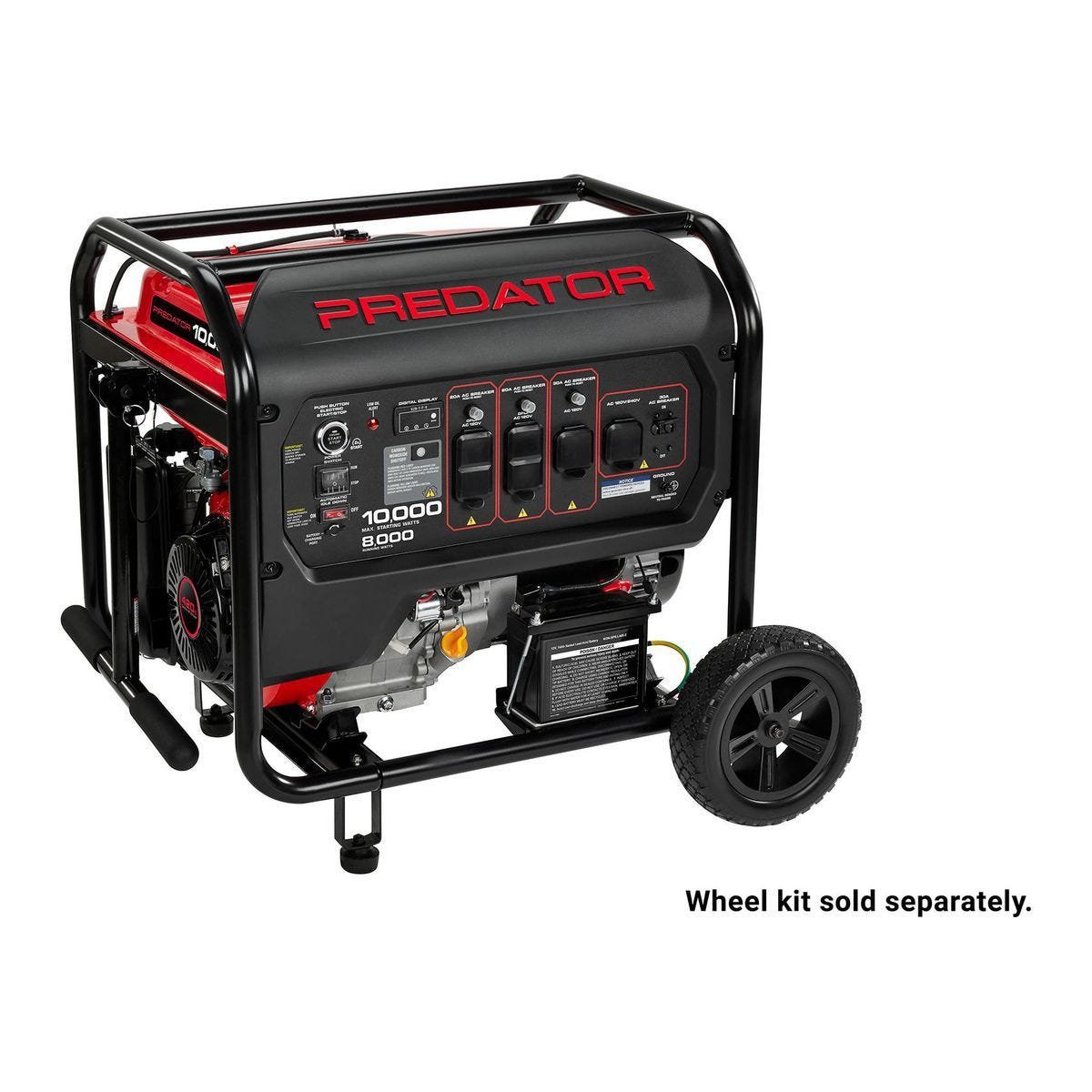
The name “Predator 5000” can refer to different products, so confirm the SKU before comparing it with a Predator 10000. This guide focuses on the gas-powered portable 5000, SKU 72613, and gas-powered portable 10000, SKU 72624. It is a documentation comparison, not a personal product test.
Featured image: Harbor Freight. Product image is illustrative; model requirements are stated in the article.
Compare exact Predator models before comparing watt numbers
The Predator 5000 and Predator 10000 names refer to headline starting-output categories, not a complete description of their continuous power or features. Begin with the Harbor Freight item number and the manual supplied for the particular machine. This article’s existing references include a 5000 manual for item 72613 and a listing for the earlier 71367 variant. Keep those identities distinct. A specification from one 5000 variant should not silently become a claim about the other.
Create a model-identification row for each candidate with item number, fuel modes, listing date, manual revision, and purchase configuration. Record which accessories are supplied and which are optional. If a retailer or reseller lists a different item number, resolve that difference before ordering. A comparison is only useful when the machine received matches the machine evaluated; a similar product photograph or the same headline watt number does not guarantee identical specifications.
Build the comparison around the equipment you need
List the intended appliances and identify their voltage, ordinary running demand, relevant starting information, and priority. Include loads that may start automatically while others remain on. A refrigerator, sump pump, or well pump can change the evaluation more than several small lights. Do not assume that doubling the advertised starting number doubles the useful household service. The actual continuous rating, short-term capability, connection arrangement, and appliance behavior determine the result.
Separate a minimum essential-load plan from optional additions. A household may choose refrigeration, a pump, and communications as priorities while leaving cooking or large heating loads off. Another household may need a different combination. Make both candidates answer the same load brief. Otherwise, a claim that the larger generator is better may simply reflect that the comparison quietly changed the intended appliances halfway through.
Use continuous and starting ratings separately
Copy the applicable continuous rating and starting rating from the exact candidate’s specifications. If the generator supports more than one fuel, make a separate row for each intended fuel mode. Do not treat the headline 5000 or 10000 as the continuous rating. Also preserve any conditions behind the manufacturer’s starting claim; a temporary capability should not be used as a sustained output allowance.
For an intentionally hypothetical sizing worksheet, suppose essential loads total 2,600 running watts, while a relevant motor start brings the temporary combined demand to 4,400 watts. Those invented figures demonstrate two checks, not a recommendation for either Predator. Each candidate must satisfy the actual operating and starting requirements under its applicable specifications. Add another appliance only after updating both cases, rather than assuming spare advertised watts always remain available.
Review voltage and receptacles before buying a cord
Check the actual receptacle arrangement on each model, not just the total output figure. Record the voltage available at the intended connection and the individual outlet or connection rating. A generator with sufficient total power can still be unsuitable for a particular appliance voltage or proposed building interface. The cord, inlet, transfer equipment, and generator must be assessed as one compatible path.
If the plan connects to house wiring, provide the electrician with the exact candidate model and manual. Ask which connection is proposed and whether changing models would require a revised assessment. Do not buy a cord solely because its plug appears to fit a photograph. Never use a wall outlet as a generator inlet or rely on a male-to-male adapter. A larger generator does not make an improvised connection acceptable.
Compare fuel flexibility with the real supply plan
Where a candidate supports multiple fuels, decide which modes you actually intend to use. Record the approved supply arrangement and the output available on each mode. Fuel flexibility can be valuable when local supply access changes, but an unprepared second fuel mode is not a ready backup plan. Consider storage, access to refills, operating conditions, and the operator’s ability to follow the manufacturer’s fuel instructions.
For gasoline operation, compare the published runtime conditions rather than tank size alone. For another supported fuel, use its own stated supply quantity and load condition. A low-load duration claim does not promise the same hours under your intended appliance mix. Keep expected duration as a separate field from electrical compatibility. Both candidates need safe shutdown, cooling, refueling, and maintenance arrangements during an extended outage.
Make portability a practical question
Find each exact model’s weight, dimensions, wheel or handle arrangement, and any optional transport accessories in its specifications. Then consider the route from storage to the suitable outdoor operating position. Steps, soft ground, narrow gates, and operator strength can matter more than the word portable in the title. Do not assume one person can move a generator safely because a product page shows wheels.
Ask who will deploy the equipment when the usual operator is away. A smaller machine that fits the verified essential loads may be easier to use in some households, while a larger machine may be necessary for a different load plan. Avoid choosing capacity before confirming that the generator can be stored, moved, and operated under the household’s actual circumstances. Portability is part of reliability when the equipment must be set up during a stressful outage.
Compare operating features under their stated conditions
Record starting controls, economy settings, monitoring features, and protective shutdown functions from the exact listings and manuals. A convenient starting feature does not remove battery readiness or maintenance requirements. A CO-related shutdown system does not authorize indoor or garage use. Keep features in the comparison, but describe what they actually do rather than using them as shorthand for safe operation in every environment.
When comparing noise claims, check how the manufacturer states the measurement, including load and distance where provided. Numbers measured under different conditions are not a clean comparison. Do not invent a field-test result or describe one candidate as quiet enough for every neighborhood based on an unqualified label. Local use conditions, placement, and the intended operating schedule still matter, and the generator must remain in a suitable outdoor location regardless of acoustic convenience.
Calculate the complete purchase cost
Use current, verified prices when actually purchasing and date the comparison. Include any needed wheel kit, suitable cords, professional connection work, permits where applicable, initial service supplies, and the intended fuel arrangement. Keep recurring fuel and maintenance expense separate from the purchase total. A promotional price can change, and a bare machine price may omit the equipment needed to make the planned setup usable.
A hypothetical comparison might show a lower machine price for one candidate but an additional accessory and connection cost. Do not conclude that the other machine is more expensive until both proposals cover the same working arrangement. Mark included, excluded, and unresolved items on each side. This makes the decision useful even when prices change because the scope remains explicit.
Which candidate should remain on your shortlist?
Keep the smaller candidate on the shortlist if its exact fuel-specific output, voltage, connections, and operating requirements satisfy the verified load plan. Keep the larger candidate when the actual requirements justify it and the household can support its deployment, supply, and maintenance needs. If neither configuration is verified, obtain the missing appliance or installation information before purchasing. There is no universal winner for every refrigerator, pump, home, or outage.
The final comparison sheet should name both item numbers and record the intended loads, continuous and starting checks, receptacles, supply plan, runtime conditions, transport needs, accessories, and total scope. Recheck it if the seller substitutes a model or if your appliance plan changes. Choose from those documented requirements rather than treating the numbers in the product names as a complete buying guide.
Start with verified model details
Harbor Freight’s manual for SKU 72613 lists 4,000 running watts and 5,000 maximum starting watts. The product listing for SKU 72624 identifies a gas-powered generator with remote start and a published 12-hour runtime at 50% load. Sources: 72613 manual and 72624 product page.
Do not confuse the 5000 variants
Harbor Freight also sells a 5000 dual-fuel inverter generator. Its product identity and fuel-specific ratings should be compared separately from SKU 72613. Check the label, product page, and manual together before using a specification found in search results. Reference: dual-fuel inverter listing.
Compare what matters to your load
| Category | What to verify for both SKUs |
|---|---|
| Output | Continuous and starting ratings in the exact manual |
| Connections | Outlet type and intended appliance or inlet |
| Starting | Operating procedure and included equipment |
| Runtime | Load percentage and test conditions |
| Handling | Weight, wheel equipment, and route to the operating spot |
| Purchase | Current price, included accessories, and applicable terms |
Identify the actual purchase decision
Write down the appliances you need to operate at once and obtain their startup information. Ask the supplier which model meets that planned combination. If an electrician has specified an inlet or cord, confirm its compatibility before choosing either unit. A larger number in the product name does not complete that assessment.
Compare accessory costs
The 72624 page states that its wheel kit is sold separately. Ask what handling accessories are included with the unit you are buying and add missing items to the comparison total. Avoid using an expired coupon as today’s price; obtain the live offer before purchasing.
Which one is better?
No universal recommendation is established here. Choose after matching the verified specifications, connection requirements, and practical handling needs to your intended use.
1 thought on “Predator 5000 vs 10000: Identify the Model Before Comparing”