
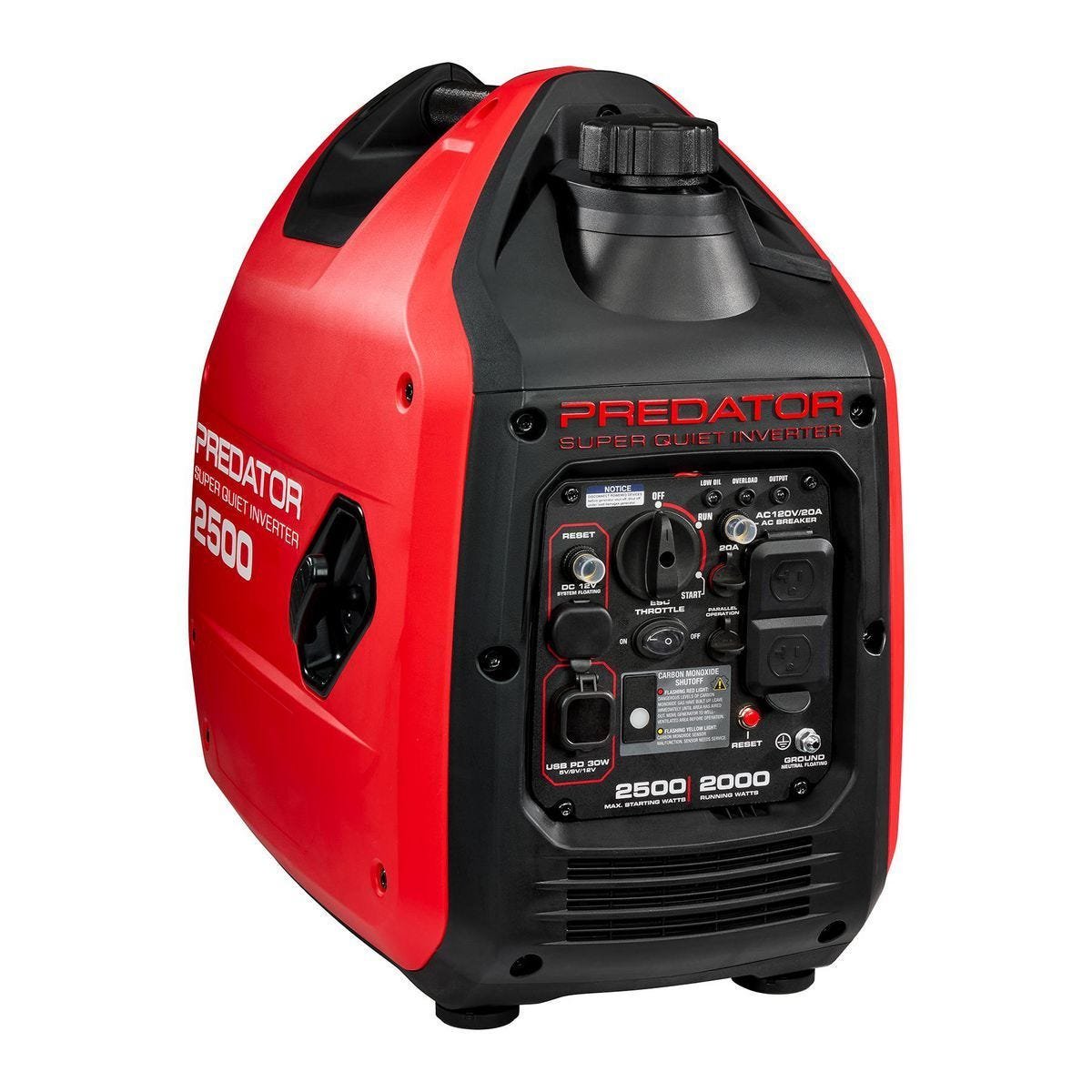
Harbor Freight lists up to 10.2 hours of runtime at 25% load for the Predator 2500 inverter generator, SKU 72010. Its product highlights specify ESC on for that claim. Treat the figure as a manufacturer statement under stated conditions, not a promise for every appliance combination. Source: official product page.
Featured image: Harbor Freight.
Read the runtime claim for the exact Predator 2500
The current Harbor Freight listing for Predator 2500 item 72010 identifies 2,500 starting watts, 2,000 running watts, and up to 10.2 hours of runtime at 25 percent load with ESC on. Keep those conditions together when comparing equipment. The starting rating describes temporary output, while the runtime statement describes operation at a particular load and setting. Neither number says that the generator can provide its maximum output for 10.2 hours. Save the model number and listing date with your comparison notes.
On the stated 2,000-watt continuous rating, 25 percent is 500 watts. That arithmetic helps explain the reference point; it does not establish how every mix of appliances will behave. A refrigerator, several lights, and small electronics may cycle or change demand through the day. A constant resistive load and a motor that repeatedly starts are different operating patterns. Use the published figure as a conditioned reference, then build a plan around the actual appliances you intend to operate.
Distinguish three questions before estimating hours
First ask whether the generator can start the connected equipment. Next ask whether it can carry the equipment while everything intended is operating. Only then ask how long the fuel supply may last under that use. A long runtime figure cannot fix an output incompatibility. Likewise, a successful brief start does not show that the generator has enough fuel, maintenance capacity, or operating arrangement for an extended outage. Write these as separate rows in your planning worksheet.
For each appliance, record the model, voltage, running demand, startup information, and whether it operates continuously or cycles. Where the information is unavailable, label it unknown instead of substituting a convenient number from an unrelated chart. The largest starting event can occur while other equipment is already running. Consider that overlap when assessing capacity. If a critical appliance has unresolved compatibility, obtain reliable information from its manufacturer or a qualified professional before depending on the generator during an emergency.
Use scenarios rather than one invented runtime promise
Create a light-use scenario, an ordinary-use scenario, and a higher-demand scenario. A light-use plan might include lighting and communications equipment. An ordinary plan might add a compatible refrigerator. A higher-demand plan might add another permitted appliance during limited periods. These descriptions are examples, not claims that any particular combination fits the Predator 2500. Add the actual equipment ratings and operating pattern to each scenario before drawing a conclusion.
Record which scenario the published 25 percent load figure resembles most closely. If your planned demand is materially different, do not scale the advertised hours by simple inverse proportion and present the result as verified performance. Engine fuel consumption is not necessarily a straight line through every output level. Instead, label the published runtime as a reference and identify your own use as unverified until you have an appropriately conducted operating record under the actual conditions.
A runtime log that produces useful information
If you already own the generator, follow its manual and use a suitable outdoor setup to record ordinary operation with compatible loads. Note the date, model, selected operating setting, intended appliances, starting time, stopping time, and interruptions. Describe the load pattern rather than writing refrigerator only: include any lights, chargers, pumps, or other devices connected. Keep fuel use and refueling records consistent, without opening or measuring a hot running fuel system.
Distinguish planned shutdowns from stops caused by fuel exhaustion, overload, maintenance needs, or a protective shutdown. If operation stopped early because an alarm or safety system activated, the event is not proof of shorter normal fuel runtime. Do not defeat a protective device to complete an experiment. Resolve the reason for the stop according to the manual or service guidance. Keep safety decisions separate from the desire to obtain a neat hours-per-tank number.
Turn the outage plan into operating blocks
An outage does not necessarily require continuous engine operation, but the appliance plan must support any interruptions. Consider when power is actually needed and what happens when it is unavailable. Refrigeration, a sump pump, medical equipment, communications, and lighting have different consequences of interruption. Do not assume that a refrigerator remains safe through any chosen schedule or that an unattended pump can wait for the next operating block. Use equipment-specific needs and relevant safety guidance to set priorities.
For planning arithmetic only, suppose a household selects three two-hour operating blocks in a day. That schedule represents six engine hours, not 24, but it does not establish six hours of fuel use under a specific load. The generator still needs safe startup, monitoring, shutdown, and refueling arrangements, and the connected equipment must tolerate the schedule. A block plan is useful when its assumptions are explicit; it becomes misleading when it is presented as a universal emergency recommendation.
Plan maintenance and refueling alongside fuel supply
Read the manual’s oil checks, initial service, and maintenance requirements before a long outage. Engine hours matter even when the electrical load is light. Keep the specified supplies and a record of completed service available. A generator may have enough fuel for a planned period while still requiring attention under its maintenance instructions. Do not treat a large fuel reserve as permission to ignore checks, run unattended contrary to the instructions, or postpone a required service interval.
Before refueling, turn the generator off and allow it to cool as directed. Plan the interruption rather than trying to maintain operation while adding gasoline. Use appropriate storage containers and follow applicable storage requirements. Record available fuel, access to additional supplies, and the time needed for safe handling. Supply disruptions can matter as much as the published tank runtime. Buying equipment that fits the load is only part of a practical plan for several outage days.
Check the connection and outdoor position
Verify the actual receptacles and their ratings on the generator before choosing cords or assuming a building connection is possible. A compact inverter generator should not be treated as interchangeable with a different generator that provides another voltage or connector arrangement. Read the item-specific manual and have any proposed connection to house wiring assessed and installed by a qualified electrician. Never use a wall outlet as a generator inlet or a male-to-male cord as a shortcut.
Runtime planning also depends on having a suitable outdoor operating spot. Keep the unit outside and away from building openings according to official guidance and the manufacturer’s instructions. The location must remain workable during the outage, including the real cord route and weather arrangements. An integrated CO shutdown feature does not make indoor or garage use acceptable. If the planned outdoor setup becomes unusable, the published runtime cannot justify moving the operating generator into an unsafe space.
What to check before relying on a seller’s comparison
Compare runtime claims only after checking model identity, fuel, load percentage, operating setting, and how the claim is qualified. The phrase up to describes a maximum claim under stated conditions, not a guarantee for your household. A different Predator model, older item number, or reseller description can carry different details. Keep a screenshot or copy of the relevant official specifications with your notes so you can identify what you actually compared.
The useful conclusion is conditional: item 72010 has a published low-load reference, and your own runtime depends on the equipment and operating pattern. Choose it only after confirming startup and continuous-output compatibility, a safe connection, outdoor placement, fuel readiness, and maintenance requirements. When reporting your own observations, state the conditions and limits rather than turning one outage experience into a promise for every refrigerator, campsite, or household.
Separate output from runtime
The same listing gives 2,500 maximum starting watts and 2,000 maximum running watts. Using the running rating, a 25% planning load is 500 watts: 2,000 multiplied by 0.25. That arithmetic helps interpret the published condition; it does not calculate your fuel consumption or establish a runtime at another load.
What to record for your use
| Item | Your planning record |
|---|---|
| Generator | SKU and manual revision |
| Appliances | Model and running demand |
| Starting needs | Manufacturer data for motor loads |
| Runtime claim | Load percentage and operating mode |
| Outage plan | Desired operating window and alternative backup |
Do not extrapolate a new guarantee
Do not assume that doubling the load simply halves the stated runtime. The product claim does not provide a full fuel-consumption curve. Ask Harbor Freight for information about the exact model if your purchase depends on a particular load and operating duration. Keep any seller response with your comparison notes.
Build the appliance plan first
List the loads you intend to operate together. Distinguish the energy needs of a long outage from the output needed when appliances start. Before relying on the generator, follow the manual for an appropriate outdoor setup and a supervised check of the planned equipment. Record what actually operates and avoid presenting a personal result as a universal specification.
Questions before buying
- Is this the same SKU as the product page?
- Does the manual match the unit being sold?
- What starting demand do my motor-driven appliances have?
- What operating mode applies to the runtime claim?
- What alternative covers a longer outage?
Short answer
The verified advertised figure is up to 10.2 hours at 25% load, with ESC on in the highlights. No runtime for your household load has been verified here. Compare the published conditions, read the manual, and assess the intended appliance combination before treating the generator as your outage solution.
1 thought on “Predator 2500 Runtime: What the 10.2-Hour Claim Means”