
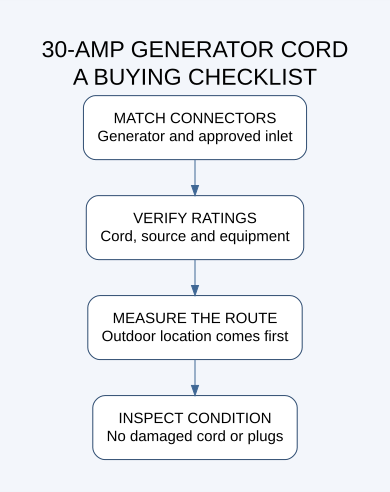
A 30-amp generator cord must match the actual generator outlet and the appliance or inlet it will supply. Record connector identification, voltage, route length, conductor details, and the intended load. The words “30 amp” do not identify every compatibility requirement.
Featured image: EnergyOfSupply editorial diagram. Editorial planning diagram; not wiring instructions.
Identify the connector rather than buying by amperes alone
The phrase 30-amp generator cord is incomplete. It describes a current category but does not specify the connector, voltage arrangement, conductor configuration, route length, or intended equipment. Read the markings on the generator receptacle and the receiving connection, then use the equipment manuals or a qualified electrician’s specification. A cord that appears sturdy is not necessarily the correct interface. Do not order from a photograph that hides the exact connector designation.
One official example is Southwire item 65038801, described as a 25-foot, 10/4 STW generator cord with 30-amp L14-30P and L14-30R ends. That description identifies a particular product, not a universal recommendation for every generator. Your generator and approved receiving equipment must match the intended configuration, and the route and load still need review. Copy all of those details into a purchase brief instead of shortening the requirement to 30 amps.
Understand why two 30-amp arrangements can differ
A 30-amp label does not mean every connector supplies the same voltage or uses the same conductor arrangement. A connector intended for one system should not be treated as interchangeable with another solely because both carry 30 in their names or markings. Check the complete designation and the actual generator specifications. Adapters may change the physical interface while leaving other compatibility questions unresolved; they do not create additional voltage or increase output.
If the receiving equipment is an inlet for house wiring, ask the electrician to specify the exact approved cord and any supported accessories. Give the electrician the generator model and manual. A different generator may require a revised assessment because receptacles, protection, or neutral configuration differ. Never use a household wall outlet as the receiving connection. A proper generator cord is part of an approved arrangement, not a way to avoid installing one.
Keep the current limit and power calculation separate
For a simple electrical relationship, apparent power equals voltage multiplied by current. At 120 volts, 30 amperes corresponds to 3,600 volt-amperes. At 240 volts, 30 amperes corresponds to 7,200 volt-amperes. These arithmetic results explain why voltage matters; they do not certify usable generator watts or permit every load combination. Real equipment ratings, power factor, generator capacity, circuit arrangement, and individual component limits still apply.
For a 120/240-volt supply, the distribution of loads can matter as well as the combined total. Do not assume a calculated 7,200 figure is freely available to one 120-volt appliance or that a cord can force the generator to deliver it. Ask the installer to explain the usable connection limit and intended loads for the actual system. Keep the cord rating, generator rating, and receiving-equipment rating as distinct fields.
Check every component in the path
The generator receptacle, cord, plugs, any approved adapter or distribution device, inlet, and receiving equipment form one path. The arrangement must respect the relevant limits of each part. A 30-amp cord cannot upgrade a lower-rated source or downstream device. A high-output generator cannot make a damaged connector acceptable. Where a component’s rating or identity is unknown, resolve it before use rather than relying on the largest visible number.
For several connected appliances, evaluate the combined operating load and relevant starting events. A pump or refrigerator may start while other equipment remains on. If the cord connects to an installed transfer arrangement, use the documented circuit and load plan. Do not mix a cord recommendation for one generator with a load plan built for another without review. A specification belongs to a defined configuration, not to an isolated accessory.
Measure the actual route from the outdoor position
Choose a suitable outdoor operating location for the portable generator under official guidance and the manufacturer’s instructions. Then measure the real cable route to the approved receiving connection. Account for walkways, obstacles, water accumulation, and places where a door or vehicle could damage the cord. A straight-line distance may understate the required length. Include enough practical routing information for a supplier or electrician to recommend the correct product.
Do not pull the generator toward a door or window to make an existing short cord reach. A longer suitable route may be necessary, but its conductor and voltage-drop requirements need review. If the available cord cannot serve the safe location, change the cord or the overall plan. Running in a garage is not a solution to a cable-length problem. The electrical accessory should support safe placement, not determine an unsafe engine location.
Review voltage drop and conductor information
Current through conductor resistance produces voltage drop along the path. Route length, conductor size and material, load, and circuit arrangement affect the evaluation. A marked current rating does not by itself establish acceptable voltage at the appliance over every length. Use reliable cord specifications, equipment requirements, and an appropriate calculation or qualified assessment. Read a calculator’s input instructions so one-way length is not accidentally treated as complete circuit length twice.
A hypothetical example can illustrate the issue without recommending a gauge: if a complete circuit resistance is 0.20 ohm and current is 20 amperes, the simplified drop is 4 volts. With other current or resistance, the result changes. These invented inputs are not values for Southwire’s cord or any particular route. They show why a buying decision needs more than the amp label and why motor-start requirements may need additional assessment.
Inspect condition before each deployment
Follow the cord manufacturer’s instructions and inspect the full length and both ends before use. Look for cuts, crushing, exposed or damaged insulation, damaged plug parts, and signs of overheating. Remove damaged equipment from service and obtain suitable replacement or professional repair guidance. Do not assume tape restores a cord to its original approved condition. A cord stored where vehicles, sharp tools, or pests can damage it needs the same inspection as one recently used.
Keep the route away from standing water and physical damage, with connections arranged according to the equipment instructions. Avoid pinching cable through a door or placing it under tires. Follow directions for laying out the cord and controlling heat rather than assuming a tightly bundled or covered arrangement is equivalent. If a connection becomes unusually hot or operation is abnormal, stop and have the cause assessed. A larger generator is not a remedy for a faulty connection.
Use a complete purchase specification
Send the supplier or electrician the generator model, marked receptacle designation, receiving-connection designation, intended voltage, measured route, load plan, and outdoor-use requirement. Ask for the exact cord model and the assumptions behind the recommendation. Confirm whether the cord is included in an installation quote. This avoids an apparently low connection price that leaves the owner to purchase an unspecified accessory later.
Keep the receipt and product information with the generator instructions. Label the intended use in the household record so the cord is not casually substituted with another cable. When the generator, inlet, or appliance plan changes, revisit the specification. A cord that fits physically after a change has not automatically been verified electrically.
What should the final check establish?
Before use, the exact connectors should be identified, the generator and receiving equipment should be compatible, the route should support a suitable outdoor position, and the cord should have the required ratings and sound condition. The load assessment should remain within the system’s applicable limits, including startup where relevant. Leave any unresolved item visible and obtain appropriate guidance before depending on the setup.
Buying by a complete specification is more reliable than choosing the thickest-looking 30-amp cord. It also makes later replacement straightforward because the household can identify what was approved and why. The right accessory is the one that serves the actual generator, connection, load, and route, not a universal product inferred from an amperage category.
Identify both ends
As a product-specific example, Southwire lists a 25-foot 10/4 STW generator cord rated 30A with L14-30P/R connectors. This example is not a recommendation for every generator. Check the exact outlet and receiving connection against the selected cord’s specifications. Source: Southwire cord listing.
Ask the installer to specify the cord
If an electrician is installing household connection equipment, request the required cord specification as part of the proposal. Ask them to identify the compatible voltage, connector configuration, current rating, and route. Do not choose an adapter solely because the plug appears to fit.
Review route length and load
Southwire’s voltage-drop calculator uses circuit information including cable length to help assess conductor selection. Have uncertain inputs reviewed rather than inventing them. Source: Southwire calculator. A longer route should be evaluated with the intended load and equipment instructions.
| Before purchase | What to verify |
|---|---|
| Generator end | Outlet identification and voltage |
| Receiving end | Appliance or inlet connector |
| Cord | Marked rating, conductor specification, application limits |
| Route | Actual length and suitable operating arrangement |
| Load | Planned appliance and starting information |
Keep outdoor suitability visible
CPSC advises using an outdoor-rated heavy-duty cord with a rating at least equal to the combined connected appliance load. Review the delivered cord’s markings and condition before use. See CPSC generator guidance.
Avoid a dangerous substitute
Do not use a male-to-male cord to connect a generator to house wiring through a wall outlet. CPSC warns that such backfeeding creates electrocution and fire hazards. Ask an electrician to specify an appropriate household connection instead.
When the equipment changes
Recheck the cord plan if you replace the generator, change the inlet, lengthen the route, or add loads. Keep the product number and original specifications with the operating instructions. For the broader cable-planning questions, see our voltage-drop planning guide.
1 thought on “30-Amp Generator Extension Cord: Match the Connector and Load”