
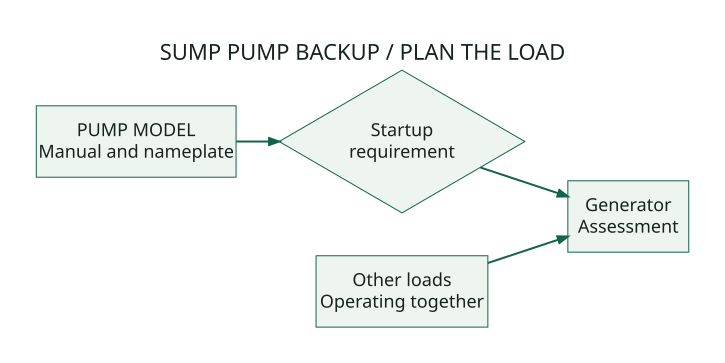
Choose backup power for a sump pump from the exact pump’s electrical requirements and the other loads you want to operate. A horsepower label alone is not a complete generator-sizing assessment. Start with the pump model, its manual, and a clear list of the planned outage loads.
Featured image: EnergyOfSupply editorial diagram. Editorial planning diagram; not wiring instructions.
Identify the pump and the whole sump system
Find the exact pump model and its accessible label or documentation before choosing a generator. Record voltage, running electrical information, and any available starting requirement. Horsepower describes a motor rating but does not directly establish the generator size. Different pump designs, motor characteristics, and operating arrangements can require different electrical assessments. If the identity is unclear, use installation records or professional help rather than opening equipment or reaching into a wet sump to obtain a number.
List every relevant component. A home may have a primary pump, a secondary pump, a battery backup system, an alarm, or more than one pit. Determine which component needs power and what operates together. A generator supplying the primary pump is not the same plan as recharging a battery backup, and a spare pump sitting on a shelf does not provide automatic redundancy. Record the configuration so the sizing discussion addresses the system you actually have.
Understand running demand and starting demand
The pump’s ordinary operating demand helps determine continuous generator capacity. Its starting event can require more than ordinary operation, and it may occur while other equipment is already running. Use reliable pump information or a qualified assessment for that event. Do not add a universal multiplier to horsepower and present the result as a verified specification. Where a manufacturer supplies a generator recommendation, keep the model and the recommendation’s conditions together.
Check voltage as well as watts. A pump requiring one voltage cannot be treated as compatible with any generator whose watt number is large enough. The actual receptacle, supply arrangement, protection, and connection also matter. If the intended system connects through building wiring, have a qualified electrician specify and install the arrangement. A homeowner sizing worksheet can organize the questions, but it does not approve electrical wiring or a wet-location connection.
Calculate the relevant overlap
Make a table of the pump and the other loads intended during an outage. Give each appliance separate fields for running demand, starting requirement where relevant, voltage, and priority. Ask which loads remain on when the sump pump starts automatically. A refrigerator or another pump may start without waiting for a convenient time. The assessment should consider the actual possible overlap rather than assuming that a person will always switch every other appliance off first.
Consider a hypothetical worksheet with 700 watts of other operating loads and a pump starting requirement of 1,800 watts. The illustrative starting case is 2,500 watts. If that pump runs at 800 watts after startup, the steady total becomes 1,500 watts. These invented values are not specifications for any sump pump and do not recommend a particular generator. They demonstrate why a system that fits the ordinary total can still need a separate startup check.
Include more than one pump when necessary
If two pumps can run together, evaluate that operating combination explicitly. Note whether both may start close together during heavy inflow and whether an alarm or controller changes their operation. A second pump often exists because the consequences of the first pump stopping are important, so its electrical requirements should not disappear from the outage plan. Ask the installer or pump professional to describe the intended operation and what backup power must support.
For a battery-backed sump arrangement, find the charger and backup manufacturer’s instructions. Determine whether the generator is intended to supply the charger, the primary pump, or both. Do not assume that charging is instantaneous or that a battery described as backup will support an indefinite outage. Record the expected recharge arrangement and the conditions behind any duration estimate. The generator and the battery can support different functions within one system.
Think about flood protection beyond electrical capacity
A correctly sized generator cannot compensate for a blocked discharge, a failed float mechanism, damaged equipment, or an unsuitable installation. Include ordinary pump inspection and maintenance in the preparation plan, following the manufacturer’s instructions. Keep service records and note any unusual cycling or behavior before storm season. The outage discussion should establish whether the pump system itself is ready, rather than treating generator purchase as a complete solution to basement flooding.
Pay attention to the consequences of failure. A frequently running pump during heavy rain creates different monitoring needs from a pump that rarely runs. Identify how the household will notice a problem and who can respond. An alarm is useful only when someone can hear or receive it and knows what action to take. If floodwater reaches electrical equipment, do not enter a hazardous area to troubleshoot; obtain appropriate emergency or professional assistance.
Plan a safe connection and route
Choose a suitable outdoor location for a portable fuel generator and measure the real route to the approved connection. Keep exhaust away from openings according to official guidance and the generator instructions. A basement pump’s location does not justify operating an engine in the basement, garage, or near a basement window. The electrical route must be planned around the outdoor location rather than using the shortest existing cord as the controlling constraint.
Have the cord, receiving connection, and any building interface reviewed for the actual load and conditions. Avoid damaged cords, crushed cable routes, and connectors where water collects. A flooded basement is not a place for improvised electrical setup. Never power house wiring through a wall outlet. When the connection is uncertain, resolve it before the next storm with a qualified electrician; do not treat an emergency as a reason to bypass the proper arrangement.
Make the fuel and operating plan realistic
A generator that starts the pump successfully can still stop because its fuel supply or maintenance plan was inadequate. Read the generator’s runtime claim with its stated load conditions, then consider the other equipment connected and the pump’s cycling. Do not substitute tank capacity for a verified duration. Prepare appropriate fuel storage, access to additional supply, required oil checks, and maintenance according to the manual.
Refueling requires a shutdown and cooling period. Consider what happens to the pump during that interruption and whether a compatible backup arrangement is needed. There is no universal safe interruption time because incoming water and pit capacity differ. Discuss this with the relevant installer or pump professional when continuous protection matters. A plan that depends on never shutting down a portable generator is incomplete if the manual requires refueling or service interruptions.
Prepare a useful verification record
Before relying on the setup, confirm the intended equipment arrangement in suitable conditions under the manuals and professional guidance. Record the pump, generator, connection, other loads, and what was verified. Include a pump start while the intended other loads are present when appropriate and safely assessed. A brief run with every other load disconnected may not represent the actual emergency configuration, especially if appliances operate automatically.
Do not force the pump to cycle repeatedly or manipulate equipment in a wet area to create an informal test. Use the manufacturer’s recommended checks and qualified assistance where needed. If the generator overloads, the pump behaves abnormally, or protection operates, stop and resolve the problem. Record the event without presenting it as proof that a larger advertised watt number alone will solve it. The cause may involve compatibility, connection, or pump condition.
What to send when requesting a sizing recommendation
Provide the pump model, voltage, available running and startup information, number of pumps, other intended loads, connection arrangement, and generator operating location. Attach accessible label photographs and relevant manuals. Explain whether the objective is temporary attended use or dependable protection while people may be away. That distinction affects the practical recommendation even when the electrical numbers are identical.
Ask for the exact generator model or required supply characteristics and the assumptions behind the recommendation. Keep unresolved fields visible, including automatic overlap, fuel duration, and what happens during refueling. The final choice should address the pump’s electrical requirements and the whole flood-protection plan. Generic watt charts are useful background, but the correct decision comes from your actual pump system and its operating conditions.
Collect the pump information
Record the model, supply voltage, electrical label, and any manufacturer information about startup. Photograph the labels without opening energized equipment. Ask the pump manufacturer for missing electrical data. If the installed system includes a separate controller, alarm, or backup unit, record those model numbers as well.
Account for startup and simultaneous loads
Harbor Freight’s generator buying guide describes a starting-load estimate as the highest-starting item plus the running watts of the other items. Use verified equipment data for those entries rather than assuming all pumps have the same demand. Source: manufacturer buying guide.
Build a load worksheet
| Item | Data to collect |
|---|---|
| Sump pump | Voltage, running demand, startup information |
| Other appliances | Simultaneous running and starting requirements |
| Generator | Continuous and starting ratings for the chosen fuel |
| Connection | Equipment and method reviewed by the installer |
An illustrative calculation
Suppose a hypothetical pump requires 1,500 watts to start while two other hypothetical loads together require 300 watts to run. The arithmetic for that particular startup scenario is 1,800 watts. These invented example inputs are not ratings for your pump and not a generator recommendation. A qualified installer should review the actual equipment and planned operating conditions.
Plan the connection and operation
Ask how the installed pump will be supplied during an outage and who will operate the backup arrangement. Include the outdoor generator location, cord route, monitoring plan, and another response if the backup is unavailable. Do not improvise a connection to the household wiring. Have the electrician specify any fixed connection equipment.
Before relying on the system
- Confirm the pump and generator model numbers.
- Resolve missing startup information.
- Review other loads expected to run together.
- Request a supervised check of the approved arrangement.
- Record the operating instructions and service contacts.
Can a generic wattage chart settle the decision?
Use it to identify questions, then obtain data for the actual pump. This article does not verify a universal wattage for all sump pumps.
For a separate motor-load example, see our refrigerator starting-watt checklist.
2 thoughts on “Sump Pump Generator Sizing: A Homeowner Load Checklist”