

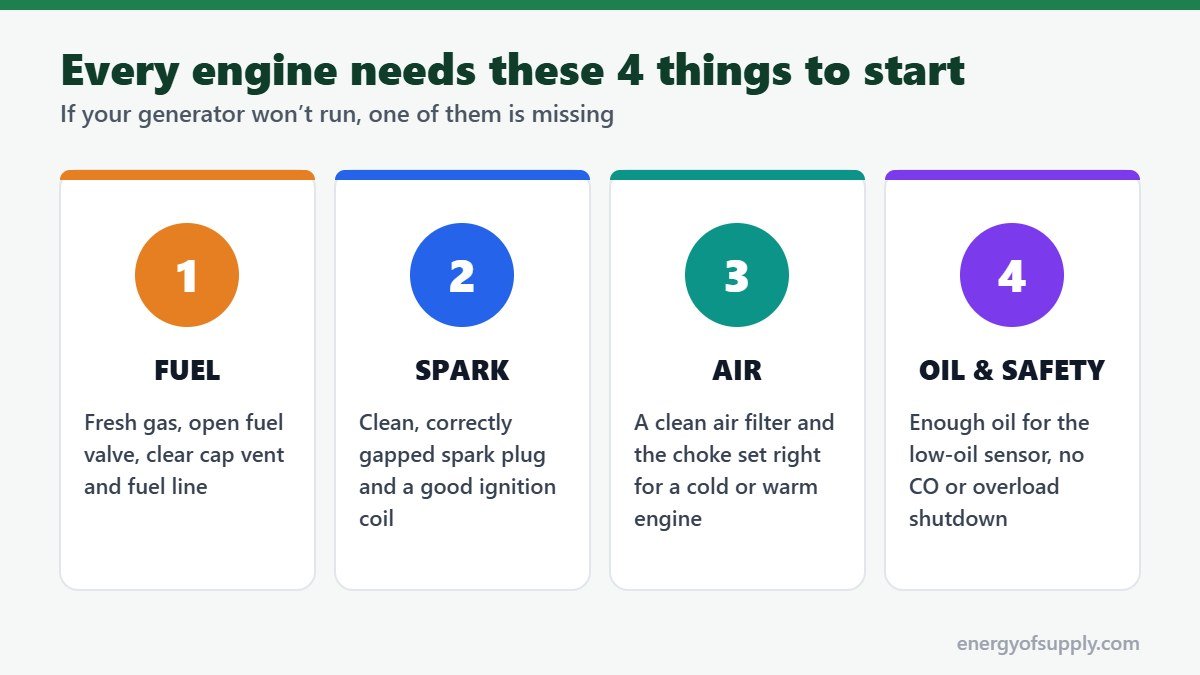
A generator that won’t start almost always has one of four problems: it isn’t getting fuel, it isn’t getting spark, it isn’t getting air, or a safety system is stopping it on purpose. The fastest way to find the cause is to start with what the engine is actually doing when you pull the cord or press the start button.
This guide is organized by symptom, so you can skip straight to the section that matches your generator and work through the checks in order, from easiest to hardest.
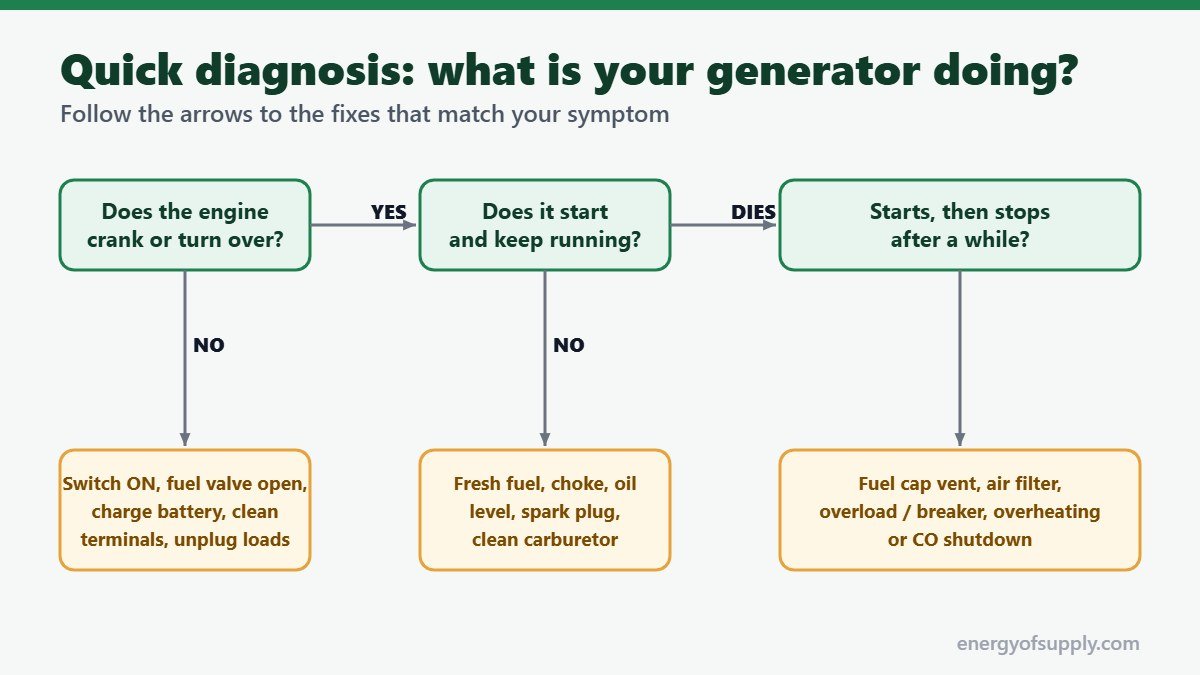
Quick diagnosis: what is your generator doing?
| Symptom | Most likely cause | Start with |
|---|---|---|
| Nothing happens when you press the electric start | Dead battery, loose cable, main switch off | Fix #1, #2 |
| Pull cord is hard to pull or won’t move | Engine flooded, seized, or load connected | Fix #3, #11 |
| Engine turns over but won’t fire | Fuel, choke, spark plug, low oil | Fix #4–#8 |
| Starts, runs a few seconds, then dies | Low oil sensor, clogged carburetor, fuel cap vent | Fix #5, #7, #9 |
| Runs fine, then stops suddenly | Out of fuel, overload, overheating, CO shutdown | Fix #10–#12 |
Part 1: Generator won’t crank at all
1. Check the engine switch, fuel valve and battery
It sounds obvious, but most “dead” generators have the engine switch in OFF or the fuel valve closed. Set the engine switch to ON/RUN and open the fuel valve. On electric-start models, check the battery: a healthy 12V starter battery should read about 12.4–12.7 volts with a multimeter. Below roughly 12 volts it may not have enough power to crank the engine. Charge it with a battery charger or the generator’s charging port, or use the recoil cord as a backup.
2. Clean and tighten the battery terminals
White or green corrosion on the terminals blocks current even when the battery is charged. Disconnect the negative cable first, scrub the posts and clamps with a wire brush (a baking-soda and water paste helps), reconnect positive first, and tighten both clamps. Replace any cable that is cracked or swollen. If the battery is more than three or four years old and won’t hold a charge, replace it.
3. Disconnect everything plugged into the generator
A generator should always start with no load. Unplug cords and switch off any transfer switch or interlock connection before starting. A connected load can make the recoil cord feel heavy and can stall the engine as soon as it fires.
Part 2: Engine turns over but won’t start
4. Make sure you have fresh fuel
Gasoline starts to break down within about 30 days, and ethanol blends absorb moisture. Old fuel leaves varnish that clogs the carburetor’s tiny jets – the number-one cause of a generator that won’t start after storage. If the fuel smells sour or looks darker than usual, drain the tank and carburetor bowl and refill with fresh gasoline. Use fuel stabilizer if the generator will sit for more than a month. For dual-fuel models, confirm the fuel selector is set to the fuel you are actually using, and that the propane tank valve is fully open.
5. Check the fuel cap vent and fuel line
If the fuel cap vent is blocked, a vacuum forms in the tank and fuel stops flowing – the engine may start and then die after a minute. Try running with the cap loosened slightly. Also check the fuel line for kinks, cracks or blockages, and clean or replace the inline fuel filter if your model has one.
6. Use the choke correctly
A cold engine needs the choke fully closed (ON) to start, then gradually opened once it fires. A warm engine usually needs little or no choke. Leaving the choke closed too long – or pulling many times on full choke – floods the engine. If you smell strong fuel, set the choke to open (RUN), wait 10–15 minutes and try again.
7. Check the oil level (low-oil shutdown)
Most portable generators have a low-oil sensor that prevents starting – or shuts the engine off seconds after starting – when the oil is low. Place the generator on level ground, check the dipstick, and top up with the oil type listed in your manual. Many units have a low-oil warning light that flashes when you try to start. Running the generator on a slope can also trigger the sensor.
8. Inspect and test the spark plug
Remove the plug with a spark plug socket and look at the tip. Black, sooty, oily or wet deposits mean it needs cleaning or replacement. Check the gap with a feeler gauge against your manual’s spec. To test for spark, reconnect the plug to its wire, hold the threads against bare metal on the engine (using insulated pliers) and pull the cord – you should see a strong blue spark. No spark usually means a bad plug, a bad plug wire, or a faulty ignition coil. A new plug is cheap, so if in doubt, replace it.
9. Clean the carburetor
If you have fresh fuel, good spark and enough oil but the engine still won’t run, the carburetor is the most likely problem – especially after storage. Spray carburetor cleaner into the air intake as a quick test: if the engine fires briefly and then dies, fuel isn’t reaching the cylinder. Drain the float bowl, remove it, and clean the main jet with carb cleaner and a thin wire. If the generator has sat with old fuel for months, a full carb cleaning or a replacement carburetor is often the fastest fix.
Part 3: Generator starts, then stops suddenly
10. Check the air filter
A clogged air filter starves the engine of air, causing rough running, black smoke and stalling. Remove the filter cover and inspect it. Foam filters can be washed in warm soapy water, dried, and lightly oiled; paper filters should be replaced if dirty. Never run the generator without the air filter in place.
11. Rule out overload and tripped breakers
If the generator stops when you plug in a large appliance, the load may be higher than its running watts – motors in refrigerators, pumps and air conditioners need two to three times their running wattage to start. Reset the generator’s circuit breaker, unplug everything, and add loads one at a time, starting with the largest. Keep total running load at or below about 80% of the generator’s rated running watts.
12. Overheating, CO shutdown and other safety stops
Generators can shut down to protect themselves. Make sure the unit has at least 3–5 feet of open space around it and that cooling vents aren’t blocked by debris or a cover. Newer models also have a carbon monoxide sensor that shuts the engine off when CO builds up – usually a sign the generator is too close to a building or in a partially enclosed space. Move it to open air; never bypass the sensor. If the generator shuts down repeatedly with no obvious cause, the sensor or low-oil switch may be faulty and should be checked by a service center.
Preventive maintenance so it starts next time
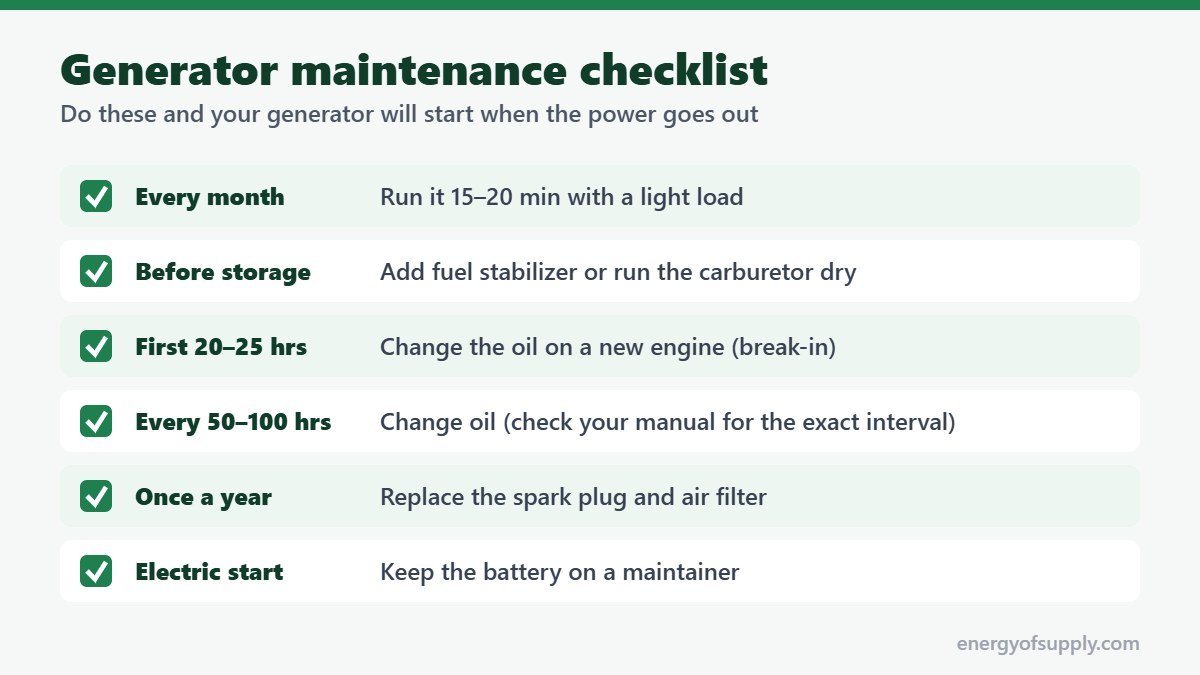
- Run it monthly: start the generator and run it under a light load for 15–20 minutes.
- Store it right: add stabilizer and run it for a few minutes, or drain the tank and run the carburetor dry before long storage.
- Change the oil: after the first 20–25 hours on a new engine, then about every 50–100 hours (check your manual).
- Replace the spark plug and air filter about once a year or every 100 hours.
- Keep the battery charged with a maintainer if your model has electric start.
When to call a professional
Stop and contact an authorized service center if you see fuel leaking, hear knocking or grinding from the engine, find that the recoil cord won’t move at all, get no spark with a new plug, or if the generator is still under warranty. Opening the engine yourself can void the warranty.
Frequently asked questions
Why does my generator start and then die after a few seconds?
The most common causes are low oil (the low-oil sensor shuts it off), a partially clogged carburetor jet, a blocked fuel cap vent, or leaving the choke closed. Check the oil first, then try running with the fuel cap loosened.
How do I start a generator that has been sitting for months?
Drain the old fuel from the tank and carburetor, refill with fresh gasoline, check the oil, charge the battery, and replace the spark plug if it looks worn. If it still won’t start, the carburetor likely needs cleaning.
Can a bad spark plug stop a generator from starting?
Yes. A fouled or worn plug can’t ignite the fuel. Test for spark; if it’s weak or missing, replace the plug.
Why does my generator shut off when I plug something in?
Usually overload. The appliance’s starting watts exceed what the generator can supply. Reset the breaker and reduce the number of connected devices, starting large motor loads first.
Is it safe to run a generator in the rain?
Only under a proper generator tent or cover that keeps it dry while leaving plenty of airflow. Never run it in a garage or under a closed porch.
Conclusion
Work through the checks in order: switch and battery, load, fresh fuel, choke, oil, spark plug, carburetor, then air filter and overload. In most cases the fix is fresh fuel, more oil, a clean spark plug or a clean carburetor – no repair shop needed. If none of these steps work, or you see leaks or hear mechanical noise, take it to a qualified technician.