
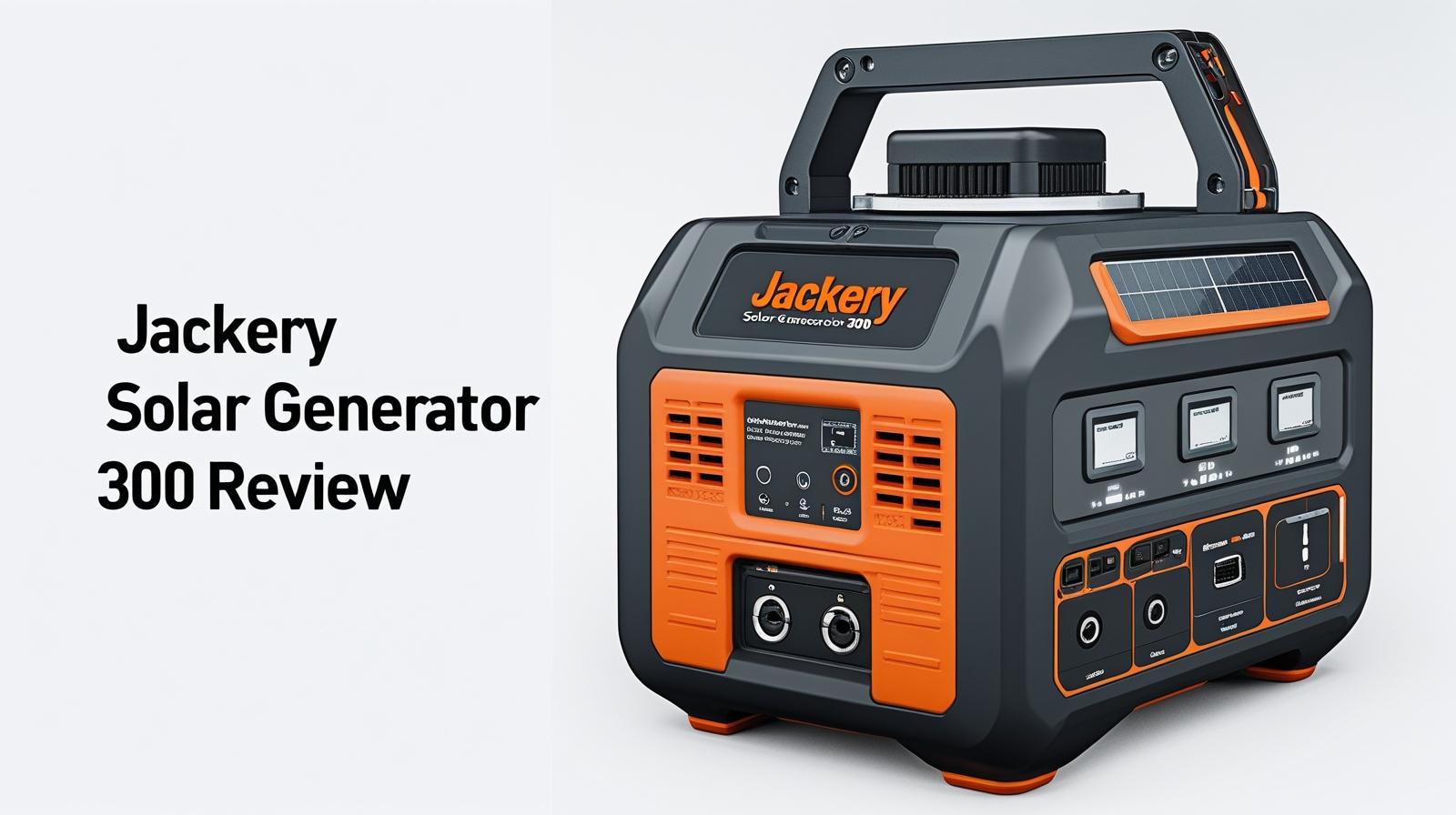
The Jackery Solar Generator 300 name generally refers to an Explorer 300 power station supplied with a solar panel. Identify the exact model, included panel and accessories before comparing a bundle with the 300 Plus or 300 V2.
In 2026, with newer models like the Explorer 300 Plus available, many still ask: Is the original Jackery 300 worth buying? Does it deliver real value for its price and size?
This Jackery Solar Generator 300 guide compares published specifications and buying considerations. It does not report hands-on testing or a verified survey of thousands of owners. Check the exact station and panel supplied in the bundle before ordering.

What is the Jackery Solar Generator 300?
This bundle combines an Explorer 300 power station with a solar panel; the included panel and accessories depend on the offer. Its battery has no combustion exhaust, but it has a cooling fan and is not noise-free.
Consider it for appropriately rated small electronics such as phones, laptops, lights and fans. Medical-device use needs device-specific compatibility and a verified backup plan rather than a general overnight claim.
Key Highlights:
- Ultra-portable at just 7.1 lbs (3.2 kg)
- 293Wh lithium-ion (NMC) battery
- 300W continuous output (up to 500W maximum instantaneous output (Jackery support))
- 2 pure sine wave AC outlets
- Fast dual-input charging (wall + USB-C)
- Included 100W solar panel with MPPT controller for efficient solar recharging

Full Specifications Table
| Feature | Details |
|---|---|
| Battery Capacity | 293Wh Lithium-ion (NMC) |
| Output Power | 300W continuous (500W maximum instantaneous output (Jackery support)) |
| AC Outlets | 2 × Pure Sine Wave (110V/120V) |
| USB Ports | 1× PD 60W USB-C (in/out), 1× QC 3.0 USB-A, 1× USB-A |
| DC/Car Port | 1× 12V 10A |
| Weight | 7.1 lbs (3.2 kg) |
| Dimensions | 9.1 × 5.2 × 7.8 inches |
| Recharge Time (Wall + USB-C) | ~2 hours to 80% |
| Solar Recharge (100W Panel) | 5.5–6.5 hours in optimal sunlight |
| Cycle Life | 800 cycles to ≥80% capacity per September 29, 2026 support table; confirm exact model |
| Warranty | 2–3 years (with registration) |
| Noise Level | Cooling fan: Jackery support lists ≤55dB; not a noise-free guarantee |

Runtime Planning and Verification
This is a research-based comparison, not a hands-on test. No independent test log or evidence for the earlier claimed user-test and laboratory results is available. Verify your exact model and load before relying on a runtime figure.
Runtime planning: The following are illustrative estimates, not verified measurements. For a conservative example, 293.8Wh × an assumed 80% usable-energy factor = 235.04Wh. A constant 30W load would then last about 7.83 hours and a 40W load about 5.88 hours before additional reserve. This assumption is not a measured battery-efficiency specification.
- Smartphone (12Wh battery): 20–24 full charges
- Laptop (50Wh): 5–6 charges
- For medical equipment, measure the actual draw and account for all accessories. The illustrative 30W/40W calculations above are not a CPAP compatibility or overnight-runtime guarantee.
- Wi-Fi router/modem (10W): 25–28 hours
- LED camp lights or small USB fan (5W): 50–55+ hours
- Drone/camera battery charger: Multiple full charges
Strengths in Action:
- Pure sine wave output does not establish compatibility with every sensitive device. Confirm the device manufacturer’s voltage, power and backup requirements, especially for medical equipment.
- Check operating temperature, ventilation and cooling-fan noise before choosing a location for the power station.
- Digital display clearly shows input/output watts and battery percentage — very user-friendly.
Limitations: It cannot run high-draw appliances like full-size refrigerators, microwaves, coffee makers, or space heaters. If you try, it will shut down safely due to overload protection.

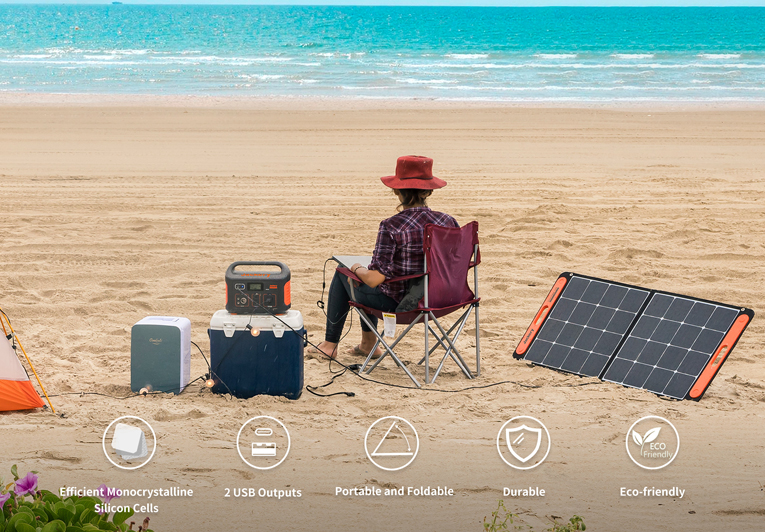
Solar Charging Performance: The bundled SolarSaga 100W panel with built-in MPPT controller performs reliably in direct sunlight, recharging the unit in 5.5–6.5 hours under ideal conditions. In partial sun or cloudy weather, expect 8–12+ hours. Many users combine solar with car or wall charging for faster results.
Detailed Pros and Cons
Pros:
- Extremely lightweight and compact — easily fits in a backpack or car trunk for hiking and travel.
- Fast dual-input charging (wall outlet + 60W PD USB-C gets it to 80% in about 2 hours).
- Battery operation avoids combustion exhaust, but the cooling fan can make noise. Follow the station’s environmental and ventilation instructions.
- Versatile ports allow charging up to 6 devices simultaneously.
- Reliable pure sine wave output protects sensitive gear.
- Good build quality with intuitive controls and clear display.
- Solar compatibility makes it eco-friendly and truly off-grid capable.
Cons:
- Limited 293Wh capacity means shorter runtime on multi-day trips without reliable sunlight or recharging.
- The SolarSaga panel is rigid and only splash-resistant (not fully waterproof — needs protection in heavy rain).
- Bundle pricing can feel premium compared to capacity (always check current deals).
- NMC battery offers fewer cycles (~500) than newer LiFePO4 models.
- Not suitable for high-wattage or continuous heavy loads.

Jackery Explorer 300 vs Explorer 300 Plus (2026 Comparison)
Many buyers wonder whether to choose the classic 300 or the upgraded 300 Plus. Here’s a clear breakdown:
| Feature | Explorer 300 | Explorer 300 Plus |
|---|---|---|
| Battery Type | Lithium-ion NMC | LiFePO4 (safer, longer life) |
| Cycle Life | 800 cycles to ≥80% capacity per September 29, 2026 support table; confirm exact model | 3,000+ cycles |
| Weight | 7.1 lbs (3.2 kg) | ~8.3 lbs (3.75 kg) |
| AC Outlets | 2 | Usually 1 |
| App Control | No | Yes (Wi-Fi/Bluetooth) |
| USB-C Ports | 1× 60W | Dual higher-power ports |
| Extra Features | Basic display | LED light, ChargeShield tech |
| Best For | Maximum portability | Longevity & smart features |
Verdict on Comparison: Choose the original 300 if you prioritize the lightest weight and lower upfront cost. Go for the 300 Plus if you want longer battery lifespan, app monitoring, and future-proofing.

How to Evaluate Owner Feedback
No dated source has been verified for a cross-store rating or a 10,000-review total. Inspect the exact seller listing, model and review dates instead of relying on an aggregated rating here.
Questions for your use case:
- A documented device-specific test is more useful than an anonymous runtime testimonial whose source cannot be verified.
- For a camping plan, record the energy used by phones, lights and fans, then compare it with available charging over the trip.
- Check the unit’s listed weight and the route you would carry it; portability is specific to your use.
Critical Feedback:
- Cloudy weather can change the replenishment plan; calculate your energy requirement instead of assuming one night or several days.
- Check the exact panel’s weather rating and charging instructions before exposing it to rain.
Assess feedback against the exact model and intended load. Comments without a model, measured draw or test duration cannot establish your own expected result.
Who Should Buy the Jackery Solar Generator 300 in 2026?
Ideal For:
- Weekend campers, van-lifers, and RV owners wanting lightweight power
- Users of medical equipment should confirm approved power arrangements and the required duration with the equipment provider; an overnight result is not guaranteed.
- Outdoor photographers, drone pilots, and remote digital nomads
- Emergency preppers focused on phones, lights, routers, and small essentials
- Users who want solar charging and can accommodate cooling-fan noise
Consider Something Else If:
- You need to power a fridge, larger appliances, or multi-day heavy use → Look at 500W+ or 1000Wh models
- You want maximum longevity and app control → Choose the Explorer 300 Plus
- You require whole-home backup → Larger Jackery or competing brands
How to Maximize Your Jackery 300 Experience (Pro Tips)
- For Camping: Pair with the solar panel and place it in direct sunlight during the day.
- Medical equipment: Follow its prescribed settings and approved power instructions. Do not change treatment settings solely to achieve a battery-runtime target.
- Battery Health: Avoid full depletion regularly; recharge to 100% every 1–2 months if unused.
- Solar Efficiency: Angle the panel properly and keep it clean. Use on clear days for best results.
- Storage: Keep in a cool, dry place between 68°F–77°F for optimal battery life.
- Multi-Device Charging: Use USB-C and USB-A ports simultaneously to maximize utility.
Frequently Asked Questions (FAQ)
Q: How long does it take to fully charge the Jackery 300? A: About 2.5 hours via wall + USB-C dual input. Solar takes 5.5–6.5 hours in good sunlight.
Q: Can it power a CPAP machine overnight? A: This cannot be guaranteed without the exact CPAP, approved power adapter, prescribed accessories and measured draw. Arrange a device-specific backup plan with the equipment provider and test it before relying on it.
Q: Is the solar panel waterproof? A: Splash-resistant only. Protect it from heavy rain.
Q: What devices can it run? A: Check each device’s voltage, running power and startup demand against the exact model’s limits. Medical-device compatibility requires separate confirmation.
Q: Is it worth buying in 2026? A: Yes, especially on sale, if portability is your top need. For longer life, consider the 300 Plus.
Final Verdict: Should You Buy the Jackery Solar Generator 300?
Choose a Jackery Solar Generator 300 bundle only after confirming the exact model, included panel, appliance compatibility and usable-energy needs. The name does not establish a current user rating, noise-free operation or guaranteed runtime.
It perfectly fills the gap between small power banks and bulky heavy-duty stations. While capacity is modest, its lightweight design, fast charging, and included solar panel make it incredibly practical for camping, travel, and emergency backup.
If your needs are light and portability is priority #1, this is a strong buy. For more runtime and modern features, step up to the 300 Plus.
Ready to buy the Jackery Solar Generator 300 Bundle? 👉 Check Latest Price & Buy on Amazon
Have you used the Jackery Explorer 300 or 300 Plus? Share your real experience in the comments — it helps other readers!
This is a research-based guide. No hands-on test, verified owner-review survey or current seller rating is established here. Consult Jackery’s September 29, 2026 Explorer 300 support specifications; confirm the exact model, seller offer and operating conditions.
1 thought on “Jackery Solar Generator 300 Review 2026”