
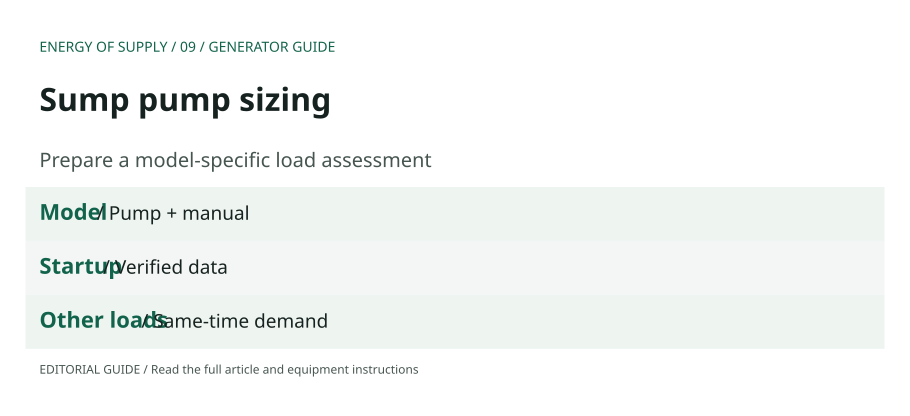
Choose backup power for a sump pump from the exact pump’s electrical requirements and the other loads you want to operate. A horsepower label alone is not a complete generator-sizing assessment. Start with the pump model, its manual, and a clear list of the planned outage loads.
Collect the pump information
Record the model, supply voltage, electrical label, and any manufacturer information about startup. Photograph the labels without opening energized equipment. Ask the pump manufacturer for missing electrical data. If the installed system includes a separate controller, alarm, or backup unit, record those model numbers as well.
Account for startup and simultaneous loads
Harbor Freight’s generator buying guide describes a starting-load estimate as the highest-starting item plus the running watts of the other items. Use verified equipment data for those entries rather than assuming all pumps have the same demand. Source: manufacturer buying guide.
Build a load worksheet
| Item | Data to collect |
|---|---|
| Sump pump | Voltage, running demand, startup information |
| Other appliances | Simultaneous running and starting requirements |
| Generator | Continuous and starting ratings for the chosen fuel |
| Connection | Equipment and method reviewed by the installer |
An illustrative calculation
Suppose a hypothetical pump requires 1,500 watts to start while two other hypothetical loads together require 300 watts to run. The arithmetic for that particular startup scenario is 1,800 watts. These invented example inputs are not ratings for your pump and not a generator recommendation. A qualified installer should review the actual equipment and planned operating conditions.
Plan the connection and operation
Ask how the installed pump will be supplied during an outage and who will operate the backup arrangement. Include the outdoor generator location, cord route, monitoring plan, and another response if the backup is unavailable. Do not improvise a connection to the household wiring. Have the electrician specify any fixed connection equipment.
Before relying on the system
- Confirm the pump and generator model numbers.
- Resolve missing startup information.
- Review other loads expected to run together.
- Request a supervised check of the approved arrangement.
- Record the operating instructions and service contacts.
Can a generic wattage chart settle the decision?
Use it to identify questions, then obtain data for the actual pump. This article does not verify a universal wattage for all sump pumps.
For a separate motor-load example, see our refrigerator starting-watt checklist.
1 thought on “Sump Pump Generator Sizing: A Homeowner Load Checklist”