
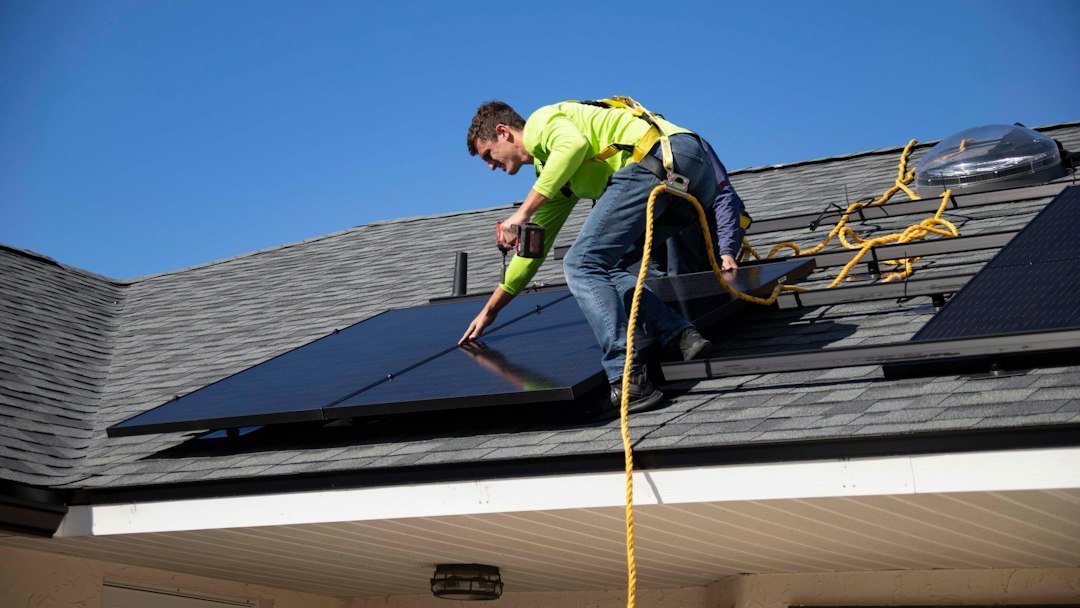
Yes, solar panels can provide electricity for a house. A properly designed system can supply some or potentially all of a household’s electricity needs over a year. Whether it can power the home at a particular moment, at night, or during an outage depends on the solar array, inverter, electricity demand, available sunlight, grid connection, and any battery or other backup equipment.
Annual production and continuous backup are different goals. A system that generates as much electricity over a year as a household uses may still need grid power at night and on low-production days. Most conventional grid-connected systems shut down when the grid fails. To operate during an outage, the home needs a system specifically designed and installed for backup.
This guide explains what a solar-powered house can realistically do and the questions to ask before buying equipment.
Can a house run on solar panels alone?
A home can use solar electricity when the system is producing power, but “solar alone” can mean several things. A grid-connected home may produce enough electricity across a year to match its annual use while drawing from the grid at night. An off-grid home has no utility supply and needs a complete plan for storage, changing weather, high loads, and extended periods of low generation. These arrangements are not interchangeable.
A grid-connected solar array without backup typically depends on the utility’s presence to operate. When power from the grid fails, the inverter normally stops supplying the house for safety. Solar panels on the roof therefore do not by themselves guarantee an energized home during a storm. The U.S. Department of Energy’s solar resilience guidance explains the need for appropriately configured equipment for backup operation.
Some backup-capable systems can supply selected loads, and some are designed for broader home coverage. Ask the installer what the proposed equipment will do in your specific situation, including which circuits remain available and whether the panels can recharge storage during an outage.
How a home uses solar electricity
Photovoltaic panels convert sunlight into direct-current electricity. An inverter converts suitable output to alternating current for the household. When the panels are producing, appliances can use available solar power. If the home needs more than the solar system is delivering, a grid-connected home can draw the difference from the utility. Depending on the installation and local rules, surplus may be exported or stored.
For example, imagine a system delivering 3 kilowatts while household appliances use 2 kilowatts. In that hypothetical moment, there is 1 kilowatt of surplus before considering the system’s controls and losses. If household demand rises to 4 kilowatts while solar remains at 3 kilowatts, the home needs another source for the difference. These figures illustrate power flow, not a prediction for a particular home.
The system’s advertised capacity is a rating under specified conditions; it is not a promise of that output every hour. To understand panel and inverter basics, see how solar panels work.
What does “100% solar” actually mean?
A proposal may say that estimated yearly solar generation equals 100% of a home’s annual electricity consumption. That is an annual energy comparison. It does not mean the panels supply every appliance every minute. Production and consumption occur at different times, and weather and seasons change the balance.
Imagine a home using 10,000 kilowatt-hours in a year and a proposed array estimated to generate 10,000 kWh over that year. The arithmetic suggests a 100% annual offset. The home may nevertheless export energy on sunny afternoons and import power after sunset. The financial value depends on the utility’s import charges, export compensation, fixed fees, and the timing of use.
Ask the installer to show the annual production estimate, the household usage period, the proposed capacity, and the assumptions for shading and local sunlight. If the proposal claims year-round independence or outage backup, ask for a separate design and explanation of those capabilities. A percentage on a sales page is not a substitute for that assessment.
Can solar power a house at night?
Conventional solar panels need daylight to produce useful electricity. After dark, a grid-connected house can use power from the utility; a house with suitable battery storage can use stored energy within the system’s limits. The battery is a separate component, not an automatic feature of every solar installation.
To estimate whether a battery could cover a night, identify the essential appliances and estimate their energy use during the intended hours. A refrigerator cycles, lights may be on for only part of the evening, and heating or cooling demand can change with the weather. The installer should also check simultaneous power and motor-starting requirements. Energy capacity in kilowatt-hours and inverter power in kilowatts answer different questions.
As a simplified example, if a hypothetical essential-load plan averages 0.5 kW for 10 hours, it requires 5 kWh of energy. Actual battery requirements may be higher because usable capacity, conversion losses, and operating conditions vary. This example does not size a battery or guarantee that its inverter can start a refrigerator or pump.
Can solar power a whole house during an outage?
It can in some properly designed installations, but not every solar system can do so. A backup system needs compatible equipment to isolate the home from the grid and supply the intended loads. Solar-plus-storage systems can support some or all circuits depending on their design. Certain products provide limited backup features without a conventional battery; verify the exact product and installation rather than assuming a universal configuration.
Ask which circuits are backed up, the inverter’s continuous and starting capability, whether 240-volt loads are supported, and how the battery is recharged. Electric heating, central air conditioning, water heaters, ranges, well pumps, and vehicle charging can greatly change the required design. A whole-home panel connection does not guarantee that all large appliances can run together.
Consider duration as well as peak power. A system might start a load yet lack enough stored energy to run it overnight. Several cloudy days can limit recharge, and household use may vary. Request a written scenario describing the loads, hours, battery reserve, and assumed weather. If backup is critical, discuss contingency arrangements with the installer instead of relying on an unverified promise.
Can solar panels power a house on cloudy days?
Panels can generate electricity from diffuse daylight when clouds cover the sun, but production varies with cloud thickness and other conditions. A grid-connected house may draw more from the utility when solar output falls. A battery can help bridge periods of lower output if the system is designed for it and enough energy remains stored.
Do not use one fixed percentage of clear-day output as a guarantee for every storm or location. For a fuller discussion, see how solar panels perform on cloudy days. If the system produces unexpectedly little under comparable conditions, record any alerts and contact the installer rather than opening electrical equipment.
How big a system does a house need?
Start with at least a year of electricity bills when available. Add monthly kWh to estimate annual use, then consider likely changes such as an electric vehicle, heat pump, home addition, or different occupancy. Your location, roof direction, tilt, shading, and available space affect how much a given array can generate.
An installer can use an established modeling tool and a site assessment to estimate annual production. Compare the estimate with your goal: partial bill reduction, an annual energy offset, backup of essential circuits, or an off-grid system. These goals lead to different equipment and costs. The number of bedrooms or the floor area alone cannot determine the right array.
Panel count also depends on individual module capacity. For example, 20 hypothetical 400-watt modules have 8,000 watts, or 8 kW, of rated DC capacity. That does not establish annual production or guarantee whole-house backup. Our guide to how many solar panels a house needs explains the sizing process in more detail.
Grid-connected, solar-plus-battery, and off-grid systems
Grid-connected solar: The utility remains available when solar output is insufficient. Export and billing arrangements depend on local rules. A conventional system typically shuts down during a grid outage unless additional backup capability is installed.
Solar plus battery: Compatible storage can shift some solar energy to later hours and, if the complete system is designed for backup, supply designated loads during an outage. The actual capability depends on usable battery capacity, inverter ratings, controls, and the installed circuit arrangement.
Off-grid: The home is designed to operate without a utility connection. The project must account for seasonal production, several days of low sunlight, storage, peak and starting loads, maintenance, and a practical contingency plan. An off-grid design is more than simply disconnecting an ordinary grid-tied array.
Ask the installer to explain your proposed arrangement in plain language. Get the equipment models, supported circuits, expected production, storage assumptions, and outage behavior in writing. An electrician and installer can assess the site and applicable safety requirements.
How much does it cost to power a house with solar?
The installed cost depends on system size, equipment, labor, roof and electrical work, location, and financing. A battery and backup equipment can increase the project scope. Compare complete proposals that cover the same capacity and services, with any storage, electrical upgrades, and roof work listed separately.
Do not assume a historic federal homeowner tax credit applies to a new installation. The IRS states that the individual Residential Clean Energy Credit is unavailable for property placed in service after December 31, 2025. Other local or utility programs may have different conditions. Confirm current rules and consult a qualified tax professional for your situation.
Our solar panel cost guide provides a historical DOE benchmark, example calculations, and a quote checklist. A current local proposal is needed for an actual purchasing decision.
Questions to ask an installer
- How much electricity does my home use each year, and what annual production is estimated for this address?
- Which panel and inverter models are proposed, and what is the array’s DC capacity?
- How were shading, roof orientation, and seasonal conditions assessed?
- What utility tariff and export-credit assumptions are included in the savings estimate?
- Does the system provide outage backup? If so, which circuits and loads are supported?
- What usable battery capacity and continuous and starting power are available?
- Can the panels recharge the battery during an outage, and what happens after several cloudy days?
- Are permits, inspection, interconnection, electrical upgrades, and monitoring included in the price?
Keep the answers with the written quote and equipment manuals. When comparing providers, give each the same electricity-use data and describe the same backup goal. A lower price may represent a different system rather than a better deal for the same scope.
Frequently asked questions
Can solar panels replace the electric company?
Some homes are designed to operate off-grid, but a typical grid-connected solar home still relies on the utility when solar or stored energy is insufficient. Going off-grid requires a specifically engineered supply and contingency plan.
Can solar panels run air conditioning?
They can contribute electricity to an air conditioner when the system and conditions support the load. Continuous and starting power, other appliances, and available energy must be evaluated. Backup operation adds equipment-specific limits.
Do I need a battery to use solar during the day?
Not necessarily. A standard grid-connected system can supply household loads while the grid is present without a battery. A battery serves a different role and is needed for many backup designs.
Will solar eliminate my electricity bill?
Not always. Fixed charges, imported electricity, export-credit rules, and financing costs can remain. Use your utility’s actual tariff and a site-specific production estimate to assess the potential result.
Do solar panels power a house in winter?
They can generate when daylight reaches them, but production changes with weather, sun angle, and day length. A full-year estimate is more useful than assuming every day will match a summer day.
Solar can power a house when the complete system is designed around the household’s actual needs. Define whether you want annual bill savings, nighttime coverage, outage backup, or off-grid operation; then compare equipment and written proposals for that specific goal.
Featured photo: Raze Solar / Unsplash.
Sources: U.S. Department of Energy: Solar and Resilience Basics; DOE: PV System Design Basics; IRS: Residential Clean Energy Credit.