
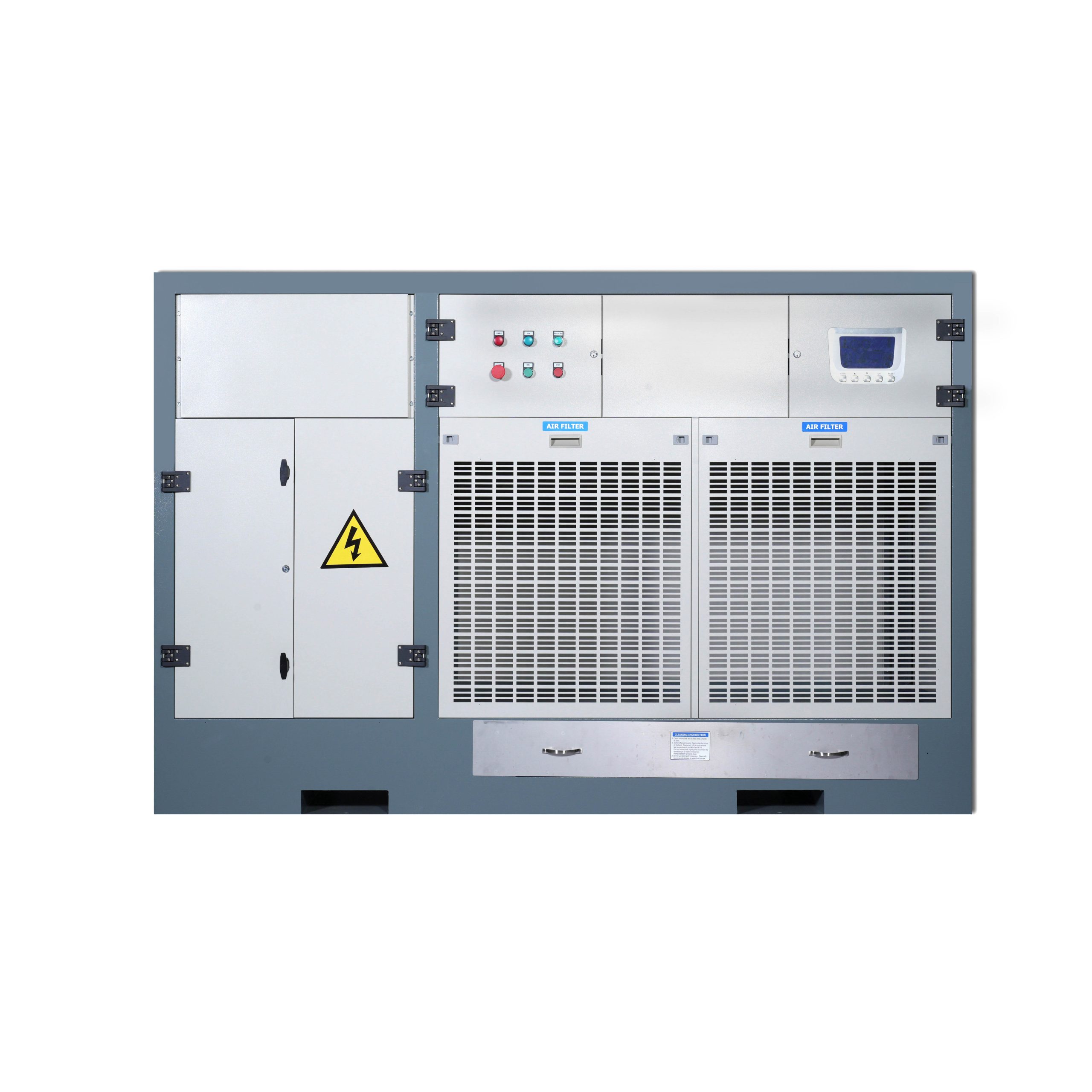
Most household atmospheric water generators consume about 0.6–3.0 kWh per liter, depending on conditions.
I’ve spent years testing water systems and working with atmospheric water generator (AWG) users. This article explains how much power does an atmospheric water generator consume, why the number changes, and how to estimate real costs for your home or business. Read on for clear formulas, real examples, energy-saving tips, and hands-on lessons to help you decide if an AWG fits your needs.
What is an atmospheric water generator?
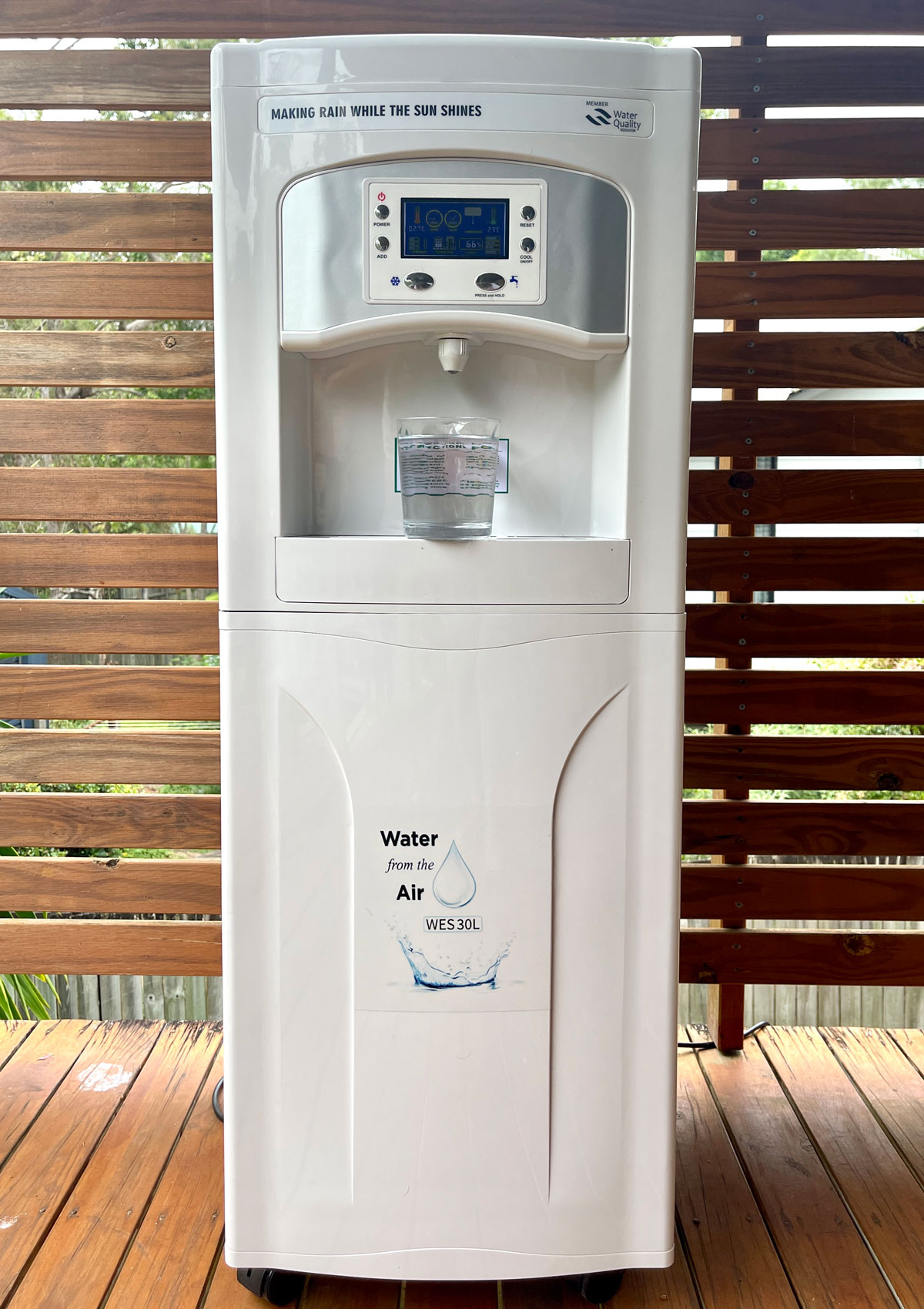
An atmospheric water generator is a machine that makes water from humid air. It pulls in air, cools it to condense moisture, and collects the water. Some models use desiccants or hybrid systems that absorb moisture and then release it as liquid. AWGs range from small countertop units to large commercial systems. Many are designed to filter and sanitize water as part of the process.

How atmospheric water generators work
Most AWGs use refrigeration. Air passes over a cold coil. Water vapor condenses on the coil and drips into a tank. Other designs use a moisture-absorbing material. They then heat that material to release the water vapor and condense it. All AWGs need power for fans, compressors, pumps, and controls. Power needs change with design, output, and weather.
Key factors that determine how much power does an atmospheric water generator consume
Power use depends on many things. Here are the main drivers.
- Ambient temperature and humidity. Higher humidity and warmer air make water creation easier and use less power.
- Production rate. Producing more liters per day needs more energy overall, though efficiency per liter can improve at scale.
- Technology type. Refrigeration AWGs and desiccant AWGs have different energy profiles.
- Heat recovery systems. Units that reuse waste heat cut electricity needs per liter.
- Unit size and quality. Larger, commercial units often use energy more efficiently per liter.
- Maintenance and filters. Dirty coils or clogged filters make the unit work harder and use more power.

Typical power consumption ranges and practical numbers
How much power does an atmospheric water generator consume in real terms? Use these ranges as a guide.
- Small countertop AWGs: 200 to 800 watts while running. Typical daily energy can be 2 to 10 kWh per day, depending on run hours and output.
- Residential home units (10–50 L/day): 0.6 to 3.0 kWh per liter in most climates. This is a practical range that covers humid and moderate conditions.
- Commercial units: 0.3 to 1.5 kWh per liter for well-designed systems in good conditions, with lower numbers when heat recovery and waste-heat use are applied.
- Very dry or cold climates: 3.0 to 6.0+ kWh per liter, because the unit must move and cool much more air to get the same water.
Remember: the theoretical minimum energy tied to condensing 1 liter of water equals the latent heat of vaporization, which is about 0.63 kWh per liter. Real devices have losses and extra loads. So practical numbers rarely fall below that without using external heat sources or waste energy.
Real example
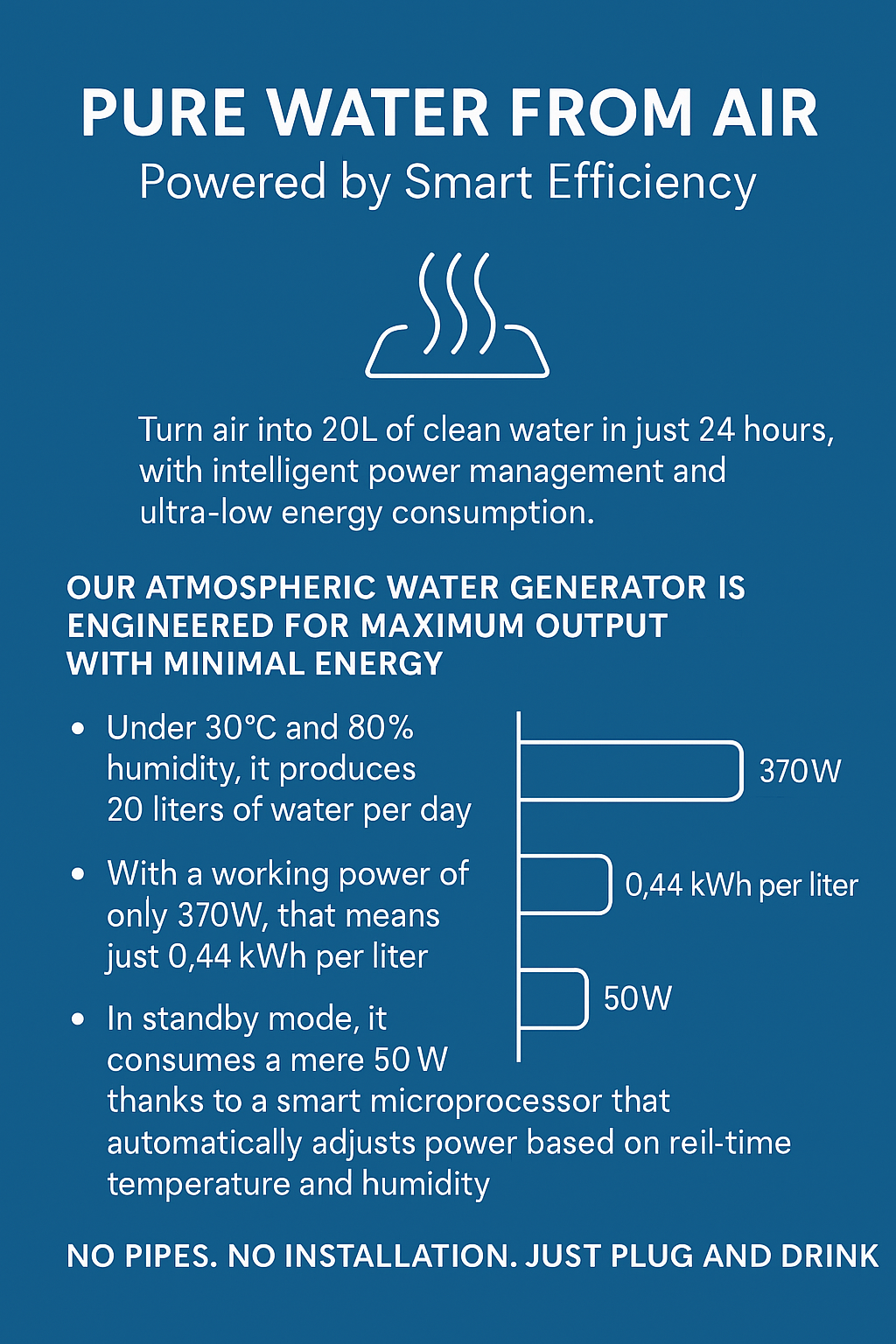
- A home AWG rated 20 L/day might run an average of 8 hours at 600 watts. That uses 4.8 kWh per day and equals 0.24 kWh per liter. Note: such a low figure usually means the device uses waste heat or an unusually efficient recovery. Verify manufacturer claims and real test data before trusting low numbers.

How to calculate energy use and cost for your AWG
Use this simple method to estimate daily and monthly electricity use.
- Find the running power in watts. Look on the spec plate or manual.
- Estimate daily run hours. This is how long the unit operates each day.
- Calculate daily kWh. Multiply running power (kW) by hours per day.
- Divide by liters produced per day to get kWh per liter.
- Multiply daily kWh by your electricity price for cost.
Formula examples
- Running power (kW) × hours per day = daily kWh.
- Daily kWh ÷ liters per day = kWh per liter.
- Daily kWh × $/kWh = daily cost.
Sample calculation
- Unit runs at 0.8 kW for 10 hours = 8.0 kWh/day.
- Unit makes 25 L/day → 8.0 ÷ 25 = 0.32 kWh/L.
- With $0.15/kWh electricity → 8.0 × $0.15 = $1.20/day.

Energy efficiency tips: lower how much power does an atmospheric water generator consume
You can cut energy use with smart steps. Try these proven tips.
- Place the unit in a warm, humid area. Better inlet air = less energy per liter.
- Use heat recovery. Capture waste heat from the compressor.
- Keep filters and coils clean. Dirt raises energy use quickly.
- Use timers and smart controls. Run when humidity is highest or when electricity is cheapest.
- Consider hybrid systems. Use solar PV or waste heat to offset grid power.
- Scale appropriately. Match unit size to your real water need to avoid waste.
Real-world experience: lessons from testing and users
I’ve installed and tested AWGs in coastal and inland homes. Here are honest insights.
- In coastal Florida, a mid-size unit produced 30 L/day using about 0.8–1.2 kWh/L. It ran more efficiently in summer.
- In a dry mountain town, a similar unit needed much more power. Costs rose quickly and output fell.
- Many users report lower performance than spec sheets state. Specs are often measured at optimal humidity and temperature.
- Lesson learned: always measure kWh with a meter for real-life data. Don’t rely on marketing alone.
Practical mistakes to avoid
- Buying an oversized unit for a dry climate.
- Ignoring maintenance schedules.
- Overlooking total cost: electricity, filter changes, and potential repairs.

Environmental impact and comparison with other water sources
Comparing how much power does an atmospheric water generator consume with other water options helps decide value.
- Bottled water has a carbon footprint from plastic and transport. AWGs avoid plastic but use electricity.
- Reverse osmosis (RO) units use less electricity per liter, but need a reliable water source and produce brine.
- Rainwater harvesting is low-energy but depends on rainfall and needs storage/treatment.
- Use life-cycle thinking. If grid electricity is green or you pair AWG with solar, AWG may be a low-carbon option in some settings.
Frequently Asked Questions of how much power does an atmospheric water generator consume
How much power does an atmospheric water generator consume for home use?
A typical home AWG uses between 0.6 and 3.0 kWh per liter in real conditions. This depends on humidity, temperature, and unit design.
Does humidity affect how much power does an atmospheric water generator consume?
Yes. Higher humidity lowers energy per liter. Low humidity forces the unit to process more air and use more power.
Can solar panels power an AWG to reduce grid electricity use?
Yes. Solar can offset the load. You need to size panels and storage to match the AWG’s daily kWh needs and run pattern.
Is an AWG cheaper than buying bottled water?
It can be cheaper over time if electricity cost is low and the unit runs efficiently. Include maintenance and electricity when comparing costs.
How do I measure the real power consumption of my AWG?
Use a plug-in watt meter or measure kWh from a dedicated circuit with an energy monitor. Track run hours and liters produced for accurate kWh/L.
Conclusion
Understanding how much power does an atmospheric water generator consume comes down to three things: your climate, the unit design, and how you run it. Expect 0.6–3.0 kWh per liter in most home situations, but always test for your conditions. Use the formulas and tips here to estimate costs, reduce energy use, and choose the right system. If you are curious, measure your unit’s real kWh, try a few efficiency upgrades, and compare long-term costs before buying. Share your experience below, subscribe for updates, or reach out to discuss sizing and savings for your situation.