
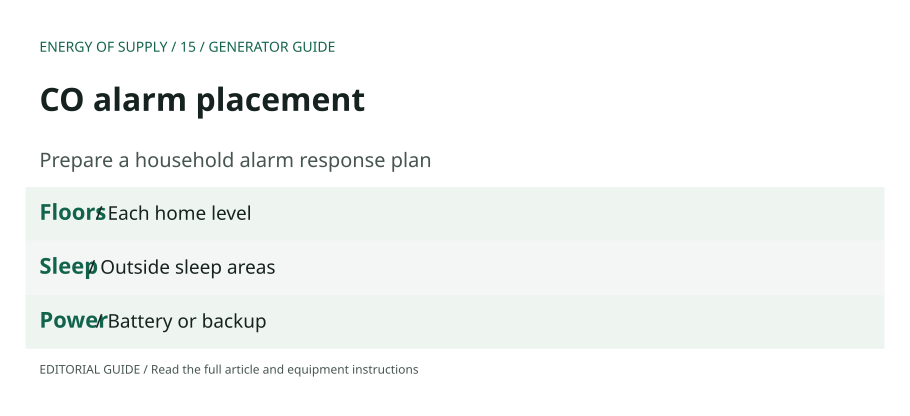
Generator users need an indoor carbon monoxide alarm plan as well as an appropriate outdoor generator location. CPSC recommends CO alarms on each level of the home and outside sleeping areas. Its guidance says not to put them in an attic or basement unless that space contains a sleeping area. Source: CPSC CO alarm guidance.
Make a room-by-room plan
Draw the floors of your home and mark the sleeping areas. Compare that plan with the alarm manufacturer’s instructions and the CPSC guidance. Record the model, installation date, power arrangement, and the location of each alarm. If a household member cannot reliably hear an alarm, ask about suitable accessible notification equipment.
Read the exact installation instructions
This article does not establish a universal mounting height or a fixed distance from every household appliance. Follow the alarm manual for those details. Ask the manufacturer about unusual layouts before installing. Do not borrow installation distances from a different alarm model or confuse smoke-alarm instructions with CO-alarm instructions.
Prepare for loss of household power
CPSC recommends battery-operated alarms or alarms with battery backup. Confirm the power arrangement of your selected product and keep the instructions accessible. Source: CPSC information center.
| Record | What to check |
|---|---|
| Alarm location | Floor and nearby sleeping area |
| Model | Matching installation and operation instructions |
| Power | Battery or backup arrangement |
| Maintenance | Testing, battery, and replacement instructions |
| Response | Household evacuation and emergency contact plan |
Testing is a separate task
CPSC recommends monthly testing and annual battery replacement. Follow the instructions applicable to your model, including any sealed-battery and end-of-life requirements. Keep a dated household record instead of relying on memory to establish readiness.
Know what to do when it sounds
CPSC advises getting outside to fresh air and calling 911 if CO poisoning is suspected. Do not ignore an alarm or treat it as a prompt to investigate while remaining inside. Share the response plan with every household member before an outage.
Do alarms allow indoor generator operation?
No. CDC warns against operating a generator inside a home or garage even with doors and windows open. See CDC guidance. Use our generator placement checklist for the separate outdoor-location review.
1 thought on “Carbon Monoxide Detector Placement for Generator Users”