
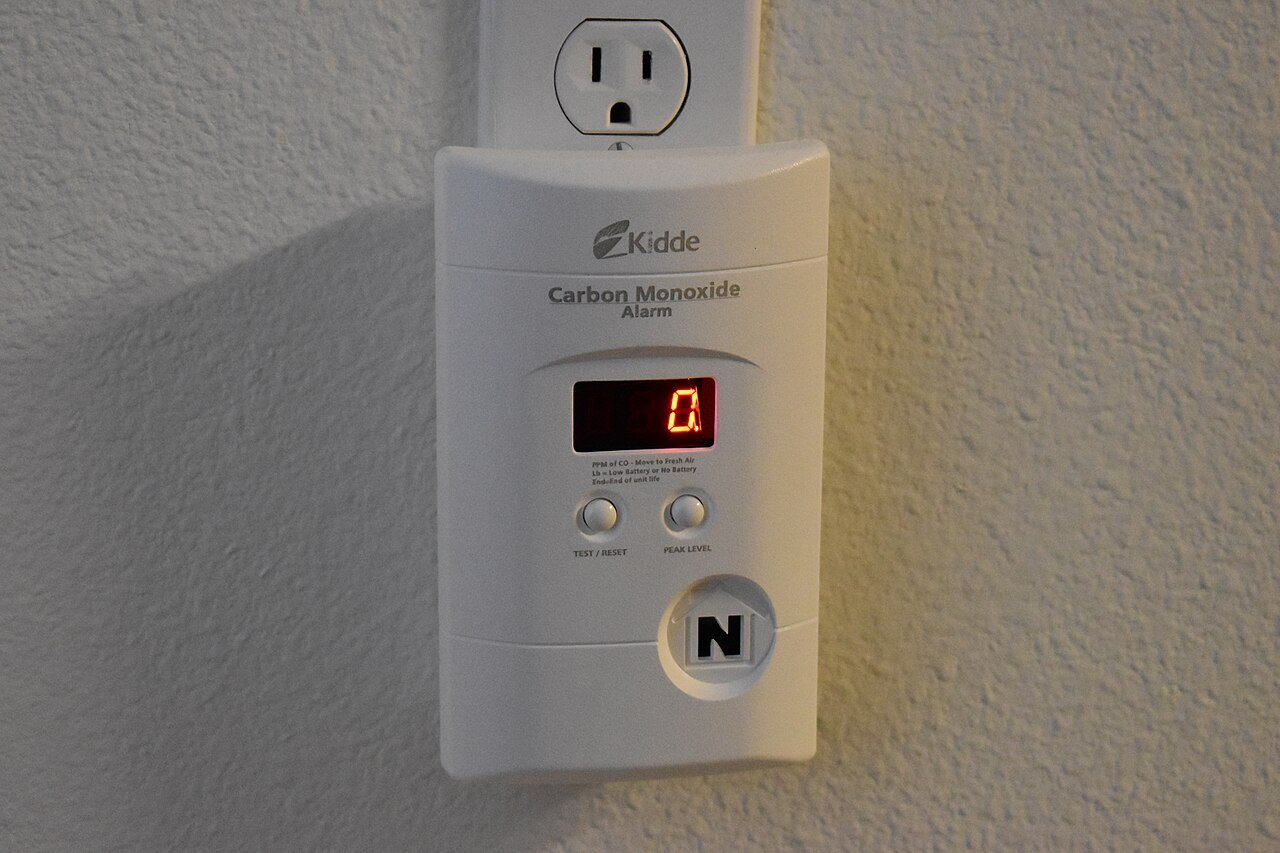
Generator users need an indoor carbon monoxide alarm plan as well as an appropriate outdoor generator location. CPSC recommends CO alarms on each level of the home and outside sleeping areas. Its guidance says not to put them in an attic or basement unless that space contains a sleeping area. Source: CPSC CO alarm guidance.
Featured image: Carbon monoxide detector by FASTILY, CC BY-SA 4.0. Resized from the original photograph; illustrative, not an installation-location recommendation.
Plan alarm coverage around the home’s sleeping areas
Start with a simple floor plan that identifies every sleeping area, each occupied level, and the routes people use to leave the home. CDC guidance calls for battery-operated or battery-backup CO detectors near every sleeping area. Read the exact alarm manufacturer’s placement instructions and applicable local requirements to complete the plan. A single detector placed wherever an outlet happens to be available may not address the arrangement of bedrooms and living spaces in your home.
Include rooms that are used differently at night, such as a guest room or another space where someone sleeps during an outage. A household’s normal bedroom map may change when visitors stay or people move to a cooler room. Record those uses instead of relying on labels from a real-estate floor plan. If the alarm arrangement is unclear or complex, obtain appropriate installation guidance before relying on it during generator operation.
Use the instructions for the exact alarm
Different alarms may permit wall mounting, ceiling mounting, or other arrangements under their own instructions. Follow the instructions for the actual model rather than assuming a universal height. Check specified separation from appliances, ventilation paths, and unsuitable environmental conditions. A general claim about where CO moves cannot replace the detector’s installation requirements. Keep the manual or a reliable offline copy with the home’s emergency records.
Do not place an alarm wherever it is least likely to make noise and call that a placement solution. If a device gives repeated signals, identify whether they are emergency alarms, low-battery indications, end-of-life indications, or another signal according to its manual. Resolve the cause without disabling protection. An unsuitable location, expired unit, or depleted battery should lead to a correction, not removal because the sound is inconvenient.
Verify protection during a power outage
A plug-in alarm should have the battery-backup capability required for the intended outage use, and its backup needs to be ready. A battery-operated unit needs the specified batteries or the applicable sealed-battery arrangement. Read the instructions rather than assuming that an illuminated indicator proves the unit will operate after household power disappears. Record the power source and the maintenance requirements for every device on the floor plan.
Interconnected or monitored arrangements can have additional requirements. Ask what remains functional when electricity or internet service is lost, and distinguish local alarm operation from remote notifications. An app notification is not a substitute for warning people who are asleep in the home. Make sure the household understands what the installed equipment provides and which communications depend on services that may be unavailable during a storm.
Create an alarm inventory that can be maintained
Give each alarm a location name, model, installation date, power arrangement, and replacement requirement. Keep these in one household record so a later battery change does not rely on guessing which unit was serviced. Replacement dates differ by equipment, so use the manufacturer’s instructions for the exact device. When a device is replaced, update both the record and the saved instructions rather than leaving an old manual as the only reference.
Include the prescribed test routine and assign responsibility to a household adult. Record completion and investigate any failed test or unexpected indication under the manual’s instructions. A test button assesses the functions described by the manufacturer; it is not an exhaust investigation or a certificate that the home’s air is safe. Do not expose a detector to generator exhaust as an improvised test. Use the approved testing method and replace or service unsuitable equipment as directed.
Teach the emergency sound and response
Have household members learn the alarm’s emergency signal and understand that a CO alarm requires prompt action. Move everyone to fresh air and contact emergency services from outside. Do not stay inside to diagnose the source, silence the alarm as the main response, or resume sleeping after a reset. Follow emergency responders’ instructions about re-entry and equipment. The plan should work even when the person who installed the alarms is absent.
Choose an outdoor meeting location and a way to account for children, guests, and pets. Keep the relevant instructions visible and easy to understand. Someone experiencing possible CO exposure may have trouble making decisions, so the response should not depend on a complicated checklist. If anyone has symptoms and exposure is possible, seek emergency help rather than waiting for a second alarm or trying to prove that the generator caused them.
Prepare for sleeping and accessibility needs
Ask whether the actual alarm arrangement can warn the people who use the home. Bedroom layout, closed doors, hearing limitations, and other accessibility needs may require appropriate equipment and professional advice. Do not assume that a device audible in the kitchen will reliably alert every sleeping person. Use the alarm manufacturer’s guidance and suitable installation expertise to resolve the needs of the actual household.
Discuss the plan with visitors before generator operation and ensure anyone responsible for children knows the meeting location. Keep an accessible phone or another means of requesting emergency help. A household briefing should be short and practical: recognize the emergency signal, leave promptly, account for people outside, and call for help. Avoid asking family members to inspect a running generator or a fuel system before getting out of the building.
Keep detector placement separate from generator placement
A well-planned alarm arrangement does not permit a portable generator indoors, in a garage, or beside a building opening. The generator must have its own suitable outdoor location under official guidance and the manufacturer’s instructions. The CDC advises more than 20 feet from windows, doors, and vents for portable generators. Measure and review the intended location before the outage; do not use a quiet alarm as evidence that an unsuitable spot is safe.
A generator’s integrated CO shutdown feature is also a separate protection measure. It does not replace indoor alarms or the outdoor-location requirements. Neither device should be defeated to keep power available. If a protective shutdown or indoor alarm occurs, respond to the hazard and obtain appropriate help rather than treating the interruption as an obstacle to work around. Power continuity is useful only when the operating arrangement remains suitable.
Consider the home beyond the generator
Fuel-burning appliances, attached garages, and other sources can also matter to a home’s CO safety plan. An alarm cannot identify the source simply by sounding. Keep equipment maintenance and emergency response broader than the portable generator alone. The relevant appliance should be serviced under its instructions by a qualified person where required. Do not assume that an alarm occurring when the generator is off has no significance.
If the household recently changed an appliance, room use, or the alarm arrangement, review the plan again. Remodeling, a new sleeping area, replacement alarms, and different power sources can make an old floor-plan record incomplete. Keep the installation requirements tied to the current equipment and layout. This is especially useful for a second home or rental property where different people may use the rooms and may not know the usual setup.
Use a pre-outage review that takes only a few minutes
Before operating backup equipment, confirm that the alarm inventory is current, required checks have been completed, batteries or backup arrangements are ready, and the household knows the emergency response. Locate the manuals offline and identify the outdoor meeting place. Check the generator location separately. These are complementary tasks; one completed row does not excuse an unresolved row elsewhere in the plan.
The final record should make clear where alarms are installed, why those locations fit the instructions, how the devices remain powered, when maintenance or replacement is due, and what people do when an alarm sounds. This provides a maintainable household plan rather than a universal mounting rule. When a location or equipment requirement is uncertain, resolve it with the manufacturer or a qualified installer before relying on the arrangement.
Make a room-by-room plan
Draw the floors of your home and mark the sleeping areas. Compare that plan with the alarm manufacturer’s instructions and the CPSC guidance. Record the model, installation date, power arrangement, and the location of each alarm. If a household member cannot reliably hear an alarm, ask about suitable accessible notification equipment.
Read the exact installation instructions
This article does not establish a universal mounting height or a fixed distance from every household appliance. Follow the alarm manual for those details. Ask the manufacturer about unusual layouts before installing. Do not borrow installation distances from a different alarm model or confuse smoke-alarm instructions with CO-alarm instructions.
Prepare for loss of household power
CPSC recommends battery-operated alarms or alarms with battery backup. Confirm the power arrangement of your selected product and keep the instructions accessible. Source: CPSC information center.
| Record | What to check |
|---|---|
| Alarm location | Floor and nearby sleeping area |
| Model | Matching installation and operation instructions |
| Power | Battery or backup arrangement |
| Maintenance | Testing, battery, and replacement instructions |
| Response | Household evacuation and emergency contact plan |
Testing is a separate task
CPSC recommends monthly testing and annual battery replacement. Follow the instructions applicable to your model, including any sealed-battery and end-of-life requirements. Keep a dated household record instead of relying on memory to establish readiness.
Know what to do when it sounds
CPSC advises getting outside to fresh air and calling 911 if CO poisoning is suspected. Do not ignore an alarm or treat it as a prompt to investigate while remaining inside. Share the response plan with every household member before an outage.
Do alarms allow indoor generator operation?
No. CDC warns against operating a generator inside a home or garage even with doors and windows open. See CDC guidance. Use our generator placement checklist for the separate outdoor-location review.
3 thoughts on “Carbon Monoxide Detector Placement for Generator Users”