
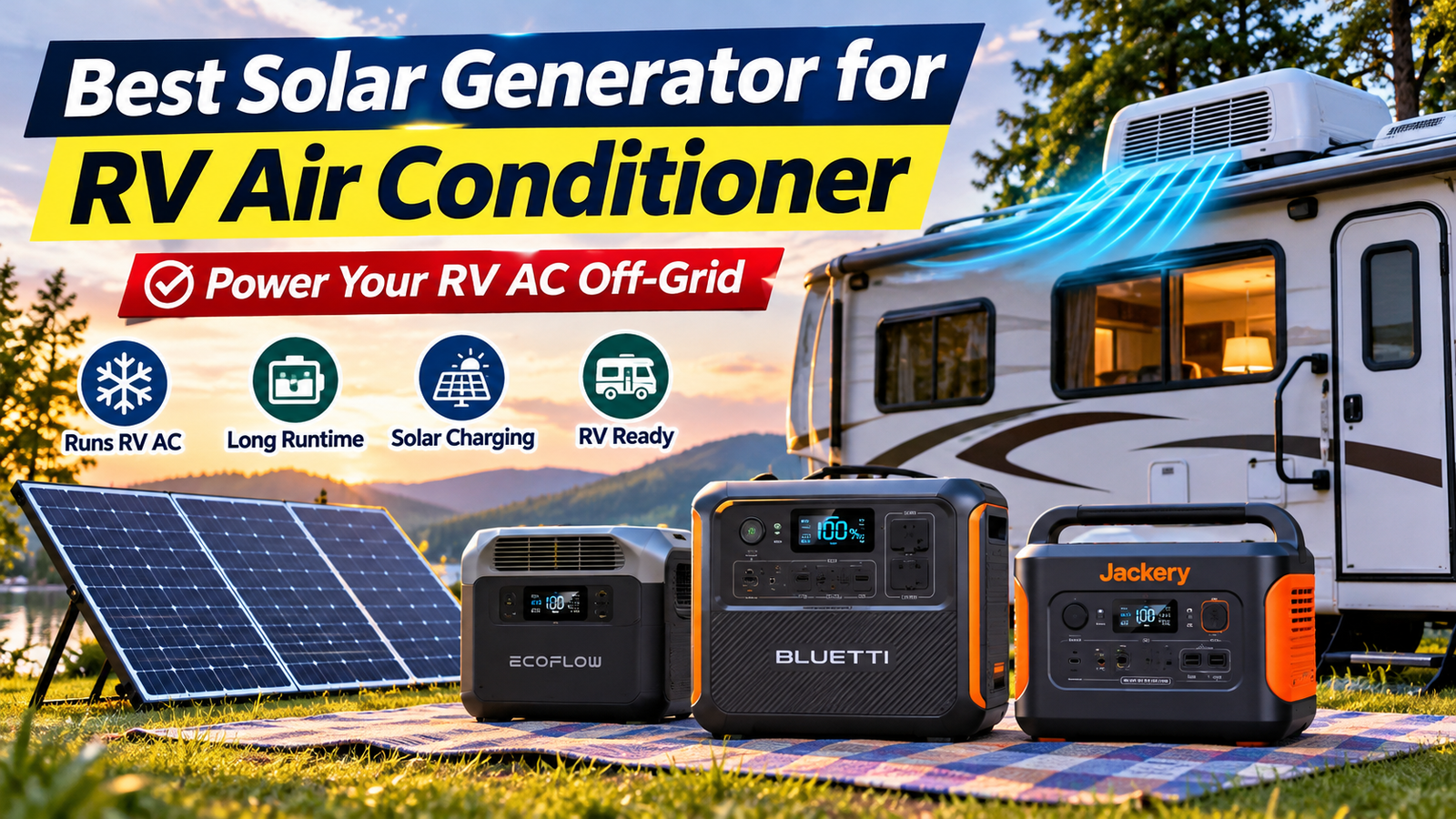
Updated for 2026 | U.S. RV buyer’s guide | Practical sizing, runtime, and compatibility information
What Is the Best Solar Generator for an RV Air Conditioner?
The best solar generator for your RV air conditioner is the one that can start the compressor, supply its continuous electrical load, and store enough energy for the number of cooling hours you need. There is no single battery-powered station that is best for every camper. A small, efficient air conditioner and a large 15,000 BTU rooftop unit have very different demands. The correct purchase depends on the air conditioner’s nameplate, whether a soft-start device is installed, other appliances, the RV’s electrical connection, and your budget.
If you are shopping for an off-grid cooling system, start by measuring or confirming running watts, starting surge, and desired runtime. Then compare portable power stations with an appropriate AC inverter, expandable battery capacity, solar-input limits, and safe RV connection options. This guide explains the process with calculations and practical examples so you can avoid spending money on a power station that trips the moment the air conditioner starts.
Important distinction: A standalone lithium battery is not a complete solar generator. A battery stores DC energy. To run a conventional 120-volt RV air conditioner, you also need a correctly designed inverter, wiring, protection, and charging equipment, or an integrated portable power station that contains those components. The original version of this article blurred that distinction; this revised guide separates them.
Scope: This is a U.S.-focused buyer’s guide for battery-based portable power stations and solar charging. It is not a review of gasoline generators or a guarantee that a particular air conditioner will work with any listed device. For RV wiring and transfer equipment, consult the RV and power-station manufacturers or a qualified RV electrician.
How Many Watts Does an RV Air Conditioner Need?
Most standard rooftop RV air conditioners require substantial power. According to EcoFlow’s 2026 RV air-conditioner wattage guide, a typical 13,500 BTU unit uses roughly 1,300–1,600 watts while running and may need approximately 2,800–3,000 watts at startup. Larger 15,000 BTU units can draw roughly 1,500–1,800 running watts and about 3,500–4,000 starting watts. These are planning ranges, not specifications for your particular AC.
| RV AC category | Illustrative running draw | Possible starting surge |
|---|---|---|
| Small 5,000–8,000 BTU | Up to about 900 W | Up to about 2,000 W |
| Typical 13,500 BTU | About 1,300–1,600 W | About 2,800–3,000 W |
| Larger 15,000 BTU | About 1,500–1,800 W | About 3,500–4,000 W |
Approximate examples summarized from EcoFlow’s published RV AC guide. Actual compressor type, voltage, ambient temperature, and soft-start equipment change the results. Read your AC’s data plate and manufacturer’s instructions.
Running watts describe the power required after the compressor is operating. Starting or surge watts describe the short burst required to get the compressor moving. A portable station may show a high “peak” or marketing wattage while its continuous AC output is much lower. Check both specifications, the surge duration, and whether the unit can actually start a motor load.
BTU is a cooling-capacity measurement, not an electrical-consumption rating. Two 13,500 BTU units can have different wattage requirements. An efficient variable-speed air conditioner may behave differently from a traditional fixed-speed compressor. For a reliable choice, the model-specific manual or an appropriate power measurement is more valuable than a generic BTU-to-watt conversion.
The Three Specifications That Matter Most
1. Continuous AC Output: Can the Power Station Keep the AC Running?
Start with the air conditioner’s running watts, then add any devices you expect to operate simultaneously. For example, if an AC draws 1,500 W, a refrigerator draws 120 W, and lighting and chargers draw 80 W, the combined continuous demand is 1,700 W. Those appliance values are illustrative; your actual loads may be different. A power station must support that total within its continuous AC output rating and any operating-temperature limitations.
2. Surge Capability: Can It Start the Compressor?
When the AC starts, the inverter must tolerate the compressor’s short starting surge plus other loads already running. If your measured AC startup requirement is 3,000 W while other equipment is using 200 W, your system must handle the relevant overlapping demand. A product advertised as “3,000 W peak” may not deliver that power for long enough or under the conditions required by your compressor. Review the manufacturer’s motor-start guidance, not just the number on the product photo.
3. Battery Capacity in Watt-Hours: How Long Will It Run?
Battery capacity is expressed in watt-hours (Wh) or kilowatt-hours (kWh). This is different from inverter output in watts (W). A 3,000 W inverter with a 1,000 Wh battery might start an AC but run it only briefly. A large battery with an undersized inverter might have plenty of stored energy yet fail to start the compressor. Both ratings matter, and neither replaces a safe, compatible connection to the RV.
RV AC Runtime Calculator: Realistic Worked Examples
For an initial estimate, use the following formula:
Estimated runtime (hours) = Battery capacity (Wh) × usable-energy factor ÷ average AC load (W)
For the examples below, assume an 85% usable-energy factor to illustrate conversion and operating losses. This is an assumption for planning, not a guaranteed efficiency for every station. Actual runtime depends on battery management limits, inverter efficiency, ambient temperature, age, other loads, and how often the compressor cycles.
| Illustrative battery capacity | 1,000 W average load | 1,500 W average load |
|---|---|---|
| 2,000 Wh | About 1.7 hours | About 1.1 hours |
| 4,000 Wh | About 3.4 hours | About 2.3 hours |
| 6,000 Wh | About 5.1 hours | About 3.4 hours |
| 8,000 Wh | About 6.8 hours | About 4.5 hours |
These calculations assume no solar input while running. They also assume the station can handle the compressor’s startup surge; runtime alone does not prove compatibility. Jackery publishes the same basic capacity-versus-load calculation in its RV AC battery-runtime guide.
Example: A 4,000 Wh system with a 1,500 W average AC load has an estimated runtime of 4,000 × 0.85 ÷ 1,500 = 2.27 hours. That does not mean it can cool an RV all night. If your goal is eight hours at an average 1,500 W, the simple estimate suggests around 14,120 Wh of nominal storage before accounting for any additional loads. The real requirement may be lower if the compressor cycles or higher if the weather is extreme.
Can Solar Panels Keep an RV Air Conditioner Running All Day?
Solar panels can replenish battery energy, but their advertised wattage is not a guarantee of constant output. Output changes with sunlight, cloud cover, temperature, shading, panel orientation, wiring, and the power station’s solar-input limits. The battery often bridges the gap when the compressor needs more power than the panels are producing. You should treat the solar array as an energy source over time, not a substitute for checking the inverter’s startup capability.
Consider a planning example: an air conditioner averaging 1,500 W for four hours uses 6,000 Wh of electrical energy. If you assume five equivalent peak-sun hours and an overall 75% solar-harvest factor, a rough array target is 6,000 ÷ (5 × 0.75) = 1,600 W of panels. This is only an illustration: the amount of usable roof area, the location, seasonal weather, and the power station’s actual solar-input ceiling may make that array impractical.
If you want to run the AC at night, solar production during the day must also charge enough battery capacity for the hours without sun. Charging losses and other RV appliances add to the energy requirement. A system can have a large array and still fail to cool the RV after sunset if the battery bank is too small.
Before buying panels, check the station’s maximum solar input in watts, allowed input-voltage range, connector requirements, and whether the proposed panels are electrically compatible. Exceeding a manufacturer’s voltage limit can damage equipment. Do not mix connectors, panels, or series/parallel configurations without confirming the specifications.
What Size Solar Generator Do You Need for a 13,500 BTU RV AC?
A common 13,500 BTU rooftop air conditioner may need roughly 1,300–1,600 running watts and a startup surge near 2,800–3,000 watts, according to EcoFlow’s 2026 guide. A practical shortlist therefore begins with battery power stations that can continuously support the AC plus other selected loads and can tolerate the compressor’s real startup demand. A system with roughly 2,000 Wh of storage may be useful for brief cooling, but it is not an all-day solution at typical rooftop-AC loads.
For several hours of cooling, consider an expandable system with materially more battery capacity and a suitably rated inverter. Do not assume that a 3,000 W station with a small battery is better for runtime than a 2,400 W station with a large battery: the former might have more startup headroom while the latter stores more energy. The right answer depends on your actual AC and desired duration.
Ask the seller or manufacturer whether the station can start your specific AC model, especially if it has a traditional compressor. If there is no compatibility evidence, ask about a return policy before committing to an expensive system.
What About a 15,000 BTU RV Air Conditioner?
A larger 15,000 BTU rooftop AC generally needs more continuous power and may have a startup surge of several thousand watts. EcoFlow’s RV wattage guidance lists roughly 1,500–1,800 W running and 3,500–4,000 W at startup as a planning range. You may need a higher-output power station, an appropriately designed soft-start system, or a different cooling strategy.
Battery size is especially important when the compressor runs for long stretches during hot weather. At a hypothetical average load of 1,800 W, a 4,000 Wh battery with an 85% usable-energy factor would provide only about 1.9 hours of continuous-load equivalent. Two rooftop AC units can require far more power, particularly if they start together. Do not assume a single portable power station can run both just because its outlet resembles the RV’s shore-power connector.
Does a Soft-Start Device Make a Difference?
A compatible soft-start device can reduce the compressor’s starting current, potentially allowing an inverter that previously tripped on startup to run the air conditioner. It does not turn a small battery into a large one, and it does not eliminate the AC’s ongoing energy consumption. Some newer variable-speed air conditioners already manage startup differently and may not need the same accessory.
Before purchasing a soft starter, identify the RV AC brand and model, confirm that the device is approved for that compressor and voltage, and follow the manufacturer’s installation guidance. Electrical work inside rooftop air conditioners presents shock and equipment-damage risks; use a qualified installer if the instructions or your skill level do not clearly support safe installation.
After installation, test the actual starting behavior with your selected power source. If the power station still overloads, the issue could be inverter limits, other loads, battery state of charge, or a problem with the AC itself. Do not keep resetting an overloaded system without investigating the cause.
How to Connect a Portable Power Station to an RV Safely
There is an important difference between plugging a small appliance directly into a power station and feeding an RV’s distribution system. The RV’s shore-power inlet, 30-amp or 50-amp service, grounding and bonding arrangement, and any transfer equipment must be compatible with the power source. An RV’s 30-amp 120-volt service has a nominal capacity of 3,600 W, while common 50-amp RV service uses two 120-volt legs and can supply more total power. These service ratings do not mean a portable station can automatically supply the same output.
Use only connection methods approved by the RV and power-station manufacturers. Some stations have a suitable RV outlet or dedicated transfer solution; others are designed only for appliances connected directly to their receptacles. A physical adapter is not proof of electrical compatibility. Never backfeed an RV or household electrical system through an improvised cord, and never bypass the manufacturer’s grounding, protection, or transfer requirements.
Do not overload a cable or adapter to make a station fit an RV inlet. If you are unsure about neutral-ground bonding, split-phase requirements, transfer switching, or the RV’s charger/converter drawing extra power, ask a qualified RV electrician to design the connection. A safe system also needs appropriate ventilation and dry, protected placement for the power station and its cables.
How to Choose Between an Integrated Power Station and a DIY Battery System
Integrated portable power station: This typically combines battery storage, inverter, charge control, display, and protection in one product. It can be simpler to transport and operate, and some models support expansion batteries. Its limits are the fixed inverter output, solar input, ports, weight, and supported expansion ecosystem. Read the specifications for the exact version and bundle, not just the brand family.
DIY battery, inverter, and solar system: This can be tailored to the RV’s electrical system, but it requires correct system design. A LiFePO4 battery advertised as 12 V and 280 Ah stores a theoretical 3,360 Wh using nominal 12 V arithmetic; the actual nominal voltage and usable capacity depend on the battery’s specifications. That battery alone does not provide 120 V AC power. The inverter, cabling, fuses, disconnects, charging components, and battery-management compatibility must all be correctly sized.
For many occasional RV travelers, an integrated station offers convenience. For frequent off-grid use with long AC runtime goals, a professionally designed RV electrical system may be more appropriate. Neither approach should be sold as an effortless plug-and-play solution for every rooftop air conditioner.
How to Compare Solar Generators Before You Buy
Use the checklist below when reviewing any brand or Amazon listing. It focuses on practical compatibility rather than unverified claims such as “best for every RV.”
| Feature | What to check | Why it matters |
|---|---|---|
| Continuous AC output | Rated watts at 120 V | Sustains the compressor and other loads |
| Motor-start / surge rating | Peak watts and allowed duration | Starts the compressor without overload |
| Battery capacity | Wh / kWh and usable energy | Determines runtime between charges |
| Solar charging | Max watts, voltage range, connectors | Limits how fast solar can replenish energy |
| RV connection | Approved output and connection method | Avoids unsafe or incompatible hookups |
| Expandability | Supported expansion batteries | Provides longer cooling time if needed |
| Weight and storage | Dimensions, mass, ventilation clearance | Matters in a space- and weight-limited RV |
| Warranty and support | Written terms, repair options, return rules | Reduces risk if the station cannot start your AC |
Also compare the complete system cost: power station, expansion batteries, compatible panels, cables, mounting or storage accessories, and any approved RV electrical work. A lower-priced power station may be more expensive overall if it needs multiple batteries to reach your cooling goal. Conversely, buying the largest available unit may be unnecessary if you only need short daytime cooling.
Common Problems: Why Your RV AC Will Not Run on Solar Power
The Power Station Trips as Soon as the Compressor Starts
Likely causes include inadequate motor-start capability, an AC startup surge higher than expected, or too many other loads already running. Check the AC’s startup specifications and the station’s actual surge-duration limits. Consider a manufacturer-approved soft-start solution if appropriate, and have electrical faults investigated rather than repeatedly forcing a restart.
The Air Conditioner Starts but Stops After a Short Time
The battery may be reaching its low-charge cutoff, or the station may be overheating or overloading. Check the display for error codes and the manufacturer’s operating-temperature limits. Compare your observed runtime with the battery-capacity calculation, including other loads such as the RV converter or refrigerator.
Solar Panels Are Charging but the Battery Still Drains
Solar input may be lower than the AC’s consumption. For example, 500 W of actual solar input cannot indefinitely offset a 1,500 W AC load; the battery supplies the difference. Check shading, panel orientation, solar-input limits, and weather. Increase energy production, reduce cooling demand, or shorten the AC’s operating time.
The Station Powers Small Appliances but Not the Rooftop AC
Small devices often have low startup requirements, while compressor motors can demand a large surge. The station’s output connector or the RV connection may also be incompatible. Do not assume that because a laptop or microwave works, a rooftop AC will also work.
Cooling Is Much Worse Than Expected
The electrical system may be operating correctly while the AC runs nearly continuously because of heat gain, dirty filters, poor insulation, or very hot outdoor conditions. Reduce sun exposure, improve ventilation and insulation, clean filters as directed, and service the air conditioner if its performance is abnormal.
Recommended Product Categories for RV Owners
Reader-selected Amazon USA options: The following eight listings are useful candidates to compare, not a tested ranking or a guarantee of RV AC compatibility. BLUETTI Elite 300 and the Jackery HomePower 3600 Plus have independently available product specifications; the other listings require the buyer to confirm their exact Amazon model or bundle before purchase. Prices, stock, and bundle contents may change.
Affiliate disclosure: As an Amazon Associate, we earn from qualifying purchases. This does not change the price you pay.
Power Stations and Solar Generator Bundles to Compare
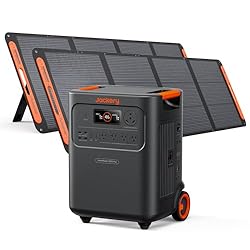
Higher-capacity option
Jackery HomePower 3600 Plus — Solar Generator Bundle
Why compare it: The linked bundle is reported to include a 3,584Wh station and two SolarSaga 200W panels, with 3,600W continuous AC output. Verify the exact Amazon bundle contents before ordering.
Before buying: The battery may offer several hours of cooling, not guaranteed all-night AC. Confirm compressor surge and RV connection.
Amazon ASIN: B0FMXCPWBN. Check current listing details and availability.
Check on Amazon
RV-ready 3 kWh option
BLUETTI Elite 300 Portable Power Station
Why compare it: BLUETTI specifies 3,014.4Wh capacity, 2,400W continuous AC output, and a TT-30 outlet on its US model. This makes it worth comparing for RV power needs.
Before buying: The 2,400W inverter rating does not guarantee it can start every rooftop AC; check surge requirements and short runtime.
Amazon ASIN: B0GKRPD6GL. Check current listing details and availability.
Check on Amazon
Additional power-station candidate
EcoFlow Portable Power Station — Amazon Listing
Why compare it: Compare this specific Amazon listing against your RV air conditioner’s measured running watts, starting surge, and cooling duration.
Before buying: Exact model, battery capacity, included panels, and AC output have not been independently confirmed for this ASIN.
Amazon ASIN: B0FQV6LMVX. Check current listing details and availability.
Check on Amazon
Alternative EcoFlow configuration
EcoFlow Portable Power Station — Alternate Listing
Why compare it: This separate EcoFlow listing may offer a different station or bundle configuration. Compare it with the first EcoFlow option before buying.
Before buying: Confirm the exact model, inverter output, storage capacity, and whether solar panels are included; do not assume the two listings are equivalent.
Amazon ASIN: B0FD3HPB83. Check current listing details and availability.
Check on Amazon
Solar bundle candidate
Jackery Solar Generator with SolarSaga — Amazon Listing
Why compare it: A solar-generator bundle can be useful when you need both battery storage and compatible charging panels for daytime replenishment.
Before buying: Check the exact included SolarSaga panel wattage and station’s solar-input limits; panel output alone will not run a rooftop AC continuously.
Amazon ASIN: B0H3T7GHZC. Check current listing details and availability.
Check on Amazon
Expansion-focused candidate
Jackery Expandable Solar Generator — Amazon Listing
Why compare it: Consider an expandable configuration if you need to add battery storage for longer off-grid cooling sessions.
Before buying: Check the supported expansion battery, total usable capacity, continuous AC output, and actual bundle contents.
Amazon ASIN: B0HF4JKGMC. Check current listing details and availability.
Check on Amazon
HomePower alternative
Jackery HomePower Solar Generator — Amazon Listing
Why compare it: Compare this Jackery HomePower listing when evaluating energy storage, charging options, and your preferred runtime.
Before buying: Confirm the exact model and whether it supports your RV air conditioner’s startup load; the HomePower name alone does not establish compatibility.
Amazon ASIN: B0FFSDCNR4. Check current listing details and availability.
Check on Amazon
High-output EcoFlow candidate
EcoFlow Portable Generator — Amazon Listing
Why compare it: This is an additional EcoFlow option to compare for larger AC loads, after checking manufacturer specifications for the exact Amazon variant.
Before buying: Confirm output voltage, running watts, surge behavior, battery capacity, and the RV-approved connection method.
Amazon ASIN: B0C1Z4GLKS. Check current listing details and availability.
Check on AmazonWhy a Smaller Solar Generator Was Not Included in the Main Picks
The user-supplied Jackery Solar Generator 1000 v2 (ASIN B0D2L1G66J) is not included as a primary rooftop-AC option. Its smaller energy capacity and output make it a poor default choice for a conventional 13,500–15,000 BTU RV air conditioner. It may be useful for smaller devices, but a rooftop AC requires model-specific startup and runtime verification. View the smaller Jackery model on Amazon.
How to choose: Check your AC’s actual running watts and compressor startup surge, then compare each listing’s continuous AC output, motor-start rating, usable Wh capacity, solar input, and approved RV connection. For example, using the planning assumption of 85% usable energy, a 3,014Wh battery powering a constant 1,500W AC load would last roughly 1.7 hours without solar input; a 3,584Wh battery would last roughly 2.0 hours. These are illustrative calculations, not tested runtimes or compatibility promises. Solar panels, expansion batteries, and soft starters must be selected for the specific station and AC model.
Technical reference: BLUETTI Elite 300 official specifications. For the Jackery HomePower 3600 Plus bundle, verify the manufacturer’s specifications and exact seller configuration before ordering.
Frequently Asked Questions
Can a solar generator run a 13,500 BTU RV air conditioner?
Yes, if the power station has enough continuous output, can tolerate the AC’s starting surge, and has enough battery energy for the intended runtime. Many conventional 13,500 BTU units need roughly 1,300–1,600 running watts and a much higher startup surge. Check the exact AC model rather than relying on BTU alone.
Will a 2,000-watt solar generator run an RV AC?
It depends on what “2,000 watt” means. A 2,000 W continuous inverter may sustain some RV AC units once running, but it might not handle the compressor’s starting surge. Battery capacity in Wh is a separate rating and determines how long cooling lasts. Check both numbers and manufacturer compatibility guidance.
How long will a 2,000 Wh power station run an RV AC?
At an illustrative constant 1,500 W load and 85% usable-energy factor, the estimate is about 1.1 hours. Real operation can be shorter or longer because of cycling, temperature, additional appliances, and battery losses. The station must also be capable of starting the AC.
Can solar panels run my RV air conditioner at night?
No. Solar panels do not generate meaningful power without sunlight. You need stored battery energy or another suitable power source for nighttime cooling. Size the battery for the expected nighttime load and allow for losses.
How many solar panels do I need for an RV air conditioner?
It depends on the AC’s energy use, local effective sun hours, and system losses. In one hypothetical example, an AC using 6,000 Wh over four hours would require around 1,600 W of panels to replenish that energy with five equivalent peak-sun hours and a 75% harvest factor. Your station’s solar-input limit and available panel space may be the controlling constraints.
Is a LiFePO4 battery the same thing as a solar generator?
No. A LiFePO4 battery stores DC energy. A complete system for a conventional RV rooftop AC also needs a suitable AC inverter, charging components, protection, and compatible wiring. Integrated portable power stations include many of those parts in one enclosure.
Will a soft starter let me use a smaller solar generator?
It may reduce startup current enough to help a compatible inverter start the compressor, but it does not reduce the battery energy required for sustained cooling. Confirm that the soft starter is compatible with your exact AC model and is properly installed.
Can I connect any portable power station to a 30-amp RV inlet?
No. Outlet shape, voltage, available power, grounding, and connection requirements must all match. Follow the power station and RV manufacturers’ approved connection instructions, and consult a qualified RV electrician if uncertain.
Is a 4,000 Wh power station enough for all-night RV AC?
Usually not for a typical rooftop AC drawing high power continuously. At an illustrative 1,500 W average load and 85% usable-energy factor, a 4,000 Wh battery provides about 2.3 hours. Actual runtime depends on compressor cycling and conditions, but all-night cooling generally calls for substantially more stored energy or a different strategy.
Final Verdict: Buy for Your Actual Cooling Load
The best solar generator for an RV air conditioner is not simply the model with the highest advertised wattage or the biggest battery. It is a complete, safe power system matched to the AC’s measured running and starting requirements, the hours you need cooling, your solar-recharging opportunities, and your RV’s connection method.
Before buying, identify your air conditioner model, confirm its wattage and startup requirements, decide how many hours of cooling you want, calculate a realistic battery-capacity target, and review the power station’s continuous output, motor-start capability, solar-input specifications, and approved connection options. Compare the full cost of the station, panels, and any expansion batteries or installation work.
For further background on energy conversion and electrical output, read How a Generator Works. For additional solar power planning, see our Can Solar Panels Power a House? guide, which covers a different, larger-scale application.
Sources: EcoFlow: RV AC running and starting watts (2026); EcoFlow: RV AC solar sizing; Jackery: RV AC battery-runtime calculation. Specifications and operating conditions vary; consult your equipment manuals before purchasing or connecting equipment.